NEW CAR REVIEWS Updated December 2015
Over 80 exclusive new model reviews and road tests by Paul Blank All content copyright - Paul Blank
Alfa Romeo MiTo - Aston Martin V12 Vantage & DBS Volante - Lamborghini Gallardo Valentino Balboni - Toyota Prius 3rd Generation - Mercedes-Benz S320 CDi - Lexus RX350/450H - BMW Z4 35i - Volkswagen Passat CC V6 FSI - Volkswagen Golf 118 TSI - Mitsubishi Lancer Ralliart Sportback - Audi Q5 3.0 TDi quattro - Lexus IS-F V8 - Volvo XC90 V8 Sport R-design - Mercedes-Benz ML320CDi - Audi S3 Sportback - Rolls-Royce Phantom Coupe - Audi A4 1.8 FSI Avant - Maserati Granturismo - Lexus LS460 - Mini Cooper S - BMW 135i Coupe - BMW X6 - Mitsubishi Lancer EvoX - Volkswagen Touareg R50 - Fiat 500 - Volvo C30 2.4S - Nissan GTR R35 - Skoda Roomster TDI - BMW 850i Convertible - Peugeot 207 XT HDi Touring - Bentley Flying Spur - Elfin MS8 Clubman - Mitsubishi Lancer VRX - BMW 320d Touring - Mitsubishi Pajero VRX & Exceed LWB Wagons - Skoda Octavia 1.9 TDI - Audi A6 2.0 TFSI - Renault Espace 2.2 dCI - Audi A4 3.0 TDi quattro - Chrysler 300C Touring - Porsche Cayman S - Skoda Superb V6 - Lexus IS250C convertible - Hyundai Santa Fe Highlander CRDi - Mercedes-Benz E220 CDi - Volvo XC60 D5 - Hyundai i45 - Audi A6 2.7 TDI - Mercedes-Benz E350 Wagon - Audi A5 Sportback 3.0 quattro - Skoda Octavia Scout - Mitsubishi i MiEV - Volvo C30 T5 R-Design - Toyota Rukus - Mercedes-Benz CLC 200K - Mistubishi Outlander XLS - Maserati Quattroporte - Volkswagen Polo 77TSI - Peugeot 3008 2.0 HDI XTE - Skoda Superb Wagon - Citroen C3 VT - Peugeot RCZ 2.0HDi - Rolls-Royce Ghost - Audi A1 - Mercedes-Benz E 250 CDi - Volvo S60 T6 - Mercedes-Benz ML350 CDi - Lexus IS350 Sport Luxury - Volkswagen Amorok Ultimate - Hyundai Accent Premium - Peugeot 508 GT - Skoda Fabia Monte Carlo - Hyundai i40 Tourer Elite - Audi A1 TFSI Sport - Audi A6 2-litre TFSI - Skoda Yeti 103TDI - Peugeot 4008 - Hyundai Veloster & Veloster SR Turbo - Volkswagen up! - Renault Twizy - BMW 520d Wagon - Porsche 911 Carrera S - Ford Focus TDCi - Chrysler 300 SRT8 - Audi A7 Sportback TDI Biturbo - Volkswagen Beetle 118TSi - Peugeot RCZ 2.0 - Volvo V40 T4 Kinetic - Nissan Micra ST - Fiat Punto Pop - Jeep Grand Cherokee Laredo & Overland - Peugeot 208 GTI - Fiat 500 Pop & 500C Twinair Lounge - Bentley Mulsanne - Citroen C3 Seduction - Volkswagen Sirocco R - Land Rover Discovery 4 SDV6 HSE - Fiat Panda range - Alfa Romeo Mito TwinAir - Jeep Cherokee Sport - Hyundai Santa Fe Highlander - Mazda 3 XD Astina - Hyundai Genesis V6 - Lincoln MKS - Volvo V40 D4 & T5 R-Design - Lamborghini Huracan


Lamborghini Huracan 610-4 - Tested
The Huracan had a big task ahead of it, even before it was launched last year. It had to improve in every way on its predecessor, the Gallardo, which had been the best selling Lamborghini ever. When I visited the factory last year, they were making the final tweaks and the last of the road tests. The Huracan also had to keep ahead of its main rivals from Ferrari and Porsche.
Lamborghini is known for its sharp, stealth-fighter jet looks, and the Huracan continues in this theme. In the showroom and on the road, it stands out. Sharp to look at (aside, in some people's eyes, from the dipping swage line under the side windows), it needs to live up to its looks in the performance department.
The Huracan certainly does. There are three modes in which the car can be used. The everyday driving mode makes it a piece of cake to drive around town in traffic. Well done to Lamborghini for that. Switch the wheel-mounted control to Sport and the beast is awakened. Quicker, more aggressive behaviour and a sound track upgrade in keeping with the Huracan's looks. Brilliant. Then there's the track setting. Really, leave that for the track.
Acceleration, which let's face it is a big part of what supercars need to be about, is loud, tremendously strong and almost frenetic because of how quickly the scenery starts flashing past. Just like it should be. I've driven some seriously fast cars, and this Lamborghini is right up there in the adrenaline pumping stakes. Big brakes haul the car up ludicrously well. I didn't really get anywhere near testing the handling of the car - and you'd need to have some time on a racetrack to see how good it is. All-wheel drive ensures tremendous grip. No doubt, the handling is exceptional...
Inside, the extreme styling theme continues, but it's an easy car to adjust to fit you. Some of the controls are as only the Italians could make. The window switches, for example. Push up to make the windows go down, and down for them to go up. Obviously nobody from Audi was in the design office the day that went through. The sideways switch on the steering wheel for the indicators (push to switch off) is novel and easy enough to adapt to. Of course there's the flip cover on the starter button and console-mounted reverse lever which add to the theatre of the whole thing.
This car is going to do the trick for lots of boys out there. It's going to be faster than their mate's cars, more in-your-face than anything else on the road (Aventador aside) and pull the girls better than almost any other car. In colours like the slightly pearlescent bright green of the car I drove, it stands out! It's a belter to drive when it's angry, but docile enough to replace that 911 you bought because Italian exotics are too temperamental for everyday use.
I'm sure Lamborghini is onto another winner here.
VITAL STATISTICS
Lamborghini Huracan LP610-4
Engine: 5.2-litre V10
Transmission: 7-speed dual-clutch automated manual
Power: 449kW
Torque: 560Nm
Performance: 0-100km/h 2.6 seconds
Price: $428,000 at time of review
Text & photos - Paul Blank (copyright)
Volvo V40 - Tested
Volvo has revised its V40 range quite significantly only a couple of years into the model's life cycle. Now, all models have 4-cylinder engines - in fact the entire Volvo range is headed that way, when not long ago the Swedes offered 4, 5 ,6 and 8 cylinder engines... The small V40 range now consists of two diesel and two petrol versions. I tested the upmarket version of each.
The first car I had was the T5, which in its earlier iteration sported a 5-cylinder engine. Now, the T5 has a 2-litre, 4-cylinder turbocharged unit, which produces a decent 180kW at 5500rpm. It certainly gives plenty of performance, but never in a raw way, more the cultured, sophisticated hot hatch. At 1468kg it's n lightweight, but a 0-100km/h time of 6.3 seconds isn't bad, 0.2 sec slower than the old model.
There are selectable driving characteristics and the 8-speed adaptive Geartronic transmission always performs as you'd hope. Handling and roadholding leave little to be desired. The T5 was the sporty R-Design version, with 18-inch alloy wheels, sportier body kit, a quite differently specified interior - altogether a successful upgrade.
The D4 I drove has a double overhead cam 1969cc turbodiesel engine, with the same 8-speed Geartronic transmission. The additional 50Nm of torque over the most powerful petrol engine means it gives the car a fair turn of speed. In fact it was surprisingly quick. The less overtly sporting nature of the car didn't detract from its driving enjoyment at all. Even when pushed hard, it was fun to punt around.
Disappointing is the frustratingly large turning circle - how does any car suffer from this? And the sat-nav requires a rotary dial for letter selecting which is just a bit old school these days. The cross traffic alert works effectively (but adds $1275 and is coupled with blind spot warning).
On the upside - the lights on the car are excellent, once you switch off the stupid automatic high beam which more and more car makers are adopting these days. These 'cever' systems just mean if there's any light at all in the vicinity of the car you can't use high beam... On another positive Volvo lighting note, the reverse lights are the best I've ever experienced.
The V40 features one of Volvo's new signature items - the frameless rear view mirror, which I quite like. And an illuminated gearshift knob showing the gear selected... okay, that's not so outstanding. And frustratingly, several non-illuminated knob titles keep you guessing at night until you're familiar with the car.
The front seats are very comfortable and the T5 R-Design upholstery materials were an especially excellent combination. I thought the boot was quite small, but it s a smallish hatchback...
And there's the drum. Many people probably compare the V40 to a Golf or Mazda 3, both of which are seriously good cars and considerably cheaper than the Volvo. There's little to criticise about the V40, except probably the price (and the high cost of some of the options). A panoramic glass sunroof will set you back $2650, keyless entry $1500 and for what Volvo casually calls "Adaptive Cruise Control and Collision Warning with Full Auto Brake including Queue Assist with Pedestrian and Cyclist Detection and Driver Alert System", will set you back $6250. Thus your T5 R-Design can easily get to the $60K mark. The V40 range starts at $36,990.
The V40's perceived exclusivity over the Golf of Mazda 3, yet lower price point than a BMW or Mercedes hatch (which boast even more expensive options) mean it has its own niche.
VITAL STATISTICS
Volvo V40 D4 Luxury/T5 R-Design
Engine: 2-litre 4-cylinder diesel/petrol
Transmission: 8-speed automatic
Power: 180/140kW
Torque: 400/350Nm
Performance: 0-100km/h 7.2/6.3 seconds
Price: $46,480/$49,990 at time of review
Text & photos - Paul Blank (copyright)
Lincoln MKS - Tested
A recent trip to the US gave me the opportunity to drive a car never seen in Australia. The Lincoln MKS is a small model by Lincoln standards, but sits in the luxury car marketplace against the Lexus IS and BMW 3-series. It's actually a little larger than those cars, and particularly (oddly) higher. So how does Ford's luxury division dish out the goods?
Well, considering the demands of a typical US compact luxury car buyer, it's pretty good. The engine as tested was a 3.7-litre 24-valve V6, which while offering decent performance from 304bhp is no powerhouse. A twin-turbo 3.5-litre EcoBoost V6 is also offered, with an additional 61 horsepower.
Six speed auto is standard, as is front wheel drive, but all wheel drive is an interesting option. A suite of up to date electronic aids such as collision warning and cross traffic alert as well as torque vectoring control are fitted.
If the exterior styling isn't the most inspiring, the interior is classy and quite modern. The console features flush 'buttons' on smooth panels which glow from behind. A neat touch. The screens either side of the main instrument can be toggled through for different information. It's a nice driving environment.
The seats are plush yet supportive enough to be suitable for an all-day drive, which I did several times in the MKS.
Of course the option range is commensurate with the MKSs luxury leanings, offering everything including a heated steering wheel and 20-inch alloy wheels.
The luggage compartment - okay, the trunk - is quite capacious, however its opening is small.
The MKS is not the driver's car that a BMW 3-Series or Mercedes C-Class is. The engine feels old fashioned (though it's not a particularly elderly design), the handling is definitely set to Cruise not Curves and there is no sporting characteristic anywhere in the car. But if comfort and low running costs are a priority, then this is more your car. It can run on 87 octane fuel and has a 4, 5 and 6 year warranty of different components.
The build quality and finish don't seem to be at the low end of the scale which so many US cars were a decade ago, which is necessary to maintain the longevity of the US car industry.
Driving the MKS was an interesting experience. It resists sporty driving, for which it isn't designed anyway (maybe the twin-turbo version is more inclined...) Certainly it's a competent compact luxury car, but it is completely uninspiring.
VITAL STATISTICS
Lincoln MKS
Engine: 3.7-litre V6 petrol
Transmission: 6-speed automatic
Power: 304 horsepower
Torque: 279 lb/ft
Performance: 0-100km/h seconds
Price: US$38,850 at time of review
Text & photos - Paul Blank (copyright)
Hyundai Genesis V6 - Tested
Hyundai is now playing in a completely new market segment in Australia with its large Genesis. The big V6 luxury sedan is quite a svelte, sleek looking design, if slightly hefty, and brings with it a frontal look which will expand onto other Hyundai models. There's no doubting the Genesis is a large car, at 4990mm long and 1890mm wide, it is bigger than a Commodore or Falcon.
Hyundai is trying to give the car branding of its own, with a sole H logo on the bootlid - everywhere else has the Genesis badge. Even, cleverly, sharply projected onto the ground from under thee door mirrors, seen when opening a door at night... Most people who saw the Genesis when I had it had no idea what the car was.
It's the second generation of Genesis, but the first to be sold in Australia. Unfortunately for us, we don't get the V8 version here... Nonetheless the V6 engine is smooth, torquey and responsive, mated to an 8-speed transmission, the changes in which can't be faulted. Good acceleration is available at any speed and the engine never sounds strained.
The handling kept surprising me (pleasantly), cornering with absolutely no body-roll, no matter how hard the car was pitched into a corner or bend.
But it's unlikely the buyer of a Genesis will ever push the big rear wheel drive car their car to its limits. For them it will be more about comfort, and here's where the Genesis excels. The seats are excellent, comfortable, very adjustable and decently supportive - as well as being heated and air conditioned... The design inside is not over the top try-hard luxury car look. This is not the Toyota Crown revisited.
There is an immense array of little features (such as a read-out showing which way the front wheels were aimed when parked) which add up to an extremely high level of convenience features. The car is crammed with high tech, including a brilliant 17-speaker audio system by Lexicon. There's crash avoidance/minimisation features including all-round electronic vision, automatic emergency braking, slightly overactive lane guidance, radar cruise control and excellent head up display.
The car has a very solid, well-made feel about it, which is going to be very important if the company aims to convert buyers away from German luxury cars. More than likely though, buyers will be people who've come up through the Hyundai model range or across from other non-prestigious brands. They will never have driven a BMW or Mercedes-Benz and won't be able to make a comparison. However, if they've got as far as a test drive of a Genesis, are sure to be impressed.
VITAL STATISTICS
Hyundai Genesis V6
Engine: 3.8-litre, 6-cylinder
Transmission: 8-speed automatic
Power: 232kW
Torque: 397Nm
Performance: 0-100km/h 5.7 seconds
Price: Starting at $60,000 at time of review
Text & photos - Paul Blank (copyright)
Madza 3 XD Astina Diesel - Tested
Not having driven a Mazda 3 for several years, and then only briefly, it was an interesting experience driving two versions of the latest model. Being one of the best-selling cars in Australia for a few years now, the 3 has a lot to live up to.
I should say from the start, I was thoroughly impressed. As would anyone be, taking a look at one in a showroom and a test drive.
The look of the latest 3 takes its styling cues from a very attractive big sibling, the Mazda 6, the reduction is size thankfully not making a cartoon character, but a well balanced, nicely detailed shape. It's certainly more attractive than most of its opposition. Inside, the good design continues, with a functional, attractive cabin and dashboard, with easy to understand and operate controls. It's a clean and uncomplicated dashboard - all credit to Mazda's designers here. Anyone could jump into a Mazda 3 and drive straight off.
I drove two versions, initially the 3 Astina SP25, then the newly launched diesel Astina. The first car impressed me with its solid, quality build and decent on-road feel. But I wasn't ready for how impressive the turbodiesel was. What a performer! This car is almost up there with GTi type performance, and at a much more accessible price point.
Using the excellent diesel engine already seen in the 6 and CX-5, in this lighter, smaller car works a treat. Although it is just under the SP25 petrol engine's power delivery, 170Nm of additional torque makes a big difference.
All Mazda 3 models are very competitively equipped, in a sector of the market which is more competitive than any other right now. The Head Up Display on the XD is great to see in a car which isn't over $100,000.
Features in the top of the range XD include 18-inch alloy wheels, LED foglights, Alcantara seat facings (added to the Astina's leather trim) and even Active Engine Sound System which adds a synthesised sporty note through the car's audio speakers... The XD Astina also has the i-Loop Energy Recovery system as used in the larger 6, reducing alternator drag and fuel consumption by storing electric charge in an on board capacitor.
There's also a sunroof, powered drivers seat and (to me, questionable) auto dimming headlights all standard fitments.
It's great to see how far Mazda has come with these cars - taking the challenge right up to the market-leading Volkswagen Golf.
Word needs to get out there about what a brilliant package this new diesel model is...
VITAL STATISTICS
Mazda3 XD Astina Diesel
Engine: 2.2-litre, 4-cylinder turbodiesel
Transmission: 6-speed manual (optional 6-speed automatic)
Power: 129kW
Torque: 420Nm
Performance: 0-100km/h 7.7 seconds
Price: $40,230 at time of review
Text & photos - Paul Blank (copyright)
Hyundai Santa Fe Highlander - Tested
There is no doubt in the buying public's mind that Hyundais are good vehicles. Sales figures support an ever growing representation of the marque here, but there had long been a view that the brand's strength was cheap cars. The Santa Fe is certainly not a bargain basement economy car though.
I tested the luxuriously fitted-out Highlander version. The Santa Fe has recently benefitted from a refresh, which is more in specifications than cosmetic updates. The nose of the car has been updated and incorporates new headlights with daytime running lights built in. Though a few years old now, it's still an attractive, modern design. The big 19-inch alloy wheels are attractive items.
There's a big price range in Santa Fe models, spanning under $40,000 for the 2.4-litre petrol entry model through to $53,490 for the top-spec Highlander. The top model is fitted with a 2.2-litre turbodiesel engine which is smooth, torquey and certainly up to the job. With 436Nm, it never feels laboured and offers a handy boost of acceleration at any speed. The 6-speed automatic transmission operates without fuss, just how you like it. It's not quite sporty, but anyone buying a Santa Fe isn't looking for a sporty drive...
The Highlander boasts three rows of seats and while the back row is well appointed with vents and speakers, it's really only suitable for kids. The seats flip down easily, but the Santa Fe floor height is unspaciously high. It's not the only vehicle of its ilk to suffer this problem, but there's a lot less cargo space inside than the large exterior would suggest. The anti-Tardis. That's probably the biggest criticism I can level at the Santa Fe.
The other main criticism (again, an increasing number of vehicles suffer from this) is the ridiculously large rear blind spot problem. An upswept window line in the name of styling is to blame - and no amount of reversing sensors, blind-spot warnings and reversing cameras can undo this evil.
On the upside, the model now features a lovely panoramic glass roof, with a proper retractable lining that opens up the interior, flooding it with light at will. The interior design is unlikely to win any design awards, but is functional and all controls easily understood and accessible.
There are several attractive Surprise & Delight features which may help buyers into the Santa Fe rather than its opposition, most interesting of which is the tailgate opening procedure. If you're loaded up with an arm-full of goodies, just stand behind the tailgate and wait for three seconds and it will open automatically - assuming the key is in your pocket or handbag. No foot waving or crazy dance steps required. It didn't do this every time I tried though.
The car also knows when you're near by unfolding its mirrors and welcoming you with some lighting before you unlock the car.
There's an increasing number of vehicles in the Santa Fe's category fighting it out for the buyer's dollar. This big Hyundai offers a decent package, which is very easy to live with on a day to day basis - and has the benefit of one of the best warranty and service packages on the market.
VITAL STATISTICS
Hyundai Santa Fe Highlander
Engine: 2.2-litre, 4-cylinder turbodiesel
Transmission: 6-speed automatic
Power: 145kW
Torque: 436Nm
Performance: 0-100km/h 9.4 seconds
Price: $53,490 at time of review
Text & photos - Paul Blank (copyright)
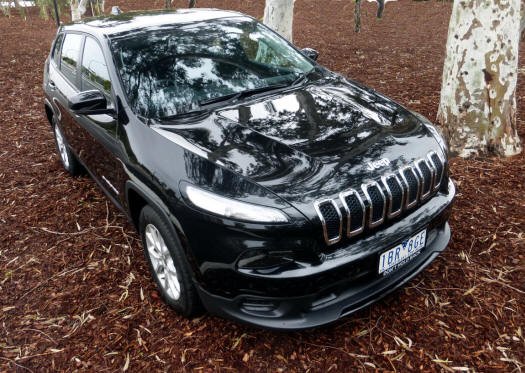
Jeep Cherokee Sport - Tested
It’s Jeep’s “All New, All Terrain Cherokee”. Well, they’re not all, all terrain. The model tested here is the front wheel drive only Cherokee Sport, not really suited to off road work…
The Cherokee range is indeed all new, heralded by a dramatic departure ion front end styling. This new look achieves three things. First, it moves the game forward for the corporate look, keeping it different from other models in the range. Secondly, in a sea of blandwagons, Jeep needed to stand out from the crowd somehow, which the new look has achieved.
And finally, it gets attention – and polarises opinions. Several people told me that they didn’t like the new look but were warming to it.
Fundamentally there are four versions. Starting with the 2WD Sport version, which has the 2.4-litre MultiAir 4-cylinder engine, which provides 190kW and 229Nm of torque. Next step up the range is the Longitude, which brings all-wheel-drive to the party, along with the 3.2-litre Pentastar V6 (200kW, 316Nm) and a higher level of equipment. The Limited is the next version, available with the V6 or a 2-litre turbodiesel (125kW, 350Nm) and a swathe of luxury equipment. The diesel also benefits from Jeep’s more sophisticated Active Drive ll 4-wheel-drive system.
Finally there’s the Trailhawk, designed for the serious off-roader who prefers a V6 petrol engine. At $47,500 it’s the most expensive version.
At $33,500 the Cherokee Sport is very competitively priced. Best sellers in the segment are the Toyota RAV4 GX (a 2-litre front wheel drive, with considerably less power and torque) and the AWD 2.5-litre Subaru Forester VTI. The Jeep’s 36 month, 100,000km warranty outguns what Toyota and Subaru offer. Other significant differences are that only Jeep provides 36 month Roadside Assist and the RAV4 only has a spacesaver spare tyre…
One of the Jeep’s big advances is a 9-speed automatic transmission, which naturally offers very smooth transition through the gears.
The 2.4-litre engine is not a highlight of the Jeep. Somehow the engineers have managed to coax a sound out of it like it’s a 1.6-litre car. It offers adequate performance, and anyone plumping for this version won’t think it’s slow – of course there’s the more sonorous V6 for those wanting more go.
Inside the Sport is a world away from the rough Jeeps of a couple of decades ago. Nice fit and finish, excellent ergonomics and decent styling are the hallmarks of this new car. The front seats are decently supportive (the rear seat is a bit flat) and offers good adjustability.
There’s a decent equipment level for an entry model, including 7 airbags, reversing camera, voice command and Bluetooth and power windows front and rear, power folding and heated mirrors, three 12V outlets, LED lights front and rear as well as electronic park brake.
The electronic systems include trailer sway damping – very useful for those who tow. The Sport’s wheels are 17-inch alloys, including the full-size spare.
The Jeep’s boot is disappointing, as with almost all small SUVs. Buyers kid themselves that they’re getting spacious load carriers, where normal station wagons offer more commodious boots. The floor of the Jeep’s boot is at waist height for the typical (mum) buyer of this car, in part due to the room the full-size spare takes up. No need for the rear seat base to flip forward so high is the boot floor when the backrests are folded. Just not clever packaging – but no worse than most similar vehicles.
Jeep offers several options for the boot area, including a kennel.
The Cherokee Sport drives nicely (engine note apart), the transmission performing very well. The steering is a little soul-less and handling more than adequate, however there’s nothing to encourage sporty driving, in spite of the model name. I felt the brake pedal needed more of a shove than many other cars I’ve driven recently, but the brakes haul the car up well enough.
The option list is relatively small, but the Cherokee model range caters for most requirements. You need to move up the range to get features such as power leather seats, larger tough screen, parking sensors, power tailgate and Alpine premium sound system, but at its price point, the Sport offers plenty.
Once people overcome their initial concerns about the styling (which appears to not take too long), I predict that the Cherokee will mirror the tremendous success that its bigger sibling the Grand Cherokee enjoys.
VITAL STATISTICS
Jeep Cherokee Sport
Engine: 2.4-litre, 4-cylinder petrol
Transmission: 9-speed automatic
Power: 190kW
Torque: 229Nm
Performance: 0-100km/h n/a
Price: $33,500 at time of review
Text & photos - Paul Blank (copyright)
Alfa Romeo Mito Twin-Air - Tested
Alfa Romeo marketing, like Fiat has been going through a vast change in Australia after the old importers were given the flick in favour of factory controlled management. And what a difference it's made - sales have soared due to a remix of models and decreases in pricing.
While Alfa Romeo's Giulietta series gained the most attention to start with (seeing excellent results), the Mito range was next for attention. The biggest change has been the addition of the first ever two-cylinder Alfa Romeo. As a price leader, the new turbocharged 875cc Mito doesn't disappoint at all.
Probably the only factor which would have been nice to see would have been a more different look for the new model. A chrome surround to the grille hardly makes enough difference.
Nobody has accused the Mito of being attractive, which hasn't changed with time, but there's a sportiness to the littlest Alfa - and the frameless door windows add to this and the slightly upmarket feel the car has. Specifications are good for a car in its price-range, with all the elements one expects - stability control, a suite of airbags, cruise control, air conditioning, power windows, etc. There's the Uconnect system – featuring 5-inch colour touchscreen, Bluetooth hands-free phone connectivity, Bluetooth audio streaming, AM/FM radio, CD player, USB and ortable media compatibility.
Alfa Romeo's slightly gimmicky DNA selectable performance parameters is still included in this base model, allowing three choices of engine mapping, steering feel, suspension settings, etc. Which none of the opposition offers.
Excellent fuel efficiency is boosted by a start-stop system.
So how does the 2-cylinder engine perform in the Alfa. Having driven Fiat 500s and Pandas with this award winning engine, I was hopeful it would suit the Alfa Romeo's character, which it amply does. The car I drove was manual, which is vastly better suited to the TwinAir engine than the somewhat dim-witted, slow changing DuaLogic semi auto Fiat offers (as well as manual). The result is the turbo twin is a lot of fun to drive. The thrum of the little engine is distantly reminiscent of the flat-four which Alfa offered for years in the Alfasud and 33 series.
Remember when the Alfasud was current, how people raved about how great the performance of the then smallest Alfa was? I certainly enjoyed every Alfasud drive I had. And it got me thinking.
An early 1.2-litre Alfasud in 1973 would do the 0-100km/h sprint in 14.1 seconds. Later, a 1.5-litre Alfa 33 (in 1990) took 11.7 seconds. In 2014 a new 2-cylinder Mito takes just 11.4 seconds. It makes an interesting comparison. And a 1976 Porsche 924, with a 2-litre engine took 11.6 seconds. Apparently the Mito is good for 183km/h flat out.
There's no doubt that in spite of the small capacity engine, the Mito is a lot of fun to drive. It encourages revs, being thrown into corners and a driving style one can associate with the Alfa Romeo badge.
With Alfa Romeo dealers offering this model at $24,000 drive away, it should help move a lot more Mitos than we've seen on the road to date.
VITAL STATISTICS
Alfa Romeo Mito TwinAir
Engine: 875cc 2-cylinder turbo petrol
Transmission: 6-speed manual
Power: 77kW
Torque: 145Nm
Performance: 0-100km/h 11.4 seconds
Price: $24,000 Drive away, at time of review
Text & photos - Paul Blank (copyright)
Fiat Panda range - Tested
After three generations of Panda, we’ve finally got these funky little mobile boxes in Australia. The original 1979 model, whilst designed by Italdesign, stylists of many an exotic car, was about as boxy as a car got. All the glass was flat and the panels not much more curvaceous. But as a practical, economical and cheap to maintain car, the little Panda was a winner. Italian farmers still love the 4-wheel-drive version.
For the second generation it gained two more doors and became a lot more of a city car suited to family use, the theme carried on for the latest generation. The newest Panda is available in a wider range of specifications than ever before.
With Fiat taking a new, confident look at properly marketing its products in Australia, and sales of the 500 skyrocketing, importation of the Panda makes perfect sense. It shares some of its structure and many mechanical components with the 500, but in a far more practical body.
That’s not to say it is plain or dull, no sir – this car has Squircles. This is a design theme of a rounded-off square which is used repeatedly throughout the Panda. It works quite well and adds some character to the little boxy car.
Three engines are available in Australia, quite specifically for different models in the range. The Panda starts off with the price-leader Pop, marketed at a driveaway price of $16,500 which is very competitive. The Pop has the least luxury of any Panda, but still has power steering, power front windows, remote central locking, a suite of airbags and (effective) air conditioning. Remember the days when Italian car air conditioning was less effective at cooling than leaving the fridge door slightly open? When it worked…
The 1.2 litre 4-cylinder engine that sits in the front of the Panda Pop is its least likeable characteristic. It’s an old fashioned kind of engine, devoid of anything other than basic motive power and noise to match. It gets the car to move, but that’s about it.
In the same story as the 500, move a step up from the Pop and you get two less cylinders. But what an engine! The 900cc turbo twin is a ripper. From the thrumming sound and low rev vibrations you know it’s something different. As you get moving in first gear there’s considerable rattling through the whole car, but pretty quickly the turbocharger is doing its job and the action starts. The TwinAir engine smooths out with a few revs and acceleration is quite good. Handling is fine and if anything, it feels a little sportier than a 500. Odd. The ride is also an improvement over the bouncy 500. It all makes the Panda a lot of fun to drive.
Sure you have to do your best to maximise your momentum, but that’s a fun part of small-engined cars. It really seems quite sporty. Even with the optional ($1500) Dualogic automated gearshift. In auto mode is slowly changes gear, and likes you to lift off the throttle to help. Once you’ve acclimatised to the tardy shifts, it’s easy to live with. You can manually flick the gearstick to make (slightly) quicker changes too.
The two-pot engine comes in Easy and Lounge trim levels. The Easy gains a few niceties and comfort features, but it’s the Lounge which gets all the fruit. Importantly, it has a height adjustable driver’s seat. I found I was perched too high in the lesser Pandas, feeling like I was on, not in the seats. The Lounge comes only with Dualogic transmission. Plus it gets alloy wheels, leather steering wheel and gearknob, window tint and more.
The final version in the range is the Trekking, which has a tricky adjustable diff (called Traction Plus) for sand and snow use, more ground clearance, plastic cladding around the car and a 1.3 litre turbodiesel engine. The diesel actually gives the easiest performance of any Panda, due to the additional torque over the other versions. It’s only available as a 5-speed manual. The Trekking is also as luxuriously appointed as the Lounge.
To underscore the snowy destinations the Trekking seems to have been designed for, it has a heated windscreen and heated front seats. The price though, will probably mean sales at the top end of the Panda range will be slow.
Various styles of interior trim delineate one version from the other, but all are pretty good – stylish and not badly finished for a budget car. They even have squircle shaped cup holders.
All Pandas have radio/CD/MP3 with steering wheel controls, Fiat’s Blue&me system with Bluetooth, USB and AUX connectivity and daytime running lamps. Stop-Start technology is fitted from the Easy upward, as are rear park sensors and switchable steering lightness (up to 35km/h), supposedly for city use, is on all Pandas.
The Lounge boasts a low speed collision mitigation system, just like a grown up Mercedes or Volvo.
On top of the dash is a plug ready to take an optional, special Tom Tom sat-nav unit that costs $540.50. You can pair your phone with the Fiat’s system either via the Tom Tom or the car’s own set-up. The Tom Tom also provides other Panda specific information. It’s sure to be a popular option.
The Panda curiously features ‘eco:Drive’ which allows owners to record their driving style onto a USB. This can be download this onto a dedicated Fiat website, which will calculate a score based on the driver’s eco-driving skills (or lack thereof).
Space in the back is tight, but at least there are rear doors to get you in there, and an adult can fit. Look at the car in profile and it’s clear the Panda is a very short car.
There’s something that little Italian cars had years ago which manifests itself as driving pleasure, in a fun kind of way. There was a period recently that many Fiats were devoid of this, but the Panda shows it in spades. Even with relatively small, but very economical engines, all Panda versions were fun to drive.
The Panda is an easy to live with car, well equipped, funky and reasonable value. Oddly, in Australia it’s priced higher than the equivalent 500s – unlike in Europe where the Panda is cheaper. It deserves to sell really well. It may take a bit of a push, but let’s hope lots of Australians work out how good it is.
VITAL STATISTICS
Fiat Panda range
Pop 1.2 manual, 0-100km/h 14.2 seconds, $16,500 driveaway
Easy 0.9 turbo manual/Dualogic, 0-100km/h 11.2 seconds, $19,000/20,500
Lounge 0.9 turbo Dualogic, 0-100km/h 11.2 seconds, $22,500
Trekking 1.3 turbodiesel manual, 0-100km/h 12.8 seconds, $24,000
Pricing at time of review
Text & photos copyright Paul Blank
Land Rover Discovery 4 SDV6 HSE - Tested
The Discovery is now recognised as one of the SUV greats, having begun so many years ago as a derivative of the original Range Rover. The model has been a huge success, with the millionth being made in March 2012. The fundamentals remain the same today - a luxurious, capable and not inexpensive vehicle as step down from the legendary Rangie.
Discovery 4 is in reality an update of the outgoing version, and although visual changes are few, it does boast some important upgrades. Prime among those is a new 3-litre twin-turbo V6 diesel engine replacing the old 2.7-litre turbodiesel, and significantly, adding 80Nm of torque. Also featuring is an excellent new 8-speed ZF automatic transmission working with the full-time four wheel drive system.
The engine is smooth and gearchanges excellent, however - especially from outside the well insulated cabin - it rattles like a diesel truck, particularly when cold. The 600 Newton-metres of torque is what the new powerplant is all about and it certainly delivers the goods. The new version does the 0-100km/h sprint a full two seconds quicker than the outgoing model.
The test vehicle was the top of the line V6, out of three versions. There's also a V8 offered.
Admit it or not, to many luxury 4WD buyers style is an important buying factor, whether it's the tough look or what they perceive as being luxurious. While nobody would accuse the Disco of being pretty, it has a functional, balances and clean overall style which remains looking trendy. The beefy 19-inch and optional 20-inch wheels give the car a good, solid stance too. Luckily its designers didn't resort to lashings of chrome to try to convince people it's a luxury vehicle (Lexus LX470).
The clean, up to date styling theme continues inside as well.
Luxury is synonymous with Discovery and there's little one could wish for beyond the equipment level offered. Crucially, one of the greatest features of Discovery and Range Rover models over the years has been a comfortable ride - without question one of the most important elements of real luxury - and the Discovery 4 does not disappoint. Some of the big Japanese 4WD vehicles with chassis have abysmal ride quality - but by never venturing beyond their favourite brands their owners never know any better... The Discovery cruises over speed bumps like a Rolls-Royce making the most of the 2.5-tonnes above the suspension. Off road, these vehicles are legendary, no matter what dedicated Land Cruiser owners say about the Japanese vehicle's superiority...
Inside there is seating for seven, though the folding rear row of seats is best for kids. The finish, styling and materials in the cabin are big parts of what makes the Discovery so special. The window controls on the top of the window ledge is an unusual design decision, but the rest of it is excellent ergonomically and stylistically.
It's a good vehicle to drive - not small in any dimension - but doesn't feel monstrous on the road. Somehow though, it left me feeling a little unfulfilled. It's hard to put a finger on it, but the driving experience was unmemorable as if this very competent machine was a little dull. But compared to what else is on offer in the price range, it would be very hard to better.
Prices start at just over $70,000 which puts the Discovery into territory where there's a lot of competition. The Discovery is leaps and bounds superior to a Pajero or Prado in terms of design sophistication, comfort and the driving experience offered. But then, how many Discovery buyers have considered a Prado?
VITAL STATISTICS
Land Rover Discovery 4 V6 Diesel
Engine: 3-litre V6 twin-turbo diesel
Transmission: 8-speed automatic, full-time 4WD
Power: 183kW
Torque: 600Nm
Performance: 0-100km/h 9.3 seconds
Price: $97,000 at time of review
Text - Paul Blank (copyright)Volkswagen Sirocco R - Tested
What's going on with the Sirocco? Why do you almost never see one on the road in Australia? With its little sibling the Golf repeatedly setting new sales records in this country, you'd think lots of people would like to upgrade to a Scirocco...
The latest generation is the first Scirocco marketed in Australia and it's good looking (from most angles), performs well, competitively priced, has the VW badge hat so many people like... I don't get why they're not flying out of dealer's doors.
With a week to review the high performance R version I got a pretty good idea of whet the Scirocco was like to live with. The engine is as so many people have enjoyed in the Golf R, it's a great unit, giving strong acceleration with a strong feeling or torque, giving excellent mid range performance too. There's a slick 6-speed gearbox.
Handling and roadholding are up to (high) expectations, with striking looking 19-inch wheels and low profile tyres doing their part. Oddly though, the front suspension was prone to bottoming out on joins in roadworks and similar bumps, even with the car in the Comfort setting. Wheelspin became wheel hop under strong acceleration from rest, especially in the wet - though this may be attributable in part to the press car having had a hard life, so perhaps there were worn bushes...
The Scirocco is fitted with XDL, which is VW-speak for an electronic differential lock system which is designed to limit torque steer.
Inside, the seats are excellent, supportive and well-suited to a sporty car. There's even room for adults in the back which few coupes can truly boast. The dashboard is flat and characterless, which is not in keeping with the stylish, sporty nature of the rest of the car, but all the controls and instruments are well laid out, easy to understand and use. Quality inside, as elsewhere on the car was clearly high.
There's little wanting in the equipment level of the Scirocco R, as you'd hope for $50,000+. Included in the spec are dual-zone climate control, cruise control, rear parking sensors, automatic wipers, trip computer, Bluetooth telephone connectivity with audio streaming and heated front seats. 6-speed manual (as tested) is standard fitment, but most customers go for the DSG, also a 6-speed unit.
The Scirocco R seems to be many things people love about modern Volkswagens, much of it amplified in a sporty coupe. So why so few sales?
VITAL STATISTICS
Volkswagen Scirocco R
Engine: 2-litre 4-cylinder turbo petrol
Transmission: 4-speed automatic, fwd (5-speed manual also available)
Power: 188kW
Torque: 330Nm
Performance: 0-100km/h 6.2 seconds
Price: $53,500 driveaway at time of review
Text & photo - Paul Blank (copyright)Citroen C3 Seduction - Tested
It will be interesting to see whether the updated Citroen C3 will help boost sales of the French marque in Australia. While several other European brands have been increasing their market share, mainly through keen ‘driveaway’ pricing and low start pricing, Citroen has been suffering lately.
There’s nothing at all wrong with the Citroen range available in Australia, and the importers sharpened the pricing last year, but it hasn’t been enough to stop the slide.
The C3 has been a consistently reasonable seller for Citroen, the first model making quite an impact. The latest update of the second series of C3 consolidates what is a neat little car. New engines and updated styling are the key new elements. I stepped into the C3 having had a few weeks in the new little Fiat Panda (which I really liked) and my initial impression of the Citroen was that it was a ‘proper car’.
It sat solidly on the road, felt well put together and had decent performance, things which the lightweight little Fiat didn’t achieve quite so well.
The C3 I reviewed had automatic transmission, which meant it came with the more powerful 88kW version of the 1.6-litre engine. It more than overcomes the loss of performance associated with an auto transmission. The performance was quite spritely.
Specifications have been changed with the update and all C3s feature the Zenith windscreen, which wraps over the roof into where other cars might have a sunroof. This gives the effect of being in a helicopter! At times it takes a little getting used to) especially the ‘floating’ rear view mirror), but I quite liked it. It certainly has a ‘wow factor’ and makes the interior feel enormously spacious.
Citroen tells me that “The angle from the driver’s eye line to the top of the windscreen is a huge 108° instead of the segment average 28°”. There’s a sliding internal blind, with (flimsy) sun visors attached – effectively an extendable roof lining, which converts the car to a ‘normal’ interior. I’ve read a review by someone who clearly didn’t understand that you could slide this into place and thought the car would be much too hot in summer. Ah well, some people are supposed to drive Toyotas and will never understand the design flair that some European cars have…
The car I drove was the base Seduction Automatic version, which also boasted power windows, air conditioning, alloy wheels, six airbags, radio, CD and MP3 player with Bluetooth and USB (with 6 Speakers), cruise control and leather steering wheel – so it’s not so basic...
The manual Seduction has a 3-cylinder PureTech engine as fitted to the Peugeot 208. At $19,990 it’s not the cheapest option in its class, with Renault, Peugeot and Volkswagen offering attractive opposition for less money. Nobody else offers anything like the Zenith windscreen though…
The interior is a clean, modern design boasting a quality level far beyond what little French cars offered a couple of decades ago. The materials, finish and ergonomics are mostly hard to fault. It’s not festooned with knobs and buttons as some new cars are, and the controls are generally intuitive to use.
The front seats are decent and offer good support, accompanied by a very good quality ride – it is French after all… In this area it excels over cars such as the Mazda 2 or Honda Jazz.
On the road the car’s comfortable ride give it a more luxurious feel than some of its competitors, helping set the C3 apart. Handling is also a strongpoint of the C3. Performance and acceleration are more than adequate, though it’s no hot hatch. And the old fashioned 4-speed automatic isn’t sporty at all.
Boot space is class leading, but the glovebox is probably the smallest….
The more upmarket Exclusive version ($24,990) gains sat-nav, 17-inch alloy wheels, rear view camera and a more luxurious cabin fit out.
Overall, while I enjoyed my week using the C3 and found nothing serious to be critical about I came away feeling that the car did nothing to advance the cause of the small car. It was competent, pleasurable and did everything asked of it, but it didn’t excel or expand new boundaries in any area. Do you recall how a Citroen GS (1970-80 and to ‘86 as the GSA) was light years ahead of any other contemporary small car in so many ways – dynamics, ride, space efficiency, technical sophistication, aerodynamics, etc, etc. The same can’t be said for the C3… It is just a very nice little car.
VITAL STATISTICS
Citroen C3 Seduction Automatic
Engine: 1.6-litre 4-cylinder petrol
Transmission: 4-speed automatic, fwd (5-speed manual also available)
Power: 88kW
Torque: 160Nm
Performance: 0-100km/h 10.9 seconds (automatic)
Price: $22,990 at time of review
Text & photos - Paul Blank (copyright)
Bentley Mulsanne - Tested
Here's something a little different... Bentley courageously launched their new, big sedan a couple of years ago. Where does it fit in the marketplace? Obviously a rung higher than the Flying Spur from their own stable, and above anything BMW, Mercedes-Benz, Lexus or Jaguar has to offer. Also above a Maserati Quattroporte, Aston Martin Rapide or Porsche Panamera. It fits somewhere in between a Rolls-Royce Ghost and the same company's Phantom. So the Mulsanne almost has a niche of its own.
The car I drove was loaded with option - probably quite typically for any Mulsanne which is likely to be delivered in Australia - which adds a squillion dollars to the 'base' price. Most of this was with Mulliner interior upgrades. Chrome inlays with little Bentley badges in the wood door cappings - a nice touch, but $5300 worth? Contrasting coloured stitching (everywhere) for about the cost of a new V-Moto scooter. There are 25 shades of leather colours o choose from. Hard for mere mortals to justify a swag of these kinds of options, but for the buyers of cars at this stratospheric level, it's an important part of the buying process. And it's unlikely there will ever be two Mulsannes delivered in Australia which are the same.
It's a big car, as well it should be. From the moment you touch the doorhandle it's very clear this is a car made to a ridiculously high standard of quality. As you'd want for your $850,000-odd. And it's very, very nice. Everything fits exactly, is crafted beautifully and feels exquisite. It's an experience being in one. Lots of leather, wood and chrome make a gorgeous cabin.
Start the car and it purrs as it awakens. The engine, believe it or not, is still based on the old 6750cc V8 which powered the Rolls-Royce Silver Shadow, Silver Spirit and beyond - and of course, the equivalent Bentleys. In fact the engine dates back to the early 1960s when first seen in the Silver Cloud 3 and Bentley S3, in 6250cc capacity. While it was dropped briefly, the engine has come back, with turbocharged assistance and many upgrades boasting a record for longevity in production. To help with fuel economy (if you care), the engine can drop 4 cylinders when cruising.
The car wafts along the road in a way Rolls-Royce and Bentley cars excel - even though there's precious little shared between Volkswagen Group's Bentley company and BMW-owned Rolls-Royce. It's interesting though, as both companies recognize that their (shared) heritage is an important part of what their products are today, so for example, both use the same kind of metal dashboard air vents with adjacent stopper knobs. No other companies use anything like it.
But back to the driving experience... It's very quiet, and while the engine is not silent, the feeling of luxuriousness is amplified by the quietness. All the power assisted controls operate with gliding precision and silence. On start-up, a polished wood panel disappears into the dashboard to reveal the SatNav and control screen. There's a clue that the Mulsanne shares some technology with other cars in the Volkswagen Group here - some of the screen graphics are the same as Skoda and Volkswagen cars.
The car offers options of driving style and in Sport mode feels oddly harsh in the suspension and heavy in the steering. It's probably fine on an Autobahn at 250km/h, but I found the Comfort setting much more in keeping with my expectations. Performance is more than adequate in any setting, and the size of the car feels like it's diminishing as you become used to the car. Immense power and torque give the big Bentley sports car like performance figures.
Probably the most divisive aspect of the car is its styling. Several people who looked at the Mulsanne while it was in my care described it as looking like a Chrysler 300 with an ugly face. I think it's a much more balanced and well detailed design than the Chrysler, but I see what people mean about the 'gangster' look, especially with the high window sill line and low-set roof styling. The nose, particularly the headlights, I just can't get to grips with. Let's bet that when an updated version comes the startled frog look will be toned-down.
It's a sumptuous car to drive or ride in and the feeling of being special riding in one will probably never go away. The Mulsanne is incredibly well built with impeccable attention to detail in the finish. And it drives beautifully for a big car. But somehow I found it a little characterless. Aside from the cartoon character nose, the sleek shape doesn't make enough of a statement for my $850K.
VITAL STATISTICS
Bentley Mulsanne
Engine: 6.7-litre V8 turbo
Transmission: 8-speed automatic, rwd
Power: 377kW
Torque: 1020Nm!
Performance: 0-100km/h 5.1 seconds
Price: $850,000 as tested, at time of review
Text & main photo - Paul Blank (copyright)
Peugeot 208 GTI - Tested
There’s been a lot of lead-up publicity to the launch of the GTI version of the Peugeot 208, much of it making reference to the iconic 205 GTI.
While there have been other models in between, they’ve somehow lacked the punchiness and verve that the original 205 GTI had. While they’ve been good to drive, they haven’t cut it in the same way the lightweight, big-engine original did.
I’d already driven the more everyday models of the 208, and even enjoyed the little 3-cylinder version. There’s some clever design in the 208, all of which is carried over into the GTI.
As is the feeling of quality of construction... While the 205 was a solid enough car, there was a pretty flimsy interior and the GTI felt like a fast version of a cheap car. Not so with the 208 GTI, which feels beautifully screwed together throughout.
The tight feeling helps make the sportiest 208 feel like a proper, fun hot hatch. It’s not just power which makes a hot hatch a winner (and the 208 GTI has plenty of that too), but an overall feeling like it’s a car you want to throw into a corner and accelerate out, grinning all the way.
The steering on the 208GTI is quite remarkable. You often hear of cars described as having go-kart steering, but I’ve never experienced a road car which gets as close to that description as this car. The very small steering wheel (more on that later), is a part of this, but there’s a quick rack and excellent feel to the power steering.
This car turns in fantastically. It grips well, except when wheelspin isn’t completely checked by the electronics, and is pure fun to throw around corners and bends.
The 147kW, 1600cc turbocharged engine is shared with the (heavier) Mini Cooper S and gives the little Peugeot a 0-100km/h time of 6.8 seconds. And it’s fun all the way. At any speed, there’s plenty of power available, and the 6-speed gearbox is a pleasure to use.
Externally, the GTI gains a subtle body kit, big 17-inch wheels with low-profile tyre and some additional decoration in areas such as the grille (impossible to get water out of after a wash). It’s not too over the top, but clearly not a poverty model.
Inside, all the 208 series models excel. Not just in excellent build quality and good equipment levels. There are good stylistic and ergonomic details. The main one, which weirdly has received criticism from some areas of the press, is the small, low-set steering wheel. The idea is that the driver looks over the steering wheel at the instruments set high on the dashboard.
I can’t tell you how many cars I have driven where the top of the steering wheel blocks the view of the tops of the gauges. Annoying, poor design. The 208 overcomes this altogether. With power steering in almost every car these days, large diameter steering wheels can become a thing of the past.
Even Peugeot’s excellent new mini SUV 2008 has this interior design feature and I’m at a loss to understand why anyone wouldn’t like it. Maybe drivers who like old Nissan Patrol 4WDs would find the change too much to bear… But I have no idea why anyone else wouldn’t like it. More cars should be so designed - but sadly it will probably be a Peugeot 208 aberration
The instrument surrounds glow red (blue in lesser 208s) and the glass roof has hidden surround lighting. The big centre screen, a cool little iPad-inspired unit isn’t entirely intuitive to use, and is the centre for lots of the car’s operations. Sat Nav is standard in the GTI. There are some tasty flourishes of red in the dash and doors. There are lots of nice little details to surprise and delight.
At $29,990 its main opposition would be the $2000 cheaper VW Polo GTI, or the about-to-be-released Renault Clio RS 200, which will fit between those two on price, but is closer to the 208GTI in specifications. I’ve driven the Polo GTI and while it is a great fun little car, I think the Peugeot pips it.
It’s quick, nimble and well equipped. Anyone who gets behind the wheel of the new 208 GTI is going to be impressed. After a week with it, I was disappointed to hand it back. Yes, it’s a worthy descendant of the 205GTI.
VITAL STATISTICS
Peugeot 208 GTI
Engine: 1.6-litre 4-cylinder turbocharged petrol
Transmission: 6-speed manual, fwd
Power: 147kW
Torque: 275Nm
Performance: 0-100km/h 6.8 seconds
Price: $29,990 at time of review
Text & main photo - Paul Blank (copyright)
Fiat 500 Pop & 500C Twinair Lounge - Tested
With Chrysler Group Australia taking over distribution of Fiat in Australia in 2013, they’ve opened things up to sell far greater numbers of cars than Ateco had before. Fiat effectively owns Chrysler which gives them a good basis in Australia to move things up a notch, or two.
The 500 has been on sale for a while in Australia, selling relatively expensively as a luxury toy. That’s all changed now and volume sales are the target. With a driveaway price of just $14,000 a 500 Pop makes a very compelling argument for itself against a raft of not so exciting Suzukis, Kias and their like. It’s the same price as Volkswagen’s excellent Up. At this price, people should be buying 500s in droves.
What do you get for $14K? Well, there’s the obvious… great styling and neat packaging. Decent handling, well sorted road manners and cute looks. Inside, there’s a pretty full complement of equipment. Power steering, power windows, air conditioning, radio/CD/MP3 with 6 speakers, Bluetooth, leather steering wheel with button controls, seven airbags... Nothing missing there. Did I mention the styling?
There’s electronic stability control, remote locking, and even a little pack in the boot with a container of oil, a folding funnel and hand wipes. Sure, it just has plastic hubcaps and no foglights (OK by me) and misses out on a split rear seatback, but it certainly doesn’t scream poverty pack.
Some of the plastics inside are not so luxuriously finished, there are shortages of trim in the boot and the miniscule back shelf is reminiscent of the lid of an egg carton, but the 500 is a cheap car and like every other cheap car on the market, some of this kind of finish is to be expected.
The 500 Pop I drove had a fabulous looking interior. The dashboard in all 500s is the same colour as the car’s exterior, which adds some light and brightness in most cases. This car also had a red and cream colour scheme – red on the seats and door trims, cream seat tops, headrests, steering wheel, centre console sections and instrument cowl. Looked like a million dollars inside, not $14,000…
How does it drive? Not bad. The 1.2-litre powerplant doesn’t offer a lot of performance, but it’s a 4-cylinder unit where much of the opposition offers only a triple - which for many buyers, will be a big plus.
If you can stir the gearstick enough and keep your right foot into it, the Cinquecento handles almost sportingly, eager to corner enthusiastically and the brakes are more than adequate.
The 500’s enemy is the speed bump. Sharp speed bumps see the front suspension crash hard, wide speed humps make the 500 pitch and bob. It’s inevitable with short wheelbase cars, but the 500 really doesn’t tackle them well except at really low speeds. Conversely the suspension is quite supple when it comes to rough road surfaces, soaking up little bumps and lumps with aplomb.
The second version I drove was a 500C (C for Convertible), in top Lounge spec with the little Twinair 2-cylinder engine. Now there’s an interesting combination. At $22,700.
I’ll start with the body. The electrically operated soft-top opens to two positions: all the way open above the seats, or more open, with the (glass) rear window all folded down just enough to completely obliterate rearward vision. Okay, taller drivers can see a bit over the folded roof… It does have a much more open feel than any sunroof and harks back to the original 1960s Fiat 500’s opening roof. It shuts very nicely and is a tight, quiet roof when closed. I liked it.
The Lounge specification adds more luxury and better trim levels (there’s an S model between the Pop and Lounge), so the car has alloy wheels, chrome trim on the bumpers, different upholstery, automatic air conditioning and a few other little goodies. If you don’t go for the opening top, the Lounge comes with a big glass roof (with internal sunblind).
Most significant though, is the engine and transmission combo the Lounge boasts. The 875cc, 2-cylinder motor has a tiny turbo to help things along. It’s a wonderful little motor too. It has 63kW and 145Nm of torque – compared to the 4-cylinder Pop’s 51kW and 102Nm.
The Twinair only comes with Fiat’s Dualogic (automated manual) transmission. Left in auto mode it slurs between ever-so-slow changes and completely dulls the car’s performance. That said, with some technique applied you can make the most of it, better than with the similar transmission in a Smart. It does however offer manual shifts (with no clutch pedal) either by a gearstick or paddles, both of which make the little car quite sporty – clearly the Italians haven’t lost their touch.
You’ve got to plan ahead to keep momentum up and use the plentiful torque rather than revs, but the driving experience is seriously enjoyable.
The 2-cylinder engine sounds just like the old Bambino – well, a less raucous version, and it’s a brilliant little unit. How does 3.9 litres/100km sound for economy? That’s 68.9mpg! Astonishing.
The 1.2-litre Pop offers 5.1 litres/100km and the 1.4-litre, 74kW S version provides 6.1 litres/100km, neither of which is bad. At an extra $1500 Dualogic is available on the Pop and S, as is the opening roof.
It took me a while adjusting the seat and steering wheel to get a comfortable driving position, which I never quite achieved - and it always felt a bit compromised.
But the single most annoying thing about the 500s, even after several years of production is the little tab on the centre console’s little bin that juts out and sticks into your left shin. Not an issue with a left-hand-drive 500… Surely someone over 5 ft tall at the factory has driven a right-hand-drive 500! This is the most appalling bit of rotten ergonomics I’ve suffered for years. The Pop and Lounge each had a different lid design, but both had this infuriating problem. When I get my 500 the first thing I’ll be doing is going in with a grinder!
I suppose that last sentence gives you a clue though about how likable the 500 is. Yep, I’d gladly have one. In Australia it would be a 500 Pop for its fantastic value, but for my holiday home in the South of France an open roof 500C Twinair.
VITAL STATISTICS
500 Pop / Twinair Lounge
Engine: 1.2-litre 4-cyl/875cc 2-cyl turbo
Transmission: 5-speed manual/5-speed Dualogic automated manual
Power: 51/63kW
Torque: 102/145Nm
Performance: 0-100km/h 12.9/11.0 seconds
Price: $14,000 driveaway/$22,700 at time of review
Text & photos - Paul Blank (copyright)
Jeep Grand Cherokee Laredo & Overland - Tested
For 2013 Jeep has given its extremely popular Grand Cherokee range a make-over. From the outside, the changes are few, and fairly subtle – the new style headlights being the most obvious – and it’s still good looking for its type.
Along with the “I bought a Jeep” advertising campaign which has been an enormous success, Grand Cherokee sales have increased in leaps and bounds with the current shape. The up-to-2013 model was a decent vehicle, but not class-leading. There were several versions to choose from, all well-equipped, but (with the exception of the powerful SRT8) the driving experience was nothing to write home about.
However, if you were moving out of a similar-sized Toyota Hi-Lux, Mitsubishi Triton or one of the myriad twin-cab utes with a chassis, the Jeep was enormously better.
With the latest version, Jeep has given us far more than a warm-over. Inside, the dashboard and centre console have come in for improvements, both functionally and stylistically. Clever electronic instruments are well thought out and up to the minute.
To drive, the improvements are harder to measure, but certainly obvious. Especially the new 2-wheel-drive Laredo model, with its 3.6-litre Pentastar V6 and 8-speed auto was actually a pleasure to drive. Almost sporty. The acceleration was surprising – in a good way. It’s got a good turn of useful speed. If this is a base model, it’s not too shabby. Sure, it misses out on the big-screen at the top of the console, sat-nav, AWD, the neat 4WD controller on the console and a swag of luxury items, but it never felt basic.
All versions have an excellent new ZF 8-speed automatic transmission with a tiny little electronic gear selector on the console. While the selector isn’t brilliant, the transmission is. Jeep claims better economy and performance with the new transmission.
The Laredo still boasts 18-inch alloy wheels, touchscreen, heated power seats, rear view camera, tyre pressure monitors, Bluetooth connectivity and stylish daytime running lamps. At $45,000 driveaway, Jeep is offering a pretty attractive package.
I also drove the upmarket Overland, with a 3-litre turbodiesel engine, which was less pleasurable mainly due to the more slovenly engine. Though it was more luxuriously equipped... The large format, customer-configurable display allows drivers to personal settings and graphics. Detailed vehicle information ranging from a large digital speed readout, navigation details, the Selec-Terrain and Quadra-Lift system and more are integrated into the system. Neat stuff and easy to use.
The Overland gives you the Selec-Terrain traction control system, with five different condition modes. Traction is also enhanced through the Quadra-Trac II or optional Quadra-Drive II 4WD systems. Also, the Quadra-Lift air suspension features five height settings.
Inside the Overland has a higher level of trim, with details such as the wood section of steering wheel and Overland badges on the seats. The seats are ventilated for heating, the dash, door trims and centre armrest are upholstered in leather. Blind spot and forward collision monitoring are also fitted to the Overland, as is adaptive cruise control.
Small item stowing capacity in the cabin is light-on. Interior quality is vastly improved over Jeeps of a decade ago, but it’s still no Range Rover.
An area of criticism would be the headlights, which don’t seem powerful enough on high beam. The Overland has the automatic dipping function which can be as frustrating as it can be useful. Many car makers are adopting this questionable technology.
You can order a Laredo with 4x4. All models are available with the diesel engine option or 3.0-litre petrol V6, and the mid-range Limited and Overland have the option of the stonking SRT 5.7-litre Hemi V8 – providing a 0-100km/h time of just 4.8 seconds.
A whole lot of small changes have brought great overall improvement to the Grand Cherokee. An owner won’t be embarrassed to have “Bought a Jeep”.
VITAL STATISTICS
Laredo 4x2 V6 petrol/Overland 4x4 V6 diesel
Engine: 3.6-litre V6 petrol/3-litre V6 turbodiesel
Transmission: 8-speed auto, rwd/4WD
Power: 270/184kW
Torque: 347/570Nm
Performance: 0-100km/h 6.6/7.8 seconds
Price: $45,000 driveaway/$71,000 at time of review
Text & photos - Paul Blank (copyright)Fiat Punto Pop - Tested
With a change of importers, Fiat is back in Australia with a vengeance. Having dwindled down to a single model (the 500 in various versions), things had got pretty grim for Fiat here. Chrysler Australia has taken over (as Fiat is the majority shareholder of the US company) and they're giving Fiat a shot in the arm here. Along with expanding the range, pricing has been a target. With 500s starting at $14,000 driveaway, Fiats are no longer expensive luxury toys. Good move.The Punto has been reintroduced, in an updated version after a couple of years of absence from the Australian market. No longer pitched against cars like the Golf, Punto ownership starts at a remarkable $13,000 driveaway, which a pretty attractive proposition. Dualogic transmission adds $1500. Three trim levels are offered. Hopefully more powerful versions will follow...
So how does the Punto stack up? In isolation, it's a very competent little car. The handling, roadholding and steering are, as you'd hope of an Italian car, really good. The car sticks to the road better than you might expect from its little tyres and the ride comfort is a cut above its class, soaking up irregularities on the road well and turning into corners in an almost sporty way.
The power output from the 1.4-litre engine is nothing to write home about. It makes a noise, it goes. Not much more really. It's a willing enough unit, but not inspiring. The gearshift, brakes and on-road characteristics are of a high enough level that you know they handle more powerful versions more than adequately.
Inside, it's a bit of a plastic paradise - nicely but unadventurously designed, well enough put together and decently functional. Remember this design is a few years old now and the game has moved on a bit. That said, it's still well up to the job and by no means worse than its opposition. There's no flimsiness to the interior, which can't be said of some of the Punto's opposition.
As a basic, entry-level car, it's well equipped: Air conditioning, power front windows, remote central locking, power steering, Bluetooth, stop/start system, ABS, traction and stability control, 6 airbags and more. It's an easy, undemanding car to live with.
Compared to its opposition - now cars like Suzuki Swift, Honda Jazz and Mazda2 it offers a bit of classiness and Euro-chic, excellent handling and very attractive pricing. Even with a few years under its belt, the Punto is a good looking car too. If Fiat can get potential buyers into the showrooms and behind the wheel, they should have a winner here.
VITAL STATISTICS
Engine: 1.4-litre 4 cylinder
Transmission: 5-speed manual, front wheel drive
Power: 57kW
Torque: 115Nm
Performance: 0-100km/h 13.2 seconds
Price: $13,000 driveaway at time of review
Text - Paul Blank (copyright)Nissan Micra ST - Tested
There's fierce competition these days in the tiddlers class and interestingly, several makers have gone the 3-cylinder way for powerplants. While Smarts have always had a triple nestled in behind their back bumper, and Daihatsu Charades sported 3 pots years back, there hasn't been much else offered until recently. Volkswagen's excellent, fun little Up features a 1-litre unit, Mitsubishi's new Mirage has a 1.2-litre engine as does the Micra. Larger capacity 1.5-litre 4-cylinder models were offered, but from early 2013 only the 3-cylinder engine is available. Three trim levels are offered.The Nissan's motor is a thrumming, willing little unit, much like its competitors. Mated to a 5-speed manual transmission, which has well chosen gear ratios, it hums along nicely without any risk of providing any performance to speak of. A 4-speed automatic transmission is offered for an additional $2000.
Handling and roadholding are remarkably good - better that I expected. There's little body roll even when you push the car a bit and the suspension absorbs bumps and rough roads at least as well as bigger cars, like Corollas... And that's a big compliment as it's hard to get a really lightweight car to have a comfortable ride. They've done a very commendable job here and it's probably what most makes the Micra passably good to drive.
The interior design is quite good, considering this is a car built to a tight budget. It doesn't have some of the screaming cost cutting features which blight the Mirage's interior. Equipment levels are certainly acceptable for the Micra's place in the market. plus there are some little Surprise & Delight features such as a handbag hiding space built into the passenger seat base and some clever computer options.
Stylistically it's not a brave as its long-running predecessor was, but that will probably give the Micra broader market acceptance. It's a cute enough shape for the intended buyers...
It is a very tinny, plasticky, lightweight piece of construction though. The door clang shut, there's bare paint on the boot ledge (which will get scratched and look scruffy quickly), and even the windscreen feels thin in the rain... The curved ribbing in the roof panel (to give strength and avoid booming) gives you an idea of the lightweight construction. You don't pay much for a Micra but you do get value for money.
Like the Suzuki Alto, a close competitor to the Micra, Nissan Australia sources the Micra in India. Nissan's 3-year, 100,000km warranty doesn't seem favourable compared to what Mitsubishi or Hyundai offer on their equivalent cars.
Is it a better car than it's prime opponent the Mirage? Probably. It rides and handles better and the interior is a nicer environment, and that's enough to tip the balance in the Nissan's favour. Importantly, the Mirage and Micra are both available in shades of metallic pink.
VITAL STATISTICS
Engine: 1.2-litre 3 cylinder
Transmission: 5-speed manual, front wheel drive
Power: 56kW
Torque: 100Nm
Performance: 0-100km/h not quoted
Price: $13,990 driveaway at time of review
Text & photo - Paul Blank (copyright)Volvo V40 T4 Kinetic - Tested
Volvo ventures into a new market segment with the V40 range, tackling cars like Audi’s A3, BMWs 1-series, top-line Golfs and Mercedes-Benz A-Class head on. The small C30 coupes never quite made the impact on the market in Australia that Volvo had hoped for, but the V40 is showing all the signs of being a big success for the Swedish company here and abroad.It’s offered here in six versions, spanning the D2 Kinetic ($34,990), with a 4-cylinder 1560cc turbodiesel engine and 6-speed manual, through to the range-topping T5 R-Design (at $49,990) – a striking looking sporty version fitted with the 2.5-litre,187kW turbo 5-cylinder motor.
The four models through the middle of the range have the turbocharged 5-cylinder, 2-litre engines in diesel or petrol. Interestingly the petrol engine has 2kW more than the diesel, 100Nm less torque, and accelerates slower than the diesel cars 0-100km/h. Volvo claims a combined fuel economy of 4.2 l/100km for the small engine diesel, through to 8.1 l/100km for the punchiest T5.
The V40s cover a good range then, all with quite high equipment levels. City Safety is standard across the range, offering automatic braking if you’re about to run into something at under 50km/h. A pedestrian airbag is fitted to all V40s, propping up the back of the bonnet and protecting the windscreen… a first in the marketplace and very Volvoey.
All V40 models feature fuel saving stop-start technology and regenerative braking.
Optionally, you can specify the safety kit sky high. There’s Driver Alert (for $2075) which gives you lane departure warning and tugs the steering to keep you in your lane. It also gives you active high beam control, forward collision warning and road sign information reading, which is shown on the instrument panel.
For a whacking $6250, you can opt for a pack which gives you Adaptive Cruise Control, which allows you to set and forget in a traffic jam (up to 30km/h), and the car just latches onto the speed of the car in front and acts accordingly while you have a chat with your passenger over a coffee. Pedestrian Detection system, collision warning and Full Auto Brake also come with this package.
Then there’s BLIS, which Volvo has offered for a couple of years now, with blindspot detection and warning (which I personally don’t like but understand its usefulness) and Cross Traffic Alert, which cleverly alerts you to oncoming traffic to the sides when you’re backing out of a parking spot.
Some of this stuff is really clever and potentially useful, some I could happily live without. Well, maybe until I’m really old…
There’s a lane-change merging aid offered overseas, but clearly Volvo is aware that’s such a monumental problem in Australia that no electronic aids can help.
The instrument panel is state of the art. You can change the style and colour scheme of the instruments, change the speedo into a tacho and other adaptations. The virtual instruments on what’s effectively a segmented screen work very well, even in the style changeability is a gimmick that will be forgotten after the first week of ownership.
The same with the colour changeable mood lighting from the little LED alongside the interior lamps.
The design and layout of the interior is very user friendly. Aside from the instrument panel, it doesn’t break any new ground, but is bang up to date. Seating space in the back gets a little tight for adults, but it’s no worse than equivalent cars.
The exterior styling has been well resolved. It hits the mark as clearly being a Volvo (that’s a good thing). The little kick-up on the rear door is reminiscent of their P1800 sports car of the 1960s. Nice touch. People are used to the long snout look on Volvos these days and in the case of the V40, the surface shaping is very well done with some subtle design blending very well. Nice, clean side styling too without too many shapes being applied (a lesson for companies like Mercedes-Benz here).
The rear is a bit more out there, but looks good to me. I do have to have a whinge about the thickness of the back pillars. It’s not just a V40 problem, but way too many car makers are putting style before function here and with a radically rising side window sill line towards the back of the car, and a too small rear window – too shallow and too narrow, even though it looks wide from the outside, there is 10cm of internal structure each side. The dinky C-pillar window is smaller than your hand span and mostly obscured from inside. A standard fit rear view camera doesn’t remove the risk and annoyance of terrible rearward vision. Come on Volvo - and almost every other car maker today – get it together, you can do better than that!
The V40 reviewed was a T4 Kinetic, which is the base petrol car, with 6-speed automatic and stop-start. The no-cost option of a matte grey finish on the 17-inch wheels didn’t do the car any favours.
The engine always felt fairly lusty, clearly a beefier unit than a 4-cylinder, making the car somehow feel more substantial to drive than a four. Performance was okay, nothing startling, but the T4 isn’t the sporty version. Gear changes from the Adaptive Geartronic unit were always clean and smooth.
I found the ride to be a bit harsh and jittery over minor bumps, but the V40 handles speed humps and similar traffic calming devices (!) quite well. In cornering the car’s composure was fine, even when pushed a bit.
Volvo offers the V40 with free scheduled servicing for 3 years or 60,000km, which has got to be pretty attractive.
The T4 isn’t the model you fall in love with (leave that to the good looking, quick T5 R-Design), but it is a very competent, well thought out package that’s right up to the moment. The V40 range will give German prestige hatch buyers a credible alternative.
VITAL STATISTICS
Engine: 2-litre turbocharged 5 cylinder
Transmission: 6-speed Geartronic automatic, front wheel drive
Power: 132kW
Torque: 300Nm
Performance: 0-100km/h 8.7 seconds
Price: $41,990 at time of review
Text & photo - Paul Blank (copyright)Peugeot RCZ 2.0 - Tested
The little RCZ has become a slightly familiar car on the Australian street now, and Peugeot has released an updated version. Foremost in the changes has been to the previously ungainly frontal styling, which few people could doubt would have benefitted from anything - even a car crash. Certainly it's an improvement. And while Peugeot has made a raft of changes to the RCZ, the majority of its dramatic styling has been left alone - and that's a good thing. Aside from its stylistic cousin the Audi TT, there's nothing quite like it on the market.
It still got a lot of comments from people, most finding the styling at the ends too bulky, but loving the curvaceous roof and rear window. The standard fitment, big 19-inch wheels also drew praise.
Inside remains the same, aside from some equipment differences. It now includes the pop-up screen Sat-Nav as a standard fitment. You can see it's not the latest generation inside, with a manual key start (ah, yes, remember them) as a clue... But it's comfortable, stylish and seems nicely put together.
There are tiny little seats in the back, suitable to a very limited age range - a baby seat fits, but even with the front seat in the forward-most position. leaves absolutely no legroom for a bub. And the seatback almost in their face, as their baby seat brings them closer to it. OK, maybe it was overly optimistic to try. My son, a grade 3 kid, fitted OK and even managed to work out the weird double-clip seatbelt.
The dashboard looks very attractive with its stitched covering, the instruments are tidy and easy to use, but there's precious little storage space for items like a phone, sunglasses, etc. There is an indentation masquerading as a cup holder in the console but it's too shallow to be of any use.
The boot is impressively large, but there's no spare tyre - just a pump. And of course there's a pop-up rear spoiler...
We drove the manual peppy petrol engined version. There's also a 6-speed automatic petrol model, with a less powerful motor. An RCZ turbodiesel is available, giving less performance but better economy. Interestingly, all three versions are the same price. Clever. More than half the RCZ sales in Australia have been this manual petrol model.
In the manual RCZ, the 1.6 petrol engine, with a turbo, has some really good performance characteristics - not in a V8 bashing way, but in a way 1960s Alfas used to be a lot of fun to drive. It's a lovely little engine which, when your foot is right down and the revs get up, really delivers a rich, enjoyable seam of power. I had the opportunity to test the car at a facility where I could get a feel for how it goes if it was pushed harder than you'd drive one on the road. After a little wheelspin, the Continental tyres grip enthusiastically with no signs of electronics spoiling your fun, even in sharp manoeuvring. The acceleration feels quicker than the factory's official 0-100 time of 7.5 seconds. And at high speeds the car is stable, the steering feel remains good and all is well with the world in a Peugeot RCZ. Good fun.
The ride is a bit harsh sometimes, but it is meant to be a sporty car and rides on very low profile tyres. Quite liveable-with though.
At $58,990 it's fairly pricey, but significantly undercuts the Audi TT and Nissan 370Z - though they also outperform the Peugeot.
The RCZ is a good little car. It's not pretending to be a mega performance car, though it certainly rates being classified as a sports car. The styling is what will attract most RCZ buyers, and if it's your cup of tea, you'll be very happy with it.
VITAL STATISTICS
Engine: 1.6-litre turbocharged 4 cylinder
Transmission: 6-speed manual, front wheel drive
Power: 147kW
Torque: 275Nm
Performance: 0-100km/h 7.5 seconds
Price: $58,990 at time of review
Text - Paul Blank (copyright)Volkswagen Beetle 118TSi - Tested
Few people realised until I explained, that this was the new, new Beetle I was driving. Then, especially the car-oriented people among them started to notice and point out the differences. But it must have been an almost impossibly difficult task for Volkswagen's designers to come up with a new version of their retro design.
How do you update a retro shape? The newest Mini – also completely different to its modern predecessor - is really only distinguishable if you park old and new together. But the Veedub designers have taken a more progressive view and moved the Beetle on…
The car is noticeably lower and sleeker looking, and really looks a lot wider, especially when seen direct on from the front or back. It's less cartoon-like, but with the separate bulging mudguards, it's a bit hard to escape that. For the style of car it is, they haven't done a bad job.
Inside, the plastic gerbera and the flower holder have thankfully, been banished. The review car's yellow exterior certainly brightened up the interior where the colour is reflected in the door cappings, dashboard and steering wheel. It got a few “wows” from people. Remembering it's a Volkswagen, the interior is logically laid out and (mostly) well made. We had a part of the grab handle constantly coming adrift. The plastics are nice quality and you'd be confident of a Beetle's interior still being in good shape after a decade.
The front seats felt a bit flat and unsupportive, but were by no means uncomfortable. Rear room is somewhat restricted, but that's got to be the expectation in such a car.
On the road, it's pretty much like a Golf – and that's a good thing – which is not at all surprising, given the commonality of components. The Beetle (it says Bug on the rear hatch), is based on the architecture of the just-replaced Golf 6.
Several passengers were quite surprised how well the car went, perhaps expecting vintage Beetle performance to go with the looks… The 1.4-litre twin-charged (super and turbo charged) motor produces 118kW and decent 240Nm of torque. Nobody could call it fast, but there's plenty of usable performance. The gearing is well chosen for practical use, not just blasting off the line.
The review car had the 7-speed dual-clutch DSG transmission, which has copped a lot of flack lately, but I found it changed gears beautifully and showed none of the low speed indecisiveness I'd experienced in earlier DSG Volkswagens. In sport mode, hanging onto the gears longer, it still shifted well. Manual gearbox is the standard fitment, DSG being a $2500 option.
Unlike the original rear-engined Beetles, the new car's ride is composed and handles undulations and speed bumps very well, even when pushing along.
So it's good to drive, it seems to be well made, but there is the image question… There are certain sectors of the market for which a new Beetle is just the ticket. And lots of the market which would never be seen dead in one. I'm sure I was the only straight man in Australia driving a pale yellow Beetle when this car was on test. And friends really did ask about the car's effect on my masculinity… If you're the kind of person who finds the new Beetle attractive, then you're sure to find it a satisfying and fun drive.
VITAL STATISTICS
Engine: 1.4-litre twin-charged 4 cylinder
Transmission: 8-speed automated dual-clutch DSG, front wheel drive
Power: 118kW
Torque: 240Nm
Performance: 0-100km/h 5.3 seconds
Price: $32,490 at time of review
Text - Paul Blank (copyright)Audi A7 Sportback TDI Biturbo - Tested
Audi's beautiful A7 – a big, chic, sleek hatchback. Audi's answer to the 4-door 'coupes' that Mercedes-Benz and BMW make... I'm pleased they've taken a different design direction, even if only slightly. And there is probably a segment of buyers who find the idea of a sleek hatchback easier to accept than a low-roof, melted looking sedan.
Based on the running gear of the uber-good if ever so slightly unexciting A6, the A7 is a winner. The styling certainly takes things up a notch, though from some angles the rear styling is a bit droopy.
The boot itself is very shallow, disappointingly so, even with just a space-saver spare wheel under the floor. The boot is long, and of course can be extended by the rear seats being flipped down.
There are some beautiful details, like the ever-so-thin high level brake light above the rear window.
The flush fitting frameless side windows look great, even if the rear door glass only opens half way down.
Audi has resisted over-styling the car, which is something certain other German makers are struggling with these days. Overall it's elegant, sporty and beautifully detailed, without being gimmicky – all on a car as big as a Commodore. And surely the style is an important element to the buyer of an A7.
The subtle pearl white paint on the review car is perhaps not the best colour to highlight the A7s styling. Big, smart 19-inch, no cost option alloy wheels help make a statement. At $3900, the S-line exterior package on the review car is a heftily priced option.
Inside, the car is exemplary. Nobody makes better quality interiors than Audi, and the A7's interior is no exception. The styling of the dashboard is unexciting and the woodwork looks resolutely fake, but it all works beautifully, sensibly and is clearly extremely well built. The seats are lovely, to sit in or look at. Room in the back is fine for a six-footer sitting behind another six-footer, with legroom to spare. But it's really only a 4-seater, except a kid could perch in the middle. The interior makes the A7 a very easy car to live with.
The A7 tested was packed with goodies – all the expected airbags, electronic aids and luxury items plus the latest raft of techy items such as forward-facing and laneway cameras. And a touch screen with handwriting recognition. The cornering headlights actually work (!) unlike any attempt since Citroen introduced it in 1968 on the DS. Fortunately the annoying auto-dipping can be deactivated.
So how is it on the road? Simply excellent. The twin-turbocharged iteration of Audi's fabulous 3-litre diesel engine suits the car extremely well. It's programmable through various modes, the sportiest of which imbues the car with a wonderfully sonorous deep rumble, almost as if there was a V8 lurking under the aluminium bonnet. That enjoyable 650Nm of torque giving 0-100km/h in a stress-free 5.3 seconds – very commendable.
In this “Dynamic” mode, the throttle response is improved, acceleration noticeably more aggressive and the driving characteristics become very sporty. I like that… In the “Comfort” mode, at the other extreme, the car is more docile, quieter and more luxury car like.
Gearshifts through the 8-speed tiptronic system are faultless, with none of the delays in acceleration experienced in some small Audis.
The car never seems fussed, whether under hard acceleration, when the eager engine takes it all in its stride, or being flicked around corners where the quattro system makes light work of any challenge. The driver can enjoy the car with the utmost confidence.
At almost $150,000, it's a lot of money. It does compare favourably with its German opposition, significantly undercutting the equivalent performing Mercedes CLS models and BMW 6-series Gran Coupe streamlined sedans. The CLS 3-litre diesel ($159,200) is significantly slower, and the 4.7-litre twin-turbo V8 (petrol, costing $210,300) has similar performance to the A7 TDI Biturbo, and will cost you big at the bowser.
Certainly from the purchase price and weekly fill up cost, the Audi leads the way. The A7 doesn't however, have quite the same cachet of the others, so it will make a hard decision for buyers.
The A7 Sportback TDI Biturbo quattro is an extremely competent, enjoyable car, with little anyone could criticise – and is very easy to live with.
VITAL STATISTICS
Engine: 3.0-litre twin-turbo diesel
Transmission: 8-speed tiptronic through quattro AWD
Power: 230kW
Torque: 650Nm
Performance: 0-100km/h 5.3 seconds
Price: $148,600 at time of review
Text & photo - Paul Blank (copyright)Chrysler 300 SRT8 - Tested
Having lost the C at the end of its name with the new model launched in late 2012, the second generation of the modern 300 series retains very strong links to its successful forebear. Chrysler did not dare mess with such a successful formula, which can be a trap...
It is a challenge for car companies though, when updating an iconic model. Keep the style and look that people liked and simply freshen it? Or start anew? What did Audi do with the TT? Or Ford with the Mustang (several times)?
It must be said though, that the renewed 300 is quite a different car, even though it looks very similar. The physical and mechanical layout is unchanged, the gangster look is exaggerated and modernised, and the technical assets of the car have seen great improvements.
The 18-inch wheels on the lower end of the range look like 15s, so big is the body styling of this car. In fact it's approximately Falcon sized. The 20s (with Pirellis) on the SRT8 get it all in proportion – and look way cool.
One area which buyers who've owned the previous model will appreciate, is the improvement in quality, especially noticeable in the interior. This is something all car makers are attuned to these days, and American cars had a long way to go…
We tested both the V6 turbodiesel version and the range-topping SRT8. Each had quite different interior finishes. Even on the more basic car, there was a feeling of quality. The SRT8 gains leather on the dash, door-trims and more gadgets, but neither feels low-rent in build quality or style.
Three versions are offered in Australia – first has the 3.6-litre V6 engine, which if experience in the Jeep Grand Cherokee is anything to go by, it's a lacklustre unit. The 3-litre turbodiesel on the other hand is an excellent engine, torquey and well suited to the big sedan. 550Nm makes up for the 176kW of power. The 3.6 petrol car has 210kW, but 340Nm of torque.
Of course the massive 6.4-litre V8 in the SRT8 is monstrously powerful and torquey - 347kW and 631Nm to boast to the boys about. And does it sound good when your foot is planted! Being able to beat a Porsche 911 in a traffic light Grand Prix will impress your mates too. This is a serious power unit.The diesel and V8 share a 5-speed automatic transmission, with paddles on the SRT8, while the V6 petrol gets a more modern 8-speed unit.
The SRT8 gains a plethora of benefits: Brembo brakes, bolstered seats, monitoring for G-forces, 0-100 times and quarter mile times, a 19-speaker Harman-Kardon sound system, subtle wheelarch flares and a rear spoiler. Auto, Sport or Track modes can be selected.
Seamlessly, when not required, four of the cylinders take a rest, making the SRT8 and SRT4.
The blue glow to the instruments at night is well flashy. The high beam of the headlights seems to just spread the light wider, gaining little extra penetration (like many cars).
The 300 makes a very credible alternative to the big Aussie cars, with a level of exclusivity they can't match. And the SRT8 must really make HSV salesmen work much harder these days.
VITAL STATISTICS
Engine type: 8-cylinder 6.4-litre
Power: 347kW
Torque: 631Nm
Transmission: 5-speed automatic
Performance: 0-100km/h 4.8 seconds
Price: $66,000 at time of writing
Text & photo - Paul Blank (copyright)Ford Focus TDCi - Tested
Ford's successful Focus range is now in its third model cycle. Each model seems to be less daring than the previous one stylistically, but all have been acclaimed as being very competent, if not quite class-leading by the European press.
We had the opportunity to drive about 3000km in Europe in the best-selling diesel engine version, with manual transmission. So how did it stack up in everyday city use, on Autobahns and loaded with four people at times? Very well, I'm pleased to report.
To look at, the current model seems a little contrived in its details – the exaggerated tail lights and unusually shaped under bumper air intakes don't work cohesively with the overall shape. Nonetheless, the styling doesn't cramp the style of door access and other vital elements (which is the case with some competitors in the field).
The finish of the car, inside and out, seems to be of a good standard, with fit lines admirably tight – though at speed there's too much wind whistle from the front windows.
Inside, the Focus is very pleasant, even in the middle of the range version tested. The upholstery material is nothing to write home about, but the seats are decently supportive, and still comfortable after spending all day continent-crossing. The car's ride is excellent and compliant, without being overly soft.
The controls are straightforward and understandable. My biggest criticism though, is if the adjustable steering wheel is set in a low position (which I like), the top of the wheel obliterates the view of the speedometer from 80km/h to figures around 200km/h. Dumb design. Fortunately my sat nav gave a readout when we were doing 175km/h on an unrestricted speed section of Autobahn.
The Focus steers very nicely, with good weight and directness at all speeds from the electric steering system. Handling is one of the car's strong-points, always leaving the driver feeling confident in the car's abilities.
The 1.6-litre turbodiesel engine helps makes a fine car. It's the equal of a Volkswagen diesel – quiet (for a diesel), torquey and very usable. The torque made it an easy car to either potter around town or cruise at low revs at speed, and there's no breathlessness when overtaking power is required.
As an overall package form one of the world's biggest manufacturers, the Focus is a well sorted, very competent package – and enjoyable to drive. Starting at $19,990 drive-away for a 1.6-litre, petrol, sedan or hatch, the Focus is certainly sharply priced. The Focus is right up there with the class-leading Mazda 3 and Volkswagen Golf.VITAL STATISTICS
Engine type: 4-cylinder turbodiesel 1.6-litre
Power: 86kW
Torque: 270Nm
Transmission: 6-speed manual as tested
Performance: 0-100km/h 11.1 seconds
Price: $22,800 at time of writing
Text & photo - Paul Blank (copyright)
Porsche 911 991 Carrera S - Tested
Remember the early Porsche 911s? Truly great cars, but they demanded a whole lot of compromises from their drivers. What a difference a few decades make!
Porsche persevered with the original 911 until well after it planned to drop the model. Strong sales demanded the rear-engined model remain in spite of its inherent issues and it outlived planned replacements.
The idea of ergonomics was unknown when the
first 911s were released in 1965. And right through to their ultimate
version, the 993 series which finished in 1990, there were problems in this
area. The cabin was cramped, but liveable. The driving position had you
taking offset pedals, (front wheelarch intrusion), a crooked-set steering
wheel – which was so close to the top of the instrument cowl that you
couldn’t wear your big diamond ring for fear of knocking the sparkler out,
and switches added wherever they might happen to fit, or not. And they were
often tiny, plasticky switches. Like the bendy plastic internal doorhandles
that a Trabant would have been embarrassed by. That said, the overall build
quality was always exceptionally high. Floor mounted pedals reminded ex-VW
Beetle owners of home, but did nothing to make the often difficult clutch
operation any easier.
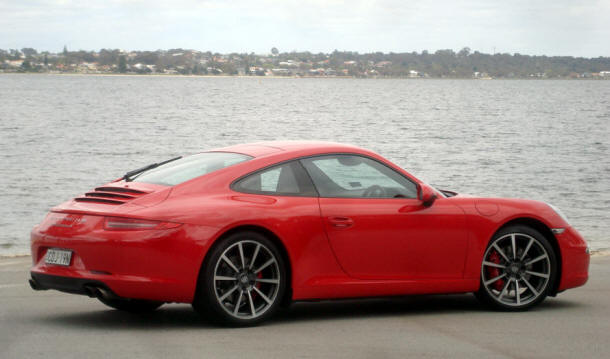
Handling could be ‘entertaining’ if you think snap lift-off oversteer taking you tail-first into the bushes is fun. But it did give a driver a heightened sense of achievement for getting it right. And they could be a potent performer with their magical air-cooled, flat 6 in the back. Brakes were always really strong though there was no feel whatsoever to the brake pedal.
But did any of that stop anyone buying a 911? The purists may think not – because they can overlook such things, but the reality is that lots of people found the compromises too much. Many a first time 911 driver simply found it a challenge to move away from being parked. It may have been a convenient way to ensure the wife never drove your Porsche, but it did limit sales.
While they look closely related, today’s 991 series of 911 couldn’t be further away from all that. Through the generations Porsche have grown the cockpit and the latest iteration benefits from the wheelbase being extended by the proximity of the front wheels being moved forward. The cabin feels noticeably wider too which is welcome. There’s no sign of the ergonomic nightmare of years long past either.
The interior is a vast step forward on the last 997 generation too. Gone is the flat centre console, gone are the cheap plastic steering wheel toggles for shifting the PDK gears. Closely related to the Panamera interior, it’s very stylish inside even without the plethora of ‘design’ options.
There are six instruments in the overlapping dials, plus an additional screen among the gauges which can show everything from phone details to tyre pressures to the Sat Nav map. The tacho sits centrally.
Outside, there’s no doubt of its heritage. 911 distilled to a new, sleeker, soother form. Moving the front wheels and windscreen forward make a huge difference. Any hint of stubbiness and too much front overhang that previous models have had is now gone. There’s a touch of the old 928 at the rounded back - and the elongated tail lights are very elegant. A slight crease from the sides of the roof down past the miniscule engine lid is a nice styling detail. It’s a very well resolved styling exercise.
So we’ve established it’s a good looking car and you can get properly comfortable in it. What you really want to know is how it drives…
Start the car with the Porsche-shaped key and it gives you a little rev from the back, with the very familiar Porsche flat-six sound. The dual-clutch PDK car I drove can be driven just like any automatic car. In automatic mode it takes off very smoothly, accelerates crisply through the gears and responds very nicely. Stand on the accelerator and whenever the tacho needle gets to 4000 the 991 comes into its own. The engine note deepens and changes from a growl to a roar and the rich power comes on with a rush. Quite an intoxicating rush... The factory says 0-100km/h takes 4.4 seconds – but if you shell out for the optional Sport Plus pack, that tumbles to 4.1 seconds.
The 7-speed PDK sometimes spends a couple of seconds shuffling the cards as you come to a halt in traffic, but not as obtrusively as in some cars with similar systems. The gearshift itself is brilliant. Quick and smooth, with additional features like kickdown to first gear for real action, then after eight-seconds, reversion to full auto mode. The engine has seen some upgrades for the 991. The Carrera S’s 3.8-litre unit now redlines 900rpm higher at 7400 – and it pulls really strongly all the way after 4000rpm.
It always feels well planted, corners very flatly and the brakes are confidence inspiring (plus there’s the carbon brake option for those who want to do the odd track day or mountain pass). There have been rumblings of complaint from some testers about the electric steering. I didn’t find any issues with it. It’s quite light, but communicative, and if you consider that the weight at the back is far more than other cars you might drive, I had no complaints.
On coarse chip roads, which the Australian countryside seems to favour, there’s quite a bit of road noise – enough that my 7-year old son commented. The 20-inch wheels look great, the low profile tyres work well beyond any limit I got near, and it’s a great idea that the front tyres have an extended ridge to protect the rims from errant kerbs.
The ride is very acceptable for a sports car of this calibre. And I think the extended wheelbase has helped diminish the pitching and bobbing front end that older 911s suffer from at times.
There’s an electric parking brake, switch to the right under the dash, which may annoy drivers of manual gearchange 991s (which are expected to be just 10% of Aussie 991 buyers), but again, I found no problem with it in a PDK car.
What I found took some acclimatisation was the gear selection switches on the steering wheel. They operate differently to how other car makers sets theirs up, which took some concentration to grow accustomed to. Both switches operate forward and backward to select gears up and down, rather than one side for each operation. Interestingly the optional paddles operate left up, right down as on other brands of car. Personally I’m not a fan of wheel-mounted gear selection with switches or paddles – I think they should be static on the steering column, not turning with the wheel.
Complaints? Precious few. I need to be able to glance at a clock without having to scroll through anything. There’s, still precious little small item storage space inside, but it’s an improvement. And someone thought it would be a good idea to put illogical sunroof controls in the console, rather than up by the sunroof itself. And the front indicator lights protrude at the most vulnerable places on the front bumper. All small issues, which the next facelift version will no doubt address.
 VITAL STATISTICS
Engine type: 6-cylinder, 3.8-litre
Power:
294kW
Torque: 440Nm
Transmission:
7-speed PDK as tested
Performance: 0-100km/h
4.4 seconds
Price:
$269,050 at time of writing
Text
& photo
- Paul Blank (copyright)
BMW 520d Wagon - Tested
Here’s a car which hardly anyone in Australia will buy. And that’s a real shame, because it is seriously good.
Why won’t Aussies buy the latest 5-Series Wagon? Because as a nation we are completely blinded by the need to own 4-wheel-drives... So anyone wanting a BMW wagon will be magnetised to one of the three sizes offered in the X range. Most likely a potential 5-series wagon buyer will home in on an X5.
Not that there’s much to criticise about an X5, but do you really need to sit a metre above other car drivers? And will you ever use the off-road capabilities of the X5. And this is important folks, 4WDs don’t have more room inside – the floor is higher as well as the roof…
Really, the on road dynamics of the lower 5-series wagon are vastly superior, and not just because of the lower centre of gravity. It’s also an automotive generation newer than the X5, and at this level, that’s significant.
The latest version of BMW’s long running and immensely successful 5-series range (which began way back in 1974) takes some good steps forward in many areas. First, it is restyled completely and while it isn’t an advanced design, it does away with the aggressive and not entirely attractive look of the previous generation.
It’s a very balanced looking car, which is no doubt helped by the short front overhang and far-forward front axle line compared to many other brands.
From the 1970s the interior of 5-series was always a modern, well-equipped and ergonomically well thought-out place. Inside, the new model follows the latest corporate look with attractive dashboard styling which exaggerates the width of the cabin. It’s a very comfortable environment. The front seats are properly supportive and nicely adjustable. Often wagons have very compromised rear seats, where comfort makes way for folding ability and limited space, but in the BMW they’re still absolutely acceptable.
Boot space is good – and not compromised by too sloping a rear window like the smaller 3-Series wagon.
The model tested was fitted with a 2-litre, 4-cylinder turbodiesel engine. Small, you might think, for a big, heavy car (it weighs in at 1715kg). But BMW has long been a master of developing extremely good diesel engines, and this unit is no exception. Aside from its great smoothness, the great attribute of this engine is the plentiful torque – 380Nm of it. And that translates to an easy car to drive around town or in the country, even when fully loaded – which can be pretty important in a wagon.
I drove this car in Europe and cruising at 200km/h on Autobahns, the car sat smooth and safe and stable. A little wind noise from around the window frames was really the only clue that the car was doing twice the speed limit in some states of Australia.
Hustle it around some bends and it responds like an expensive, well-bred car ought to. Responsive and confidence-inspiring with lovely feel to the steering. Top value for money and definitely better than a tall 4WD…
VITAL STATISTICS
Engine type: 4-cylinder, 2-litre turbodiesel
Power: 135kW
Torque: 380Nm
Transmission: 8-speed automatic
Performance: 0-100km/h 8.3 seconds
Price: $89,900 at time of writing
Text & photo - Paul Blank (copyright)
Renault Twizy - Review
Make no mistake: This is a world-changing car.
I’ve never before been convinced that electric cars are the future. Or that they even have much more than a short term future. For all the pressure the Greenies and Governments put on car makers, for the most part electric cars have hardly advanced in 100 years. They can either go fast for a brief time or slowly for a longer time. They’re too heavy and need slow recharges. Battery life deteriorates, ranges are poor and normal petrol cars converted to electric innards are an inefficient compromise.
Hybrids are a short-term solution to the fossil fuel problem. And in many cases, like in Australia, electric cars are not zero emission – they just move the emissions and fuel usage from the car to the power station. Australians buy big cars in case they need to move the whole family. We buy huge four wheel drives in case we have to visit the centre of Australia. We’re simply not going to buy cars which have a 100km range and where a small electric car costs more than a Landcrusier.

Electric cars should be used by government utilities where they only need to do a limited distance each day and can be plugged in at night when their drivers have gone home. Or private buyers who want to have a small car as a city runabout… And the price needs to be reasonable. Almost $50,000 for a Mitsubishi MiEV is ludicrous, no matter how good the car is. And none of the others offer any kind of value for money.
Well Renault seems to have cracked it. They’re launching a whole range of electric cars and the most convincing of the lot is the little Twizy. What an incredibly well thought-out design! At last – an electric car that makes sense.
This is the sort of unusual design and uber-clever thinking that you only see in products made by tiny companies where the owner is on drugs – the banks aren’t interested and after the launch you never hear of them again. But to see one of the major players come up with such an exceptional car, so different to anything anyone else makes is totally commendable.
So what is the Twizy? It’s the next step up from a scooter. It isn’t meant to be all things to all people. It’s not a mum’s wagon and it’s not an executive express. It is strictly a city car, strictly a 2-seater and completely funky.
A strong steel-tube skeleton with plastic panels, which provides a much higher level of occupant safety than a scooter, the Twizy operates like a car, not a scooter. There is a steering wheel (with airbag), seatbelts, four wheels and a low centre of gravity. The two seats are tandem style, with a proper driving position up front and a decently supportive seat in a reasonable amount of space behind. If you opt for the all glass roof, the rear passenger has no need to fear claustrophobia.
The door are optional too. They have no side windows and the lower section is transparent, also helping alleviate any claustrophobic feelings. The lightweight doors swing up from the front (yeah, like a Lamborghini) so if you’re in a narrow space there’s no problems getting in or out. No side windows means no fogging and demisting issues. Keeping the Twizy’s weight low was one of the design targets.
Two electric power units are available. The base car fits into the ‘Sans Permit’ category with just 4kW, it can be driven by 16 year olds without a license, and old ladies who are too scared to try to get a license, like the myriad of other little plastic buzz-boxes you see around France, Italy and Spain. It’s capable of only 45km/h.
But the big seller will be the ‘proper’ 16kW model, able to reach 80km/h. 0-45km/h time is 6.1 seconds. It’s not fast, but it isn’t meant to be a sports car. Weighing just 473kg (less for the 45), the all-round disc brakes don’t have too much work to do.
Starting at €6,990 and up to €8,490 for a loaded model they’re keenly priced. There’s a 3-year unlimited kilometre warranty. The batteries you lease for a few euros a month (depending on the distance you drive), which helps keep the cost down, but also Renault guarantees that if it won’t hold more than a 70% charge, they’ll replace the battery pack at no charge (sorry…).
Renault says it takes a usefully short 3½ hours to fully charge a Twizy, good for 100km of driving.
It’s just 1381mm wide, so can fit in spaces Smart owners wish they could get into. Inside, it’s surprisingly comfortable. The dashboard is very car-like, with a small electronic instrument panel ahead of the car-like steering wheel. The seat adjustment is fore and aft slide-only, but I did not find it hard to get a good driving position. The seat must be slid forward for an adult to get in the back – small kids can squeeze through without moving the seat.
The rear seat fits a full sized adult – I’m 6-feet tall and fitted well with another 6-footer sitting in the front. The back seat passenger sits knees-out and the view ahead isn’t good, but you’re close to the view at the sides – and as I mentioned earlier, a glass roof helps a lot.
The interior is fairly plasticky, by necessity – it has to be weather-proof. But it’s not all horrible plastics, and there are lots of colour and finish options to keep you away from too much grey. The same on the outside, where colour inserts on the doors, in the roof and for the main body offer some relief. There are two decently big gloveboxes and a good storage area under the rear seat, all lockable, but there’s no boot per se. Not even a back window…
There’s a broad range of options, including a choice of colours of alloy wheels, leg covers, interesting exterior graphics, a child’s seat and even painted dashboard sections.
Car designers aim to have three ‘surprise and delight’ features in a new car – they may be clever storage areas, electronic gimmicks (like self parallel parking) or tricky lighting. The Twizy is a surprise and delight feature itself. An exceptionally well-conceived design brought to reality without the usual diluting of a design which cautious big car makers suffer from.
Will it catch on? I certainly hope so. It’s a clever design, aimed at a specific target market and is sensibly priced. It should become a world beater in the scheme of electric cars – which so far have been nowhere near as popular with private buyers as makers and governments around the world had hoped. In 2012 the Twizy was the biggest selling electric vehicle in Europe.
It’s different enough that other makers won’t copy it for a few years unless it’s a major success.
As for Australia, the Twizy will probably be to frighteningly different for the law-makers to allow to be marketed here. And if, by lucky chance it ever does come, hopefully its chances won’t be ruined in the way Mercedes-Benz Australia spoilt the Smart’s chances by marketing it as an overpriced luxury toy. But I suppose with the hopelessly misguided Nissan Australia making decisions about Renaults in Australia, we’ve got virtually no chance.
It’s been a long time coming… an electric car from a major car manufacturer that isn’t a compromise, and that makes sense. The Twizy has converted me.
VITAL STATISTICS
Engine type: Electric
Power:
16kW
Torque: 57Nm
Performance: 0-45km/h
6.1 seconds
Price:
€6,990, sadly not offered in Australia
Text
& photo
- Paul Blank (copyright)
Volkswagen up! - Tested
The heading above is the last time I’ll write the name the way Volkswagen wants us to. So for now, it’s the Up. And it’s a car I approached with some uncertainty. As a completely new small model, I thought Volkswagen had missed a big opportunity to make the car look funky – like a Smart or Fiat 500. It looks a bit bland and the early ideas like a rear engine and other unusual engineering solutions had disappeared by the time it became a production reality.
Volkswagen has offered smaller cars than the Polo in Europe for years and most of them have been pretty dull really. But there’s been a game-changing car for VW to aim at in this tiddlers category. With a model shared by Peugeot (as the 107), Citroen (C1) and Toyota (Aygo), the tiny car market was turned on its head a few years ago. The joint effort small car was designed to be manufactured with all kinds of cost-cutting measures. And now we have the Volkswagen group’s answer, using many of the same design and construction techniques. And they have Skoda and Seat versions of the Up too.
Even on the 4-door version the rear side windows only flip open, don’t wind down. Just like the French/Japanese trio. Similarly, the rear window and tailgate are one piece of glass. There’s no soft-touch plastic inside and the headrests are built into the seat, in the old tombstone style. And its windows seem to have the thinnest glass I’ve ever seen on a car. There are no controls on the steering wheel (which I quite like). But that said, it does have a couple of cup holders and decent storage spaces inside.
Oddly, there are only air vents on the outer ends of the dash with a central dash-top vent which blows air generally into the cabin too. And there’s a single power window button on each front door, rather than having a master switches on the driver’s door. Surely central dash-mounted buttons would have made more sense – but would have cost a few euro-cents more.
Does it feel cheap? No, not really. OK, it doesn’t feel premium or luxury car like, but the buyer of such a car isn’t looking for or expecting that. They want practicality, quality of build, economy and ease of use. All of which it has in spades.
Built alongside Porsche Cayennes and Audi Q7s in Volkswagen’s Slovakian factory, you can expect the quality of build to be good – and it clearly is. There are no buzzes and rattles and it all seems properly bolted together and has a decently solid feel on the road.
In fact, even if you throw it around a bit through the corners, its composure is remarkably good for a bottom of the barrel car. The little 14-inch wheels and economy tyres acquit themselves well, without instant understeer that some cheap littlies suffer from. The standard power steering has excellent feel at all speeds. The ride is good – harder to achieve in a lighter a car is – though within limits...
The new 1-litre 3-cylinder engine is a corker. Sure it runs out of puff when the car’s loaded and heading up a steep hill, but it is only a litre in capacity. It thrums like an early Suzuki 4WD or an old Charade, but it’s actually quite smooth and has remarkable flexibility – just what’s needed in an economy car. Somehow it encourages spirited driving…
And the brakes are very impressively good.
Volkswagen has specified the equipment level of the Up quite well for Australia. A laser-activated automatic low-speed braking system is standard – typically something fitted to much more expensive cars. Ideal for girls who insist on texting while driving…
There’s power steering, the steering wheel is height, but not reach adjustable and the driver’s seat has height adjustment. It’s air conditioned and has a (relatively) decent sized boot with an adjustable floor.
For $500, there’s the optional dash-top screen which brings sat nav, extra instrument graphics (tacho, temp gauge), economy readouts, bluetooth for your phone and other gadgets. Excellent value and any Up buyer would be crazy not to take this option.
Looking at downsides… it comes only as a 5-speed manual, which will rule out some potential buyers. There are only two rear seatbelts, which while it’s a small car, limits the number of children who might otherwise easily fit. Surely this is an oversight that the importers must fix.
It’s fun to drive, cleverly packaged, economical and built like a Golf… For $13,990 for the 2-door and $1000 more for the extra back doors, the Up offers pretty convincing value for money. Every time I drove it for the review week, it put a smile on my face. And for that, the Up gets a big tick.
VITAL STATISTICS
Engine type: 3-cylinder 1-litre
Power: 55kW
Torque: 95Nm
Transmission: 5-speed manual
Performance: 0-100km/h 13.2 seconds
Price: $13,990 at time of writing
Text & photo - Paul Blank (copyright)Hyundai Veloster & Veloster SR Turbo - Tested
There seems to be a renewed interest from manufacturers - luckily for buyers - in sporty cars. Hyundai has never really had a sporty model in their range (their old mid-size coupes may have been sporty looking but were not actually sporty to drive), so their first serious attempt is interesting.It's an interesting car in several ways. Design-wise, it is interesting for its layout. On the driver's side it has one long door. On the passenger side, a shorter door with a rear door fitted in behind. Quirky, yes. More practical than a 2-door car, but not as hatchbacky as a 5-door. Probably quite a clever marketing idea. The styling is interesting too. A gaping grille at the front helps it look like some kind of fish you'd only find at the greatest depths of the Pacific Ocean. It's even bigger on the SR Turbo model. The sides are dominated by vast wheelarch flares. While at the back it's clear there was free crack for the styling team at Hyundai's studio. What a mess. You'd describe the car's styling as edgy, but not coherent.
There may be more headroom provided than some low-roof coupes, but your noggin has the sun beating down on it - and the roof-lining is at very close proximity to your forehead. My 7-year old son found the space in the back fine and thought the extra door with hidden doorhandle was a great novelty.
The interior is comfortable, without the sometimes intrusive seat side bolsters some sporty cars have. There's a lot of hard plastic in the construction, but it's commensurate with the car's price. The Turbo model tested had an excellent, logical and simple to use Sat Nav system with the 7-inch LCD touch-screen. And remember Hyundai is the first to offer free annual upgrades - an idea which everyone will have to copy. The headlights are excellent. The 6-speed gearbox, like all the controls, is light and easy to use.
The Veloster + version, for $2000 over the base model gains an electric driver's seat, leather/leatherette trim combo, a panoramic glass roof, upgraded instruments, push-button start (looks cool) and heated door mirrors. The neat glass sunroof with electric retracting internal sunshade works well, except at higher speeds when it gets quite noisy.
Two power plants are available. One for girls, one for boys. The naturally aspirated Veloster is completely devoid of any performance. You can guess who that's for. Dramatic looks, inside and out, big alloy wheels, low slung aggressive styling - backed up for the traffic lights Grand Prix by.... absolutely nothing. It seems the girls don't mind, because they've been marching out the door at twice the rate Hyundai expected. Obviously it hits a certain nail on the head. This model, by the way, idles so amazingly quietly and smoothly you'd think it has start-stop technology (which it doesn't).
For the rest of the population, the SR Turbo has recently joined the Veloster range. With 125kW under the fake-vented bonnet it makes for a much better all-round car. This one has the goods to back up its looks. Acceleration off the line isn't as strong as you might expect from a relatively light car with 200 horsepower, but mid range it's really strong. It's commendably lag-free.
Maybe it was the tyre pressures on the test car, but at freeway speeds the steering felt quite woolly and slightly detached. Body-roll is very well controlled and high quality Sachs shockabsorbers have been specified for the Australian market cars.
The Turbo gets even more in your face styling with more exaggerated accoutrements either end. Stylish alloy wheels with chrome blades on the spokes look great. Special colours are offered on the Turbo, including a matt-grey finish that must be hand-washed only and 'Marmalade': a chameleon of flip-flop colour that changes hue when viewed from different angles, however it will only be available for a six-month period. Certainly the car gets plenty of looks from the public.
The Veloster is not going to woo anyone from the Toyota 86 waiting list, but for those who are not looking for an out and out sports car, the Veloster makes an interesting alternative at an attractive price - and people seem to really like it.
VITAL STATISTICS
Engine type: 4-cylinder 1.6-litre non-turbo / turbo
Power: 103kW / 150kW
Torque: 166Nm / 265Nm
Transmission: 6-speed manual (auto optional)
Performance: 0-100km/h Non-turbo: clock still ticking / Turbo: 8 seconds
Price: $23,990 / $31,990 at time of writing
Text & photo - Paul Blank (copyright)Peugeot 4008 - Tested
Here's Peugeot's most cynical-ever model. That said, it's a decent car.While more and more car makers are sharing parts and whole cars with each-other - and it's nothing new - the Peugeot Group has been strengthening it's alignment with Mitsubishi. Peugeot and Citroen have been parts of the same company for decades, and both of the French makes are offering models manufactured entirely by Mitsubishi in Japan. The little Mitsubishi MiEV electruc car can be bought in Europe as a Peugeot or Citroen. For Australia, we have two models. First we saw the Peugeot 4007 which is Mitsubishi's very competent Outlander, styled to look more Peugeot-ey and featuring the French company's excellent turbodiesel engine.
Now the 4008 has been launched, based on the smaller Mitsubishi ASX. In this case, it's just the styling at either end and the badges which are different. It must be said though, that the 4008 looks far smarter and more upmarket than the dour-looking ASX. Both (and the Citroen version) share the Outlander floorpan (heavily Lancer-based itself) which means they're all decent little SUVs. Each has a variety of standard fitments which helps place them slightly differently in the marketplace. Or maybe it will just confuse everyone.
Peugeot offers the 4008 in Active or more luxurious Allure versions. I drove both and they drive as well as eachother. The Automatic transmission in the Allure seemed to suite the car better - though some people find CVT transmissions seem odd with their constant revs as speeds rise. The Allure is only available in auto with all-wheel-drive, whereas 2WD and 4WD manual or auto can be chosen in the Active.
For an additional $3500 you can option up the Allure with 18-inch alloy wheels and leather trim - both very nice but like in any other car, won't make a zack of difference to your resale price. For comparison, the Citroen C4 Aircross is a couple of grand more, but comes with CVT auto and 18-inch wheels standard. The Mitsubishi ASX is cheaper than both - but doesn't have quite the spec or the cache of the French versions.
Probably the most annoying element, which many small SUVs suffer from, is the very small boot space. At least there's a full-size spare wheel robbing you of a lot of space in the 4008 though. And I suppose if you need boot space, you'll get a bigger car. Space inefficiency seems to be the hallmark of Japanese SUVs.
The cabin is nicely fitted out and well finished. Unlike the 4007, the indicator stalk is not changed over to the other side like on European cars. There's a standard fitment rear view camera - with a small screen in the rear view mirror or if you opt for Sat Nav, on the 7-inch screen. The perforated leather trim is very nice and adds a much more luxurious feel than the cloth trim options.
The 4008 drives pretty much like an ASX. No surprise there. That makes it among the better vehicles in its class. The 2-litre petrol engine is willing enough, but nothing remarkable. Now if they offered it with the brilliant Peugeot turbodiesel engine that the 4007 boasts, even at a higher price, it would be a real winner.
VITAL STATISTICS
Engine type: 4-cylinder 2-litre petrol
Power: 110kW
Torque: 197Nm
Transmission: 5-speed manual or 6-speed CVT
Performance: 0-100km/h 10.2 seconds
Price: $28,990-$38,490 at time of writing
Text & photo - Paul Blank (copyright)Skoda Yeti 103TDI DSG - Tested
This is a car which has received very good reviews in the press in Europe and Australia. It's a completely new model, so it was good to take the diesel version out for a week's test in the everyday kinds of use that Yetis are most likely to face. That meant taking it on the school run, packing a baby and all the necessary accoutrements as well. Realistically, the strongest segment of buyers will be young families.It's a bit hard to place the Yeti against other cars in the marketplace. Perhaps the Kia Soul or Toyota Rukus are its competitors. Or maybe the yawn-inducing options of Honda CRV or Subaru Forrester? The Yeti sits within quite compact dimensions, unlike the CRV or a RAV4.
Looking at the list of competitors the Yeti faces, there's only one other European vehicle - the Volkswagen Tiguan, from the same family as the Yeti. And how many of the others are neat, smart designs rather than just fodder? The Yeti whilst not a screaming bargain, is very well priced.
It's styling is funky, up to the minute and not as derivative as some. Can anyone remember what a Honda CRV looks like? Even my friend who is the most critical of off-beat styling and detests 4WDs thought the Yeti was a good looking thing. The rear is quite vertical making the most of the boot space - which tells the story of the remarkably space efficient interior layout. The Yeti has Skoda's clever VarioFlex seating system with a 3-piece rear seat is a practical feature and helps allow a myriad of layouts for carrying combinations of passengers and payload.
How it drives is the little Skoda's ace card. Even with a diesel engine with DSG (automated manual) transmission it's a remarkably sporty little thing - not what you expect, and a very pleasant surprise. You can find yourself punting it around the back streets at night in a way you just wouldn't even think of in a Vitara or Rukus. And the headlights are excellent...
It's propelled by a 103kW 2-litre turbodiesel from the Volkswagen group's stable - the same unit as used in the slightly pricier, heavier Tiguan. The Yeti boasts a Haldex clutch, which sends power to whichever end of the car needs it most, depending on road conditions. On the bitumen, it's basically a front-wheel drive, but up to 90 per cent of the power can be seamlessly diverted to the rear wheels when necessary. I didn't venture off road with it, but by all reports, it's very capable.
I also had opportunities to drive the petrol engine variants of the Yeti, which in both small and larger engine versions were also very good, I think the turbodiesel is the pick of the bunch.
The whole car feels well built - and by Skoda's recent reputation it should be almost bullet-proof. The finishes inside and out are above average. Altogether a very good, complete, clever and competent package which shames some of its mediocre competition. I'm pleased to see it's catching on, because it's a very deserving car.
VITAL STATISTICS
Engine type: 4-cylinder 2-litre turbodiesel
Power: 103kW
Torque: 320Nm
Transmission: 6-speed DSG
Performance: 0-100km/h 10.8 seconds
Price: $35,690 at time of writing
Text & photo - Paul Blank (copyright)Audi A6 2-litre TFSI - Tested
Audi has moved their big A6 into a more affordable price bracket with the introduction of a 2-litre turbo version of the model. At first it might seem like there's a lot of car for a 2-litre 4-cylinder engine to lug around, but like so many of the VW-Audi group of engines, this TFSI unit is quite exceptional and performs well beyond expectation. It's front wheel drive and can do the 0-100km/h sprint in a not unreasonable 8.3 seconds.
The transmission is a multitronic CVT with 8 ratios and a sports mode, but paddles are a relatively low cost option. The A6 2-litre has stop-start technology, which is becoming very familiar in new European cars. It restarts quickly and smoothly. It was hot weather when we had the car so the air conditioning was usually on, which mostly kept the stop-start inoperative.
Inside, it's Audi quality through and through, though the LED dots for a fuel gauge seemed a little cheap. The car rides very nicely even when the road surfaces leave a little to be desired and it isolates outside noise very well, helping ensure the A6 has a luxury car feel. The boot is usefully spacious too.
It's pretty well equipped even in standard form and doesn't feel like a stripped out model.
Downsides? Only a few. First and most stand-out for me is the rear seat. For a big, luxurious sedan, I found the rear seat is simply inadequate. Far too little under-leg support which meant I found it impossible to find a comfortable seating position. Though that said, one rear seat passenger, without being asked, commented how comfortable she thought the back seats were... Then there's the styling - it looks chic and well balanced, with tasteful detailing - but is it special enough against its competition? Does it look different enough from an A4? I know this is a problem that Audi is looking at, that too many of their cars look the same, just in different sizes, hard to distinguish unless you really know what you're looking at.
With a saving of about $16,000 over the next (2.8-litre) A6 model, the 2-litre brings the A6 to a swag of new buyers. Comparing it to the equivalent BMW and Mercedes-Benz offerings also makes the Audi seem very attractively priced. Audi is also offering a 2-litre diesel A6, with similar performance for an extra $1000, which is excellent value too.
VITAL STATISTICS
Engine type: 4-cylinder 2-litre turbo
Power: 132kW
Torque: 320Nm
Transmission: 8-speed CVT
Performance: 0-100km/h 8.3 seconds
Price: $77,900 at time of writing
Text - Paul Blank (copyright)
Audi A1 TFSI Sport -
Tested
Here's the Audi that has the Mini Cooper S
directly lined up in its cross-hairs. The Sport takes the already very
competent A1 to a completely new level. It's not a cheap Cooper S
alternative like its sibling the Volkswagen Polo GTI might be, and
starting at $42,500 needs to be a pretty compelling package to get
buyers over the line.
First up, it needs to be properly fun to drive. And it certainly achieves this objective. The punchy 1.4-litre motor boasts a supercharger and a turbocharger to ensure there's power throughout the rev range. In this clever unit the supercharger works to provide low-end torque, while the turbocharger takes care of business high in the rev range. 136kW is put to the ground via a 7-speed twin-clutch automated manual gearbox - sophisticated, smooth changing and well suited to the nature of the engine. Drive it as a normal automatic and it goes well enough. Select S mode and the car's character changes instantly to a gnarling, sporty bull at a gate. It hangs onto the gears, lets the driver get the best out of the revs and allows for very pleasurable back street racing. Of course I didn't try this... The $200 option of paddle shifters would be a no-brainer option, however the test car wasn't fitted with these.
When pushing hard the A1 takes a little
getting used to. Especially in S mode, it's too eager to spin the front
wheels and make the driver look like a hoon. It baulks a little off the
mark sometimes which is disconcerting. Then there's the feeling that it
will understeer too much, which fortunately it doesn't. With a little
practice and reducing the ham fistedness (footedness?) of my driving it
became a pleasure to punt around. And it's very fast. Turn in is sharp,
there's little body roll (it's quite stiffly sprung) and the brakes are
confidence-inspiring.
It's a chic looking little package, inside and out. Very Audi styling (at least it's not a different sized photocopy which their sedans seem to be) and it's well recognizable by people who know their upmarket brands. There are some very nice details in some areas, such as the headlights and the arch over the pillars - especially when (expensively) optioned in silver paint. The S line body kit includes deeper, more aggressively styled bumpers, a roof spoiler at the back and rear diffuser. Inside the A1 is class leading both in design and finish. The quality isn't up there with say their big A6, but for the class it's superior. Unlike the overtly styled (and some say tasteless) interior of the Mini, the A1 is classy and well laid out. The big multimedia screen is a plus too. The sporty front seats hug occupants well and the rear seats, well, they're fine for short journeys or short passengers.
There's not much boot space, but it's no worse than any other car in the class.
So the A1 offers itself as a credible opponent to the Mini - it's not a tarted up cheap car, but has a chic style and wears an upmarket badge which gives it street cred that's backed up by proper performance and quality. If you like the idea of a Mini but can't bear the cartoon-like characteristics of it, then here's a car which might be just what you're looking for.
VITAL STATISTICS
Engine type: 4-cylinder 1.4-litre turbo and supercharged
Power:
136kW
Torque: 250Nm
Transmission:
7-speed automated manual
Performance: 0-100km/h 6.9 seconds
Price: $42,500 at time of writing
Text
- Paul Blank (copyright)
Hyundai i40 Tourer Elite - Tested
The i40 Tourer tackles a fresh sector of the market for Hyundai. I think the plethora of SUVs and 4WD wagons has depleted the market of traditional wagons, so I was pleased to see another wagon enter the market. Rather than just adding a wagon back to an existing model, Hyundai has chosen to initially make the i40 Tourer a stand-alone model. Of course it shares many components with other Hyundais, and that’s not a bad thing.
Stylistically it’s not bad at all. Sleek and modern looking the car received quite a few positive comments in the time I had it. A couple of lines aren’t quite right (the back edge of the rear side windows for example), but overall it has a classy appearance.
And this carries over to the car’s interior, which is highly stylised. I’m not enamoured by the form-before-function centre console though. Sure, it looks dramatic, but the layout of the switches seems to have been left to wherever space remained after the stylists had finished.
On the down side: I can’t understand why there is a musical production which plays on entering and leaving the car. For some reason somebody at Hyundai has overdone the chimes with a nine-note rendition from under the dashboard on entering and exiting the car.
In real criticisms, while the headlights have turning lights and a neat, curved row of LEDs in them, the high beam has very poor projection, bad enough to limit speed at night when travelling in the country.
How does it drive? Very nicely. It doesn’t have the feel of an Audi or a Volvo, but if you’re moving out of a Corolla that’s a few years old, you’ll be impressed. The ride and handling seem to be among Hyundai’s better recent efforts. The engine, in the diesel I drove, was willing, had a small sweet spot where the turbo was spinning just right and torque could be enjoyed - and the transmission was excellent. There were little paddles for gear changing, but they really don’t suit the characteristics of the car’s powertrain – and an i40 buyer doesn’t need to pretend he or she is Mark Webber.
There are three different trim levels, the highest of which, Premium is extremely well kitted out, but expensive at $46,490 (diesel). The mid-range Elite version I tested still had a good level of equipment and was a little lower priced at $41,490 – which nevertheless isn’t cheap. i40s start at $32,490, so obviously Hyundai is trying to market it as a premium car.
So where does it fit in the marketplace? Ecven it's place within the expansive Hyundai range can be a bit confusing. VW‘s updated Passat wagons range from $40,990 to $45,990 (the V6 is more). The attractive Mazda6 wagon starts at $35,950 and Volvo’s little V50 wagon sits in the mid to low $40s. Maybe Ford’s excellent but larger Mondeo wagon at $32-48K or even Peugeot’s new 508 Touring starting a smidge over $42K would be considerations. Whichever way, it will take a change in mind set about Hyundais for before some buyers even look at the i40. But it does deserve consideration.
VITAL STATISTICS
Engine: 4-cylinder 1.7-litre turbo diesel
Transmission: 6-speed automatic
Power: 100kW
Torque: 320Nm
0-100kmh:
Price: $36,490
Text copyright Paul Blank
Skoda Fabia Monte Carlo - Tested
The Volkswagen group's new kid on the block in Australia - Skoda - is actually the oldest marque in the group's many brands. While the company and its products have been through some ups and downs over the decades, the current range is impressive for its design and build quality. And Australians are gradually starting to wake up to the value for money message which Skoda encapsulates so effectively.The recently released Fabia is now in its second generation in Europe. With the local Skoda importers aiming to have the company's full range here, the little Fabia is a welcome addition. It's based on the VW Polo - and that's no bad thing. So far, Skoda only offers the manual gearbox and the 77TSI 1.2-litre with a little turbo as a standard car and the up-spec Monte Carlo version. Automatic and the ball-tearing RS are coming later...
If you know much about modern Skodas, you'll be familiar with the way their products offer pretty much the same as their Volkswagen counterparts but with more equipment and at a lower price. The same goes for the Fabia.
A Volkswagen Polo lurking underneath is a fine car, and the suspension tuning to suit the Skoda is outstanding - the handling and comfort balance is commendable. The engine pulls well beyond the expectations of a 1197cc - and it does good service in the Polo and Golf. The gearchange is good to use and suits the slightly sporty nature of the Fabia.
The Monte Carlo benefits from stylish black 16-inch alloy wheels, really excellent sports seats, sports pedals, a body kit, metallic black roof and body highlights and Monte Carlo badges. The lights and grille are also blacked-out. There's no performance differences in the Monte Carlo spec. It costs an extra $3K, and aside from the better seats, is pretty much aesthetics. That said, it does make it a chic little car - taking the Monte Carlo way beyond the Japanese and Korean fodder, but still below the cost of a Mini Cooper, Fiat 500 or Polo GTi.
Is it any good? Absolutely. There's no doubting the build quality. The equipment levels are competitive and it's something a bit unusual - all pluses. Minuses? Nothing major except that some people still equate Skoda with their awful period in the 1970s...
VITAL STATISTICS
Engine type: 4-cylinder 1.2-litre turbo
Power: 77kW
Torque: 175Nm
Transmission: 5-speed manual
Performance: 0-100km/h 8.9 seconds
Price: $21,990 at time of writing
Text & photo - Paul Blank (copyright)Peugeot 508 GT - Tested
There’s good news at Peugeot – they have taken a quantum leap with their new 508 range. The build quality, driving experience and value are vastly improved. Not that there was a great deal to criticise in the outgoing model, but it was pretty unlikely that a Volkswagen, Audi or Volvo buyer would have been impressed enough to buy one. But that’s changed.Comparing the quality of build and finish – bodywork, interior, boot and minor details, there’s nothing in it between the 508 and its natural competitors. Outside, the paint is deep and rich, the panel fit is exceptional (as are the commendably narrow panel gaps) and the fit of items such as bumpers and lights leaves nothing to be desired. A good clue to a car’s quality.
The way the thick lower section of the bootlid fits flush with the bumper makes a welcome change to the scooped out section almost every other car has… The short rear guards, sectioned by the tail-lights and bumper is unusual close-up, but from a distance helps give the car a cohesive shape. At the front, the aggressive nose got lots of positive comments during our week with the 508GT. Peugeot has made great strides in dropping their tongue hanging out of the mouth look…
Overall the shape could be described as sleek if a little plain, but at least it won’t ever be accused of being ugly like its predecessor. And the details, such as the lights and wheels are attractive. It has a longer wheelbase than the 407 before it, but a shorter overall length.
Really though, it’s inside where the car really impresses. The quality of fit and the finishes used – as well as the very neat, carefully considered design – really impress. This could be the interior of an Audi. Every surface and control feels good to touch, the styling is excellent and the quality of construction is immediately evident. It all works very nicely – with the sole exception of a lack of cubby holes. There’s nowhere on the console to hold a mobile phone…
The seats are also pretty special. Long seat bases, good adjustability, decent rear space and nicely-trimmed leather upholstery all add up to help make the interior a very pleasant environment. The back seats flips down to make a flat loading space.
Another nice detail inside is the dark lenses on the interior lights, each of which is very smartly designed – and bound to be quickly copied by other car makers.
The 508 GT is the range-topping model, and unusually, especially for a performance model, it’s a diesel. While this may have some people thinking twice, it does make good sense. When you consider that over half the new car sales in Western Europe are diesels these days, and in larger cars, economy is also important, and Peugeot has some very effective turbodiesel engines, why not?
How does it drive? Well, the torque is the key. And there’s plenty at just about anywhere in the rev range and available at any speed. The 2.2-litre HDi engine boasts 450Nm which comfortably gives the car performance of 0-100km/h in 8.2 seconds. The 6-speed automatic transmission is a sweet to operate unit. This package gives superior performance and economy to the previous 2.7-litre V6 which was so admired in the 407.
The GT also benefits from suspension upgrade details like aluminium dual wishbone front end design.
The 508 GTs equipment level also impresses – keyless entry and go, colour head-up display, auto wipers and lights, 18-inch alloy wheels, quad-zone air conditioning, electric park brake and a multi-function steering wheel.
The GT also features a sensor behind the interior mirror which takes in various parameters and assists with the car’s adaptive lighting to maximise light output.
Some of the options are pretty well-priced. Just $500 gets you 19-inch alloy wheels (over the GTs standard 18-inches) and satellite navigation with head-up display is only an additional $1500.
And in the value for money stakes, the 508 stacks up well. The 508 starts at $35,990 for the 1.6 turbo. The GT reviewed here is $52,990 compares favourably with Volkswagen’s newly updated sporty petrol Passat V6 FSI (at $55,990), Alfa Romeo’s 159 Ti 1750 TBi (priced from $54,480), the Volvo S60 D5 (at $51,950) or Audi A4 2.0 TDi ($55,400).
If you haven’t driven a Peugeot for years, I’d recommend taking one of these out on the road – you’ll be impressed.
VITAL STATISTICS
Engine type: 4-cylinder 2.2-litre turbodiesel
Power: 150kW
Torque: 450Nm
Transmission: 6-speed automatic
Performance: 0-100km/h 7.2 seconds
Price: $52,990 at time of writing
Text & photo - Paul Blank (copyright)Hyundai Accent Premium - Tested
If you follow the line of family history of the new Accent, it will take you directly back to the original Hyundai cars which came to our shores way back in 1986. Back then, these Excels were honest little cars, followed by the model which really popularised the brand, the huge-selling Excel of 1993-2000. These were pretty awful things but the price was low and sales were vast, with 200,000 sold here.Fast forward, following the replacement models to today and you have a very different kettle of Korean fish. We tested the Accent Premium, which is the top of the line model, fitted with goodies that old Excel owners couldn’t have even dreamed of.
There’s a small screen for the reversing camera built into the rear-view mirror. Decently supportive seats smartly trimmed in perforated partial-leather - plus leather steering wheel… There are smart 16-inch diameter alloy wheels. There’s keyless entry and go. None of this is what the old small Hyundais were about.
So you really have to think differently when evaluating this car. Priced against excellent cars like the Ford Fiesta and the slightly larger Mazda 3 the Accent compares favourably.
It shares some under-pinnings with its sister-car the Kia Rio, which is probably its most effective challenger in the marketplace.
The boasts a twin-camshaft 1.6-litre engine and 5-speed manual or 4-speed automatic transmission, is no bad thing as all are fine units though the transmissions have fewer ratios than some more up to date cars. The engine puts out a decent 91kW, utilising direct injection and variable valve timing. The performance produced is more than acceptable for a 1600. At 1560kg it’s not a lightweight like small Hyundais of old. The Accent is not exactly sporty, but that’s not the purpose of this model.
The automatic transmission fitted to the car we tested performed well, with smooth changes and eager kickdown.
If there’s an area to criticise, it’s the steering – much too light and devoid of feeling. While this might be fine for old ladies parking, on the road it’s just too vague and uncomfortably disconnected feeling. It leaves the driver feeling like they don't fully have control.
Inside, the Accent is high class. The finishes and somewhat dramatic sculptured design are good in my books. It’s not as boring inside as some of its competition (Volkswagen could learn something here). There’s good room for two six-footers to sit one behind the other, though leg support in the back is almost non-existent for taller people.
Outside, the styling doesn’t excite me much – it’s definitely modern looking, but doesn’t have the stylistic harmony which some other models of Hyundai enjoy these days.
Is it a good car? Undoubtedly. Would you buy it for your Mum? Yes, unless she’s been used to a BMW. It’s safe, well-equipped, nicely made but not a car to get excited by. The more basically fitted out Accent range starts at $16,990, underscoring Hyundai’s long held value for money message.
VITAL STATISTICS
Engine type: 4-cylinder 1.6-litre
Power: 91kW
Torque: 156Nm
Transmission: 5-speed manual or 4-speed automatic
Performance: 0-100km/h 9.0 seconds
Price: $20,490 at time of writing
Text - Paul Blank (copyright)Volkswagen Amarok Ultimate - Tested
It’s not often that a major car maker branches out into a new category where other makers have dominated – and I’m not talking about the obscure niches which certain manufacturers seem to be creating.In the medium to large pickup category the Japanese makers have owned the market for years - in particular Toyota, with their Hilux.
In the month prior to when I tested Volkswagen’s new entrant to the sector, the Hilux was the biggest selling vehicle in Western Australia – by far – almost doubling the sales of the next best seller, the Commodore. And in the USA, pickups have long outsold passenger cars as best sellers month to month.
So the Amarok goes up against the Hilux, Nissan Navara and Mitsubishi’s sleek (for a pickup) Triton. Pricing is competitive and equipment levels on the Volkswagen are slightly higher than the competition.
The Volkswagen has a 2-litre twin-turbo diesel engine. That’s a litre smaller than the Toyota powerplant, but produces virtually the same power and almost twenty percent more torque – and that’s where the difference is counted. The towing capacity for the Amarok is class-leading. Advantage Volkswagen.
It’s a rattly-sounding diesel, not one of the company’s best from an aural standpoint, but it feels strong and provides decent economy. The two turbos work in sequence, ensuring that there are no peaks and troughs in performance.
A clever suspension design is part of the reason the Amarok provides a superior driving experience – almost car-like. The 6-speed gearbox has a decent feel to the gearchange and the steering gives the driver confidence that the Amarok is in touch with the road – something which is a little lacking in the competition…
It’s slightly larger all round than the Hilux, which will probably work in the Amarok’s favour. Space inside the cabin benefits from almost 200mm extra width. The rear seats offer decent support and there’s sufficient space for five six-footers to sit comfortably. The rear seatback isn’t too vertical like some of the opposition. And it doesn’t suffer from the floor being too high compared to the seats, which blights the enjoyment of so many compromised designs.
Some of the hardware inside is familiar – such as the instrument cluster and climate controls – but sharing these with Volkswagen road cars is no bad thing. Overall fit and finish inside is up to Volkswagen’s usual high standard . We tested the Ultimate, fitted out with leather interior, big alloy wheels and a range of other goodies to set it more upmarket.
The opposition offers more commercial vehicle style products – where the finish and the drive are significantly inferior to the Amarok. The only thing against the VW at this stage is that the automatic transmission model isn’t available yet, but it is coming.
If ever a new contender is set to shake up a category, this is it – and deservedly so. If you're thinking about a vehicle in this category, do your self a favour and test drive the Volkswagen rather than heading to your Toyota dealer in default setting.
PS: I've recently tested the new addition to the Amarok range - with automatic transmission, which is sure to only increase the appeal of a class leading vehicle.
VITAL STATISTICS
Engine type: 4-cylinder 2-litre turbo diesel
Power: 120kW
Torque: 400Nm
Transmission: 6-speed manual (auto optional)
Performance: 0-100km/h 11.1 seconds
Price: $58,490 at time of writing
Text & Photo - Paul Blank (copyright)Lexus IS350 Sport Luxury - Tested
Lexus’ current IS shape has been with us a while now and the model has continued to evolve. Initially the 2.5 litre 6-cylinder was the only engine, and this was supplemented a little later by the monstrously quick and impressive IS-F, sporting the big V8 from the largest Lexus model – but that’s really a specialist model selling in tiny numbers.
Next came the convertible version of the IS250, which has received a mixed reception in Australia as a not-quite-anything car. It’s good, but not great.
The latest iteration is the addition of a bigger, 3.5-litre engine, along with a swag of minor upgrades across the IS range. What a difference. The IS350 is what the model should have been all along. It’s sure to bring a lot more buyers to the Lexus marque.
The lusty engine transforms the compact Lexus and allows the competence of the chassis to shine through. The IS250 was always seen as a poor choice in relation to a BMW 3-series, but the IS350 redresses the balance.
We tested the Sports Luxury version, which includes a set of upgrades including different suspension settings, low profile tyres on bigger, 18-inch alloy wheels (tastefully finished in a dark grey metallic, which often looks ungainly, but suits the Lexus well), a body kit which includes and aggressive looking a low front spoiler, body-hugging sports seats and a number of other decorative differences inside.
On the road, the nicest aspect of the IS350 is its performance. It’s not the in-your-face performance of the IS-F, but there’s always plenty of power on call to get you through traffic. When you want to push the car along a little more, it responds very well… The paddle shift actuated gearshifts work as they should in a sporty car, allowing the driver to take the car to the rev limiter, without the car shifting up by itself. All credit to Lexus for that.
In fact, when it’s being hustled along a bit is when the car is at its best – and quite rewarding.
While the tyres are very low profile and grip pretty well, they have a very road-car type of tread pattern and become quite noisy when cornering even when cornering moderately hard. I imagine that with a set of grippier rubber, there would be a big improvement to be enjoyed.
It took me a while to find a comfortable driving position, but the driving position offers a good range of adjustment (electric steering column adjustment, partial electric drivers’ seat) and the seats feature excellent side bolsters. Eventually I got it right and then after a couple of hours continuous behind the wheel I could climb out of the car feeling fine.
As a country cruiser the IS350 proved excellent, its easily accessible acceleration being a boon. But if you put your foot down it does like to drink fuel… But I suppose you pay for your pleasures.
It’s a bit limited on space for loose items in the cabin, with just a narrow console box and flip-out door pockets in addition to the glovebox, Rear seat accommodation is moderate, but acceptable, and the boot space is quite alright. Unlike with the comparative compact models of BMW, Mercedes-Benz and Audi, there’s no wagon version of the IS on offer.
So how does the IS350 stack up against its main competition? Starting at $64,800 to $81,300 for the range topping version as tested, its pricing sits a little lower then the opposition. There’s no doubting it is a good drive, is very nicely built and well equipped… as are the German trio it’s up against. Then it probably comes down to the question of how important the brand name is to a buyer.
VITAL STATISTICS
Engine type: 6-cylinder 3456cc
Power: 233kW
Torque: 378Nm
Transmission: 6-speed automatic
Performance: 0-100km/h 7.1 seconds
Price: $81,300 at time of writing
Text - Paul Blank (copyright)
Mercedes-Benz ML350 CDI -
Tested
Mercedes-Benz has been making progress with
their strong selling ML range. The second shape of the US-built model
has been with us a few years now and has been the subject of some mild
tweaking. And the results help make the ML an even more enjoyable
machine.
The model tested was the sort-of mid-range ML350 CDI, with a 3-litre turbo-diesel engine which produces 165kW and an ample 510Nm of torque. The MLs now start with a 300CDI ($84,700), then the model tested at $91,340 (or $106K for a top spec 350 CDI).
Then there are two petrol engine version offered in Oz - the ML 350 (for virtually the same money as the 350 diesel) and the mighty AMG 6.3 with more mumbo than anyone could ever need, at $175,815.
The ML350 CDI certainly is an easy to
live with car. They are pretty comprehensively equipped in terms of
luxury appointments. The example tested was kitted out with a nice
selection of options too, including very attractive 21-inch AMG wheels,
glass sunroof, Distronic, electric lumbar support and dubious running
boards. I found the running boards just got in my way, though I
understand how many buyers find them useful.
The AMG undertrays front and rear with their blocky-looking styling and matt-chrome finish suit the ML well and come in a package which includes an AMG chrome tailpipe.
The car had height-adjustable suspension which also boasts comfort and sport mode shockabsorbers. In either setting the comfort level of the ride is good. The ML always feels well planted on the road, and occupants never get that feeling of teetering that some tall vehicles suffer from. Maybe that's helped by the chunky wheel and tyre combination, which properly fill the wheelarches.
We went for a country drive which a good many MLs seem to do. The first strong impression that was even on coarse bitumen and at country sorts of speeds, the ML remained very quiet inside. It took some jiggering around of the seat and steering wheel adjustments, but after six hours behind the wheel in one day, at the end, I was very pleased that I felt no discomfort.
The engine pulls very well, the torque making overtaking on country roads quite an easy proposition. Flick the left hand paddle a twice to drop back a couple of gears and it's ready to pounce. The shifts are smooth and seamless at any speed.However it's in town where the biggest bugbear becomes apparent. Taking off from being stopped isn't the ML350CDI's strongpoint. Even if you stand on the go-fast pedal, there's a considerable delay before there's any action. It's a heavy car and the turbos aren't working when it's stopped. You get used to it, but it's frustrating nonetheless. As soon as you've (eventually) got rolling, there's plenty of performance though.
And if I'm being critical, I don't understand why Mercedes-Benz sets their multifunction indicator stalk so low down, stopping a driver's hands adopting the 10-to-2 driving position... Making room for the cruise control stalk above it can't be reason enough for this.
The space in the rear is good and the boot is amply big enough. If you need more seats or more space, of course there's the bigger GL-Class on offer. But the ML is a pretty well-rounded package and once you've found the powerplant and option mix that suits you, it's a machine you would be assured of getting a lot of satisfaction from.
VITAL STATISTICS
Engine type:
6-cylinder 3-litre turbo diesel
Power:
165kW
Torque:
510Nm
Transmission:
7-speed
automatic
Performance: 0-100km/h 8.6 seconds
Price:
$91,340 at time of writing
Text & Photo - Paul Blank (copyright)
Volvo S60 T6 - Tested
If this car didn't wear a Volvo badge or you could test-drive it blind-folded, it would get rave reviews from any driver. It certainly deserves them. What a great package.
There were a few fears that once Ford had let Volvo go to new Chinese owners Geely that new products would take a nosedive in many areas. Not so.
OK it looks like an aardvark - long nose, high tail. The wagon's not so extreme... It isn't unattractive though, and some of the styling detailing is quite good. Importantly, it further distances the Volvo look from even the more recent Volvo looks, which haven't universally been winners.
The turbocharged 5-cylinder engine is a gem. It's the heart of what makes the T6 such a brilliant car. I also drove the D5 turbodiesel, and while it's engine is perfectly adequate, it takes away so much of the sharpness which makes the T6 such a success. The T6 engine offers instant, strong performance anywhere in the speed range. And it's a very rewarding car to fang around. Couldn't say that about many Volvos in the past, except certain special versions...
0-100km/h in 6.2 seconds is a result of a 3.0-litre, double-overhead cam 6-cylinder, turbocharged petrol engine. Output for this powerplant is 224kW and it gives very decent torque of 440Nm. The power is transmitted via a 6-speed automatic (with manual selection only via the gear lever) and the truly excellent traction is supplied by an electronic all-wheel drive system. It's not an M3, but it's a fraction of the money.
The build quality, finish, detailing and quietness are all features at least as good as well-respected German rivals. And that's saying something.
I didn't like some of the interior finishes, but that's more a matter of taste. The layout of the controls (even to details like Volvo's almost iconic climate control buttons) is exemplary. Straightforward to understand and use. The seats are excellent, though rear headroom is compromised for taller passengers by the sloping roofline.
The car tested had the optional Driver Support Package, which includes a blind spot warning system, driver alertness monitoring system, park assist, adaptive cruise control, and pedestrian detection with full automatic braking (which I didn't test). I doubt I'd take this option if I was ordering an S60 - I found the warnings just a bit too annoying.
However, it is a thoroughly enjoyable experience to drive this car. It's not pretentious, but is high quality. It's well equipped and is clearly well made. And good value to boot. I'm pleased to report that it was one of the few cars I've tested lately that I could own and genuinely expect to enjoy long term.
VITAL STATISTICS
Engine type: 6-cylinder 3-litre turbo
Power: 224kW
Torque: 440Nm
Transmission: 6-speed automatic
Performance: 0-100km/h 6.2 seconds
Price: $64,950 at time of writing
Text & Photo - Paul Blank (copyright)
Mercedes-Benz E 250 CDI -
Tested
The latest E-Class is an
extremely competent car, encompassing all the latest technological
features that Mercedes-Benz has. The car boasts a fine chassis, mixing
sporty handling and excellent roadholding with a comfortable ride. The
body feels taught and the fit and finish in all areas, are of high,
Mercedes-Benz quality. The comfort and convenience features rate highly.
But how do you choose which model to buy?
There's a pretty big range offered in Australia – and more still in
other markets. To start at the bottom (which is actually a pretty high
starting point), in the Petrol range – it begins with the 250CGI (with a
high-tech turbocharged 1.8-litre, 4-cylinder), then the E350 (3.5-litre
V6), followed up by the E500, with a strong 5.5-litre V8 and ultimately
the stupendous E63 AMG (386kW 6.2-litre V8).
 Then
there are the diesel variants – E220 and E250, both with 4-cylinder
2.1-litre turbodiesels with differing power outputs (the 250 has 100Nm
of extra torque), and the E350 CDi, with a 3-litre six-cylinder
turbodiesel.
Then
there are the diesel variants – E220 and E250, both with 4-cylinder
2.1-litre turbodiesels with differing power outputs (the 250 has 100Nm
of extra torque), and the E350 CDi, with a 3-litre six-cylinder
turbodiesel.
Then there are the four E-Class body styles – sedan, wagon, coupe and
cabriolet, plus different trim levels… And an extensive options list.
At $98,400 the 250 CDI Elegance I tested recently offers a very complete
car. It has the turbodiesel 2.1-litre engine, mated to a 5-speed
automatic transmission. More powerful and with cleaner emissions while
using less fuel than previous models, the engine is remarkable for its
smoothness and flexibility – with an impressive 500Nm of torque being a
big help. The 150kW (204bhp) engine offers plenty of low-down grunt,
with an unusual deep thrumming noise – and none of the old fashioned
diesel clatter.
The styling is always a matter of taste, and while I find some of the
detailing a little fussy (like the nose), overall it's a very balanced
shape – and the interior design is excellent, emphasising the spacious
cabin with lots of horizontal shapes. Fortunately the car doesn't have
the bland overtly rounded shape that many new cars share – it's quite a
sharp looking thing.
Equipment? It's a comprehensively fitted out car, with the sorts of
luxury and features you expect at that price point. But what the E-Class
offers above its competitors is an extremely high level of safety items
designed into the car. It's all there in the background ready to save
you if necessary – probably the biggest clue to how clever are these
many features, is how the seatbelts briefly pull gently against you
after clipping in, as they measure your height and weight to work
optimally.
Criticisms? Very few – it's a well thought out car. The navigation
system struggled a few times, thinking we were driving through parks or
on incorrect roads – but many systems do this. The buttons to release
the centre console storage box lids are hidden and not ergonomically
located. But if that's all I can find criticise, then it's a remarkably
well executed design.
Would I have one? The answer is resoundingly YES. The E-Class is a very
easy car to live with. It's quiet and comfortable, isn't too large and
even with the 250 CDI engine, it has performance aplenty. And it's
beautifully built. But then I'd be tempted by a wagon… and a 6.2 litre
AMG V8 engine would be pretty appealing… Whichever way you go with a new
E-Class you won't be disappointed.
VITAL STATISTICS
Engine type:
4-cylinder 2.1-litre turbo diesel
Power:
150kW
Torque:
500Nm
Transmission:
5-speed
automatic with two modes
Performance: 0-100km/h
7.2 seconds
Price:
$98,400 at time of writing
Text & Photo - Paul Blank (copyright)
Audi A1 - Tested
It is interesting that other makers have taken a while to tune into the success of the modern Mini and tried to either emulate or squeeze into the same sector of the market. There are two proper alternatives now being offered to buyers. While there are other excellent high performance small cars, a hot hatch (Golf GTi, etc) does not have the same cachet of quality and chic design that the Mini has. Now buyers can add the (not entirely convincing) Citroen DS3 and Audi's latest, the A1.
How does the littlest Audi shape up? Well, the starting point is the car it's based on - the exceptional new VW Polo (reviewed below). Add more luxurious fittings, higher equipment levels and plenty of Audi style and the result couldn't turn out bad...
The basics are: Sneaking in under $30,000 is the 1.4 TFSI, in 6-speed manual form. Optional is a 7-speed S-tronic automated dual-clutch unit with paddle shifters, at $2350. At 1040kg the 1.4 lovely turbo shared with many other VW group models is as sweet as ever, giving lively performance. Good economy is aided by a (switchable) engine stop-start system which turns the car off when you halt. Audi claims 5.3 l/100km.
There's a lot of fun to be had with the A1's handling and roadholding - as you'd expect of a car with the competent Mini in its sights. It's a properly 'chuckable' little car which can leave a considerable smile on your dial at the end of an enthusiastic run. The steering is electro-hydraulic and provides good feedback without being too light. The upcoming big performance model should be unbeatable.
Attraction and Ambition were the two trim level options at the launch, and a sporty S-Line followed soon after.
The body styling is very Audi, but somehow looks punchier in the taught, compact dimensions of the A1 than on larger Audis. While the silver roof rails aren't entirely original, they look very good, especially on dark colours. The test car we drove got positive attention and comments wherever it went.
Inside, the A1 is a little plain compared to a Mini, but that's a relief as I find the Mini interior too extreme. Colour options allow those who want to the ability to jazz up the A1 interior. It's all Audi quality, which means it's right up there for fit and finish, and you'll appreciate the careful consideration in the design and materials choice. The boot isn't especially capacious, but flipping the seats creates a decent volume.
If there was an area of criticism it would be the amount of road noise on coarse surfaces, which isn't up to luxury car standards.
Nevertheless, the team at Audi have come up with a very credible little car, one which is a fantastic package and offers a real alternative to larger performance luxury cars. I'm sure the A1 will be a big success - as it absolutely deserves. Whether or not you believe that good things come in small packages, the A1 won't disappoint.
VITAL STATISTICS
Engine type: 1.4-litre turbo
Power: 90kW at 5000rpm
Torque: 200Nm at 1500rpm
Transmission: 6-speed manual
Performance: 0-100km/h 8.9 seconds
Price: $29,900 at time of writing
Text & Photo - Paul Blank (copyright)Rolls-Royce Ghost - Tested
It's a pretty momentous occasion when Rolls-Royce launches a new model. And after the Phantom, a completely new car out of a completely new factory form a completely new company (BMW effectively bought just the name...) of ten years ago, the Ghost caters for an altogether new market segment. Whilst the vast Phantom is really in limousine territory - except for the Coupe and Convertible versions, the new 4-door Ghost is a whole size smaller.
That means it's just very big. The size of a big Bentley or a long wheelbase Mercedes-Benz S-Class. I had the good fortune to drive one for a day, through the beautiful West Sussex region in England. Having been driven to the factory in a Phantom - and I've driven several of them - the Ghost is positively more usable. Whilst it is unquestionably a large car, it's the model for an owner-driver, not for a chauffeur. The more compact dimensions add a usefulness and sporting feel - relatively.
That said, it doesn't miss out on anything. In fact the new twin-turbocharged high-tech 6.5-litre V12 engine gives exceptional performance for a car twice the weight of a Hippopotamus. Zero-100km/h in 4.7 seconds. That's impressive! And with such vast reserves of torque, the acceleration is always available and comes completely easily. The 8-speed automatic transmission handles thing in an exemplary manner - you couldn't ask for a better transmission.
The Ghost sits very nicely on the road, with brilliant isolation from irregularities on the road surface. The vast tyres offer plenty of grip in tighter cornering or wafting around fast bends.
The seats offer a rare level of comfort – but it is a Rolls-Royce... Passengers in the back are offered space and comfort outshone by very few cars. Although the Ghost is the 'little Rolls-Royce' it still offers huge rear space. The seat is set back from the door aperture – unlike most cars where the wheelarch intrudes and passengers' shoulders are against the door itself. The rear hinged doors make access a doddle and a button on the rear pillar lets the door shut electrically negating the need to reach forward to pull it shut manually. Beautiful.
The rear seat passengers have a controller in the fold-down armrest and folding tray tables set into the front seatbacks also feature large screens – about the size on a laptop. The back is certainly a place in which anyone would feel pretty special.
Up front, it's at least as good. There are the same beautiful finishes and colours and details throughout. The readout below the instruments showing the date, mileage and other details are lit in a stylish font. The double width screen in the centre of the dashboard is remarkable too.
The wide screen not only shows the navigation map and the many programmes for controls, but has a remarkable new system for parking. In addition to the view from the rear parking camera, there's a helicopter view of the surroundings – displayed simultaneously on either side of the screen. Using cameras and a clever computer programme, it shows live what's around the car's sides and rear, plus shows the car's trajectory based on steering angle. Amazing.
The interior of the Ghost is an inspiring place to be. Even aside from the technology and features, the shapes, textures and colours work beautifully making a very special environment.If there's anything I'd criticise it's the huge door mirrors, the size of which apparently complies with EU regulations, but block far too much outward view. Aside from that the Ghost is most certainly a beautiful car to drive, for its comfort, for the attention to detail in its design and fit-out and for the driving characteristics of the machine itself.
As the spiritual successor to revered classic Silver Shadow and the Silver Spirit of the '80s, there can be no doubt that the Ghost will be a success.VITAL STATISTICS
Engine type: 6592 cc V12 twin turbo
Power: 420kW at 5250rpm
Torque: 780Nm at 1500rpm
Transmission: 8-speed automatic
Performance: 0-100km/h 4.7 seconds
Price: $695,000 at time of writing
Text & Photo - Paul Blank (copyright)Peugeot RCZ 2.0 HDi - Tested
The RCZ moves Peugeot into an altogether new market segment - one which only a handful of makers have any offerings. The chic sporty car sector. The most obvious competitor to the dramatic RCZ is the Audi TT, but buyers are likely to also consider a fully loaded Mini Cooper S, BMW 135 Coupe or even a Nissan 350Z. Perhaps a second hand Porsche Cayman...
Peugeot has a fine history, but it doesn't include sports cars. So the RCZ takes the French marque into uncharted territory. Its design is a bit limited by the mechanical components available - the company doesn't have a gutsy V6 or a rip-snorting turbo four at hand. However they can make a sexy looking car and give it great handling, braking and roadholding. So that's what they've done.
Aesthetically the RCZ divided people who looked over it while I had the test cars. Generally the scales of opinion tipped in its favour. Certainly the dramatic rear and unusually sculpted roof and rear window glass gained positive remarks, however the nose of the car, with its unsophisticated graphic didn't gain much approval. I understand that Peugeot has finally worked out that their range's tongue hanging out of the mouth and Bride of Wildenstein eyes headlights do not make for a winning look and intend to fix it...
There are plenty of very tasteful details in the design - for example the lovely polished alloy look rails which run up from the bottom of the A-pillar to the bottom of the C-pillar. It all adds up to a car which certainly grabs attention and from some angles has the look of a mini-supercar.
Inside, it's pretty compromised - but that's what you've got to expect in a car of its ilk. Cabin storage space is frustratingly limited, but the boot is usefully large. The finish is very good, and seems to be up to German car standards. Nice finishes and a good quality feel of solid construction... It's pretty comprehensively equipped too so there's little you'd need to look on the options list for. That said, the 19-inch alloys are pretty attractive items (to Peugeot's credit 18-inchers are standard). I found the seat bases too narrow, which seems unusual for a company whose cars are known for their comfort. Not just overtly sporty, just squeezy.
How does it drive? I tested two of the three versions offered in Australia - the 2-litre turbo-diesel and the 1.6-litre turbo petrol, which is the only version with automatic transmission. The third version is a manual, turbo petrol, but 2-litres. Interestingly all versions sell for the same price here. Both RCZs had plenty of performance without risking being termed high performance cars. The torquey diesel gave one of the least diesely feeling performances I'd experienced lately. And while I'd had my doubts about the 1.6 automatic, the gearing in the 6-speed box suits the car extremely well and the little turbo works very smoothly, so it impressed more than I'd expected. Obviously the petrol 2.0 turbo is the performance model. All are Euro 5 compliant for emissions.
It's great for us Aussies that the importers are bringing the RCZs to Australia. They may only sell in small numbers - as would any car in its class, but could be a great halo model to benefit the rest of the Peugeot range. It will probably mainly sell on looks alone, but there's a depth of character and quality evident in the RCZ which will make living with the compromises of such a car acceptable. With a little hesitation, it gets the thumbs up.
VITAL STATISTICS - Details for 2.0 HDi
Engine type: 1997cc 4-cylinder turbo diesel
Power: 120kW
Torque: 340Nm
Transmission: 6-speed manual
Performance: 0-100km/h 8.2 seconds
Price: $61,500 at time of review
Text & Photo - Paul Blank (copyright)Citroen C3 VT - Tested
The small Citroen C3 turned out to be a bit of a surprise packet for its Australian importers, selling in quite decent numbers - by local standards for the marque. Late 2010 saw the launch of a new model, which is certain to capitalise on the strengths of the original C3.
The cute styling remains, but the latest version has a bit more of a sophisticated look without giving up the cues which made the model a sales winner. Citroen is making a big deal about the panoramic windscreen on some models, in which the glass continues uninterrupted into the roof above the front seats - and they should make a fuss about it, as it makes the car a pretty special place to be. Internal sliding blinds and visors help when it's too hot or glarey. It makes a great point of differentiation in the marketplace.
Regardless of which version of the new C3, the interior is a good place to be. Citroen have obviously been learning about interior quality and the benefits it has in impressing users - as well, no doubt, about longevity. The dashboard layout is quite sophisticated for a car in the C3s category, even on the basic models. The front seats are decently supportive, though the rear seat is a little flat. During several day long drives on Autobahns and Autoroutes in Europe, comfort levels proved fine.
Though performance in the 1.4-litre petrol version I tested didn't quite live up to the rest of the car. It seriously ran out of breath at about the top legal speed there - 130km/h - but almost everyone drives faster than that. The little C3 could go faster, but it was a struggle... The 1.4 is the base model in Australia, and all other versions have considerably more power and torque on offer. Both 1.6-litre petrol and diesel C3s are marketed alongside the 1.4.
On the road the car sits nicely at speed, though the new electric power steering doesn't the provide the greatest feel - but then the C3 isn't meant to be a performance car.
Even the entry-level VT we drove is well equipped and includes an MP3-compatible radio/CD player with steering wheel-mounted controls, air conditioning, electrically-adjustable door mirrors, front electric windows and a multi-function on-board trip computer. Nothing to complain about, especially given it's almost $4000 cheaper than the previous base model C3...
Starting at $19,990 - up against the Volkswagen Polo and Peugeot 207, the C3 will have a pretty good chance of continuing its success in Australia.
VITAL STATISTICS
Engine type: 1360cc 4-cylinder
Power: 54kW
Torque: 118Nm
Transmission: 5-speed manual
Performance: 0-100km/h 14.2 seconds, gasp
Price: $19,990 at time of review
Text & Photo - Paul Blank (copyright)
Skoda Superb125TDI Wagon - Tested
Occasionally a car comes my way which, after I've finished testing it, I think I could happily own. And Skoda's Superb Wagon is one such car. I was really impressed last year by the V6 4WD Superb sedan, so a 2-litre turbodiesel, two-wheel-drive would have a lot to stand up to.
It's not a light car - mainly because it's quite large. How would a 4-cylinder diesel stack up propelling this car around. Fine, is the answer. The deeply impressive engine is shared by many models in the Volkswagen family and it excels in all applications. It's smooth, quiet and has ample grunt - even in this big wagon. Sure, it's not a supercar, but there's plenty enough acceleration available to feel properly sporty - and I wasn't expecting that. The braking, steering and roadholding are similarly good.
The DSG transmission - also shared widely in the Volkswagen group - is also widely acclaimed and whether left in 'auto' mode or shifted via the paddles, operates extremely well. No complaints there.
But a wagon has a specific role to fulfil - as a people and load carrier. You may know that the Superb sedan sits on an extraordinarily long wheelbase, giving limousine-like rear legroom (no, I'm not exaggerating), and the wagon benefits from this. It may not be quite as wide inside as a Commodore wagon, but it's at least as spacious. The boot is decked out with clever storage features unique to Skoda.
Then there's the question of equipment levels. This, tied in to pricing, is sometimes the difference between a car being competitive in the marketplace or not. Heated seats front AND rear. Airbags galore. Automatic parallel parking. Automatic wipers and lights. Cooled glovebox. Pirelli tyres on 16-inch alloy wheels. There's plenty there.
Then there's Skoda's quality. Sure, some people remember Skodas of old, but these modern cars rate extremely highly. In European and English quality surveys, Skoda outranks both Volkswagen and Audi products - and nobody can claim they're no good.
Unlike the slightly gawky shape of the Superb sedan, the wagon shape sits very comfortably on the long wheelbase. It's an attractive, well balanced machine.
How does it compare to its opposition? A Commodore Sportswagon with the 'economical' 3-litre SIDI engine... a second faster to 100km/h, a lot thirstier (9.2 l/100km as opposed to Skoda's 6.6 l/100km), the Holden has 65kW more, but 60Nm less. Prices - almost on par, to Holden's advantage but the Skoda is better equipped and undeniably better made. And nothing depreciates faster than a Commodore (except a Falcon...). Check Skoda's depreciation levels - the Superb rates better than most cars on the market.
Above and below the model tested, Skoda offers 1.8-litre turbo petrol and the 3.6-litre V6 and all-wheel drive models of the Wagon. The Volkswagen Passat Wagon, Ford Mondeo Wagon and Mazda 6 Wagon, all good cars, less spacious and in a generally similar price range don't add up to as good a car as the Superb, which really is a superb package. The real shame is that hardly anyone will buy one...
Postscript: I was so impressed I bought a Superb V6 wagon...
VITAL STATISTICS
Engine type: 2-litre 4-cylinder turbo diesel
Power: 125kW
Torque: 350Nm
Transmission: 6-speed DSG
Performance: 0-100km/h 8.9 seconds
Price: $43,990 at time of review
Text & Photo - Paul Blank (copyright)Peugeot 3008 2.0 HDi XTE - Tested
In a completely new market sector for Peugeot, it's interesting that the first impression I got of driving off in the 3008 was one of its high quality.
The door shuts nicely (it's a minor but telling thing), and the fit and finish - as well as the styling - of the interior is far better than expected. It's tastefully designed, and nicely finished, with more than a few features to keep you interested. The elevated driving position is complimented by a high centre console, with a grab-handle set on the passenger's side of the gear selector. A neat row of toggle switches sits at the top of the console - a bit reminiscent of new Minis without the gimmickiness.
The chrome surround to the instruments and air vents as well as a few other chrome highlights throughout the cabin work very effectively in adding to the luxurious feel. In the best French car tradition, the seats are very comfortable. The wonderful full-length glass roof helps make the the cabin feel spacious and was enjoyed especially on the wintry days of our test.
The styling may be a bit ungainly at the front - a range-wide problem for Peugeot which apparently has a fix on the way, but overall the shape is sleek for a crossover vehicle, accentuated by the vast, steeply raked windscreen.
There's a really solid feel to the drive. It's that feeling of quality again. It's not heftiness, but proper build quality. Some people doubt the French can ever meet German quality of construction, but if a car was going to be knocking on the door, this is it.
Our test car was the larger diesel engine version - with Euro5 level of emissions (which means it's cleaner than just about anything else on the road. At 120kW and 340Nm of torque, it gets along nicely, as mated to the 6-speed automatic transmission. It's not fast, but that's generally not what the buyer of a car like this is looking for. The ample torque means that even if it's loaded with a full family and all the gear they might take on a holiday, it will still pull well up hills on country roads.
There are a load of goodies to please every user, from secret cubby holes in the rear floor (under the floor mat) to the impressive head-up display (all cars should have this feature), it's well thought out. Other features include a vast cooled compartment between the seats, a removable, rechargeable torch in the boot, rear side sunblinds, distance alert, hill-hold and one-touch rear seat folding from the boot.
18-inch alloy wheels mean a tyre inflation kit, whereas the 17-inch wheel clad 3008s come with a full size steel spare wheel. A clever optional grip control system will be available soon as a concession to those who might occasionally want some off-road or poor surface capability.
The 3008 is not pretending to be a 4WD vehicle, but offers a very good alternative for people who want the size and elevated driving position but recognize that they don't need to kid themselves about going bush in their family wagon... How nice there's a good option. 3008 models start at $39,690 and include petrol and a smaller diesel engine options. If you're in the market for something like this - do go and have a look - you might be very pleasantly surprised.
VITAL STATISTICS
Engine type: 1997cc 4-cylinder turbo-diesel
Power: 120kW
Torque: 340Nm
Transmission: 6-speed automatic
Price: From $47,490 at time of review
Text & photo - Paul Blank (copyright)Volkswagen Polo 77 TSi - Tested
The new Polo should be a threat to its bigger sibling the Golf. And the new Golf is an exceptionally good car. We tested the 77kW Polo 77 TSi and it showed it was a real winner as a small performance car. Though that's not really what the model is supposed to be. The Polo GTi is the hot hatch in the Polo family.
There's no doubting the all-new Polo makes an excellent compact car around town, but what really surprises - in the most pleasing way - is what a great car it is to fang around in. The delivery of power with the little turbocharger assisting the 1.2-litre motor along is excellent. There are no flat spots and it doesn't run out of puff. The gearchange is easy and encourages a bit of enthusiastic playing - as does the whole car.
Even though the suspension setup and 15-inch wheels shod with Continental tyres more suited to everyday driving, the combination acquits itself remarkably well when you're pushing hard. There is so much fun engineered into the chassis of this little car... It just begs you to take it to a circuit and see how well it performs. Don't worry Mr Volkswagen Australia, I didn't. But I would have loved to!
As an everyday town car, the Polo also performs its duties very, very well. The quality of the construction is obvious - and something people expect from Volkswagen, but it doesn't suffer from being the entry-level model.
The driving position is fine, the seats supportive and controls leave nothing to be desired. OK, it's not luxurious, but not much is left out when you check the specs list. Power steer, climate control air conditioning, power windows, central locking, etc. There are 6 airbags, cruise control, hill holder and the expected electronic aids - EBD, ABS and traction control.
The rear seat is relatively comfortable, and while you can't fit three adults, it's no worse that the competition. The boot is usefully large for such a small car, even with a full-size spare tyre underneath, and of course it's expandable with the 60/40 rear seat flipping forward.
And for the first time for a Polo, it looks like a grown-up car. The very aggressive front styling, in the new Volkswagen corporate look, suits it very well. Visually, it's clearly a less sophisticated little brother of a Golf, but that's completely appropriate. One benefit of not being a Golf is that additional rear windows are fitted in the C-pillars, diminishing the blind spot that Golfs have had from day 1.
Overall, the package is quite exceptional. There are a variety of versions, none of which are the cheapest in their category, but all of which offer a superior package in all respects. Petrol and diesel versions are offered here. There's a 7-speed DSG version of the 77TSI in addition to the 6-speed manual we tested. No Polo buyer will be disappointed. And there deserves to be a lot of them.
VITAL STATISTICS
Engine type: 1197cc 4-cylinder turbocharged
Power: 77kW
Torque: 175Nm
Transmission: 6-speed manual as tested (see review)
Price: $19,850 at time of review
Text - Paul Blank (copyright)Maserati Quattroporte - Tested
Now in its fifth generation - each of which has owed nothing to previous models - Maserati's luxurious Quattroporte has met with unprecedented success.
There's little doubting that it's a beautiful piece of machinery, both aesthetically and technically. As the market has opened up in the Quattroporte's field, with Porsche's very competent but incredibly ugly Panamera and the incredibly svelte Aston Martin Rapide at the other extreme of styling, they tackle the older Italian head on. Whilst their prices vary, and the Maserati and Porsche come in several versions, they're aimed at the same lucky buyers.
The current Quattroporte has been such a success that it sells more annually than every previous model put together. Maserati has had time to refine the Quattroporte since its introduction in September 2003. The biggest change came in 2007 when the car was re-engineered to take proper ZF automatic transmission, having originally only had Ferrari-based rear-mounted gearbox with gearshift by steering column-mounted paddles. This necessitated major changes to the floorpan. But it was worthwhile given that most of the market for such cars really demands automatic transmission.
Upgraded engine specs have come with model changes, the hottest of which today provides 323kW - sufficient to propel the 2.4-tonne sedan to 100km/h in 5.1 seconds. The glorious sounding V8 engine is an absolute gem, especially from 4500rpm where the rich stream of power comes on strong. When pushing along this engine is clearly the heart of what makes this a great car. It really provides supercar performance and exciting acceleration. It's a rare pleasure to drive a car with so much performance - and handling and braking to match, that can comfortably seat four adults.
And very comfortably too... Luxury is what the Quattroporte is supposed to provide, and it excels here too. The standard equipment list, even on the 'base' model is impressive. And when spending $300-odd thousand, you'd expect it to be pretty comprehensively equipped... There's chilled drink holders, TV, electric assist boot opening and closing and even the front passenger seat can be electronically adjusted by the rear seat occupants. Options include a rear-seat entertainment system with TV screen, adjustable and heated rear seats, a fitted luggage set and a vast array of trim and colour options.
The recent update also sees subtle styling changes along with specification upgrades. A revised centre console layout is prime among the detail changes inside.
If you're in the league of buying a car of this nature, and a 2-door car just doesn't work for you - and the idea of an expensive SUV just doesn't cut it, the Quattroporte offers a pretty intoxicating package.
VITAL STATISTICS - Quattroporte/Quattroporte Sport GT S
Engine type: 4244cc/4691cc V8
Power: 295kW/323kW
Torque: 460/490Nm
Transmission: 6-speed automatic with paddles
Price: $296,000/339,000 at time of review
Text & photo - Paul Blank (copyright)Mitsubishi Outlander XLS - Tested
There are two breeds of SUVs. Those which are big, tough 4WD machines, Landcruisers, Pajeros, Patrols and their like. Not necessarily all that pleasant to use around town, but when taken off road, they excel. Then there are the more road-friendly machines. At one extreme Porsche Cayennes, BMW X5s and Range Rover Sports. But at the more accessible end of the market there's a proliferation of models to choose from where on-road is more important than off-road.
One of the nicer offerings in this category is Mitsubishi's Outlander. The popular model received an update a little while ago, bringing the front styling in line with the Lancer, which it shares some underpinnings with. And it looks pretty good. Interestingly Peugeot and Citroen have an arrangement with Mitsubishi where they take versions of the Outlander for certain markets with different front styling and engines.
We tested the XLS version. With the Luxury Option Pack, it's packed with all the luxury goodies Mitsubishi can throw at it - a fold down DVD player for rear passengers, 18-inch alloy wheels, glass sunroof, sat nav, a huge Rockford Fosgate sound system, and heated, powered, leather seats. It also has rain sensing wipers, auto headlights, and a reversing camera as well as a cool box and smart key. All in all, there's not much more you could want.
Mechanically, it features Mitsubishi's willing 2.4-litre four, mated (optionally) to a CVT transmission with 6 'modes' available by paddles or the console shifter. Unless you're new to CVT and the 'slipping clutch' sounds, the system works very well and is nicely suited to the engine's characteristics. Compared to its Pajero or Challenger siblings, the Outlander is positively sporty. It can even be fun to punt around a bit - something foreign to many similar offerings. Mitsubishi has done well with the Outlander, the mix of ability, equipment and drivability making a winning combination.
Cheaper versions and larger-engined V6 Outlanders are also offered.
VITAL STATISTICS
Engine type: 2359cc 4-cylinder
Power: 125kW
Torque: 226Nm
Transmission: 6-mode CVT automatic with paddles, or 5-speed manual
Price: $40,490 at time of review
Text & photo - Paul Blank (copyright)
Mercedes-Benz CLC 200K- Tested
This is the Evo Edition version of the long running small Mercedes coupe. That means, it's loaded with goodies including the panoramic glass sunroof, attractive 18-inch AMG alloy wheels with low-profile tyres and dark tinted 'privacy glass' at no extra cost. Which at $65,900 for the 2-litre supercharged coupe is a pretty attractive price.
The CLC began life an automotive generation ago with a different name and different styling at its extremities. As the Sportcoupe launched in 2001, it was based on the previous C-Class (nothing wrong with that) but as the C-Class changed completely, this car has been upgraded without benefiting from the wholesale changes that the completely new C-Class saw.
Certainly the update makes a far better looking car of it. The dynamic front end styling suits the pronounced wedge shape of the car better than in the earlier version. It's at the high back of the car where its biggest problem now lies. The earlier model had a small, secondary vertical window built in to the tailgate. With the update, this has been deleted, and while it may look sportier and more modern now, it means the CLC has appalling rear vision. You can't see much out of the raked rear window - the roof of a car a few car spaces behind, provided it's not a low sports car. And the poor view out the internal rear-view mirror, more than 50% of what you see is the interior of the car - and not much out the slot-like rear window. It makes lane-changing a risky proposition.
That criticism aside, it's a pretty likeable car. Inside is pure Mercedes-Benz, meaning well laid out controls, with logical operation, easily readable instruments and a good quality feel of solid construction. The front seats are a bit odd, in that the base is too flat and unsupportive of your thighs, but the backrests are beautifully formed and body hugging. The 2-tone upholstery materials in the car we drove was very nice too. It's of a material called Artico, which Mercedes-Benz describes as "man-made leather". Remember, that this company has a decades long history of making extremely good quality artificial upholstery materials. The rear seats, hard to get to for an adult as with any coupe, are adequately comfortable, and allow almost enough headroom for a 6-footer. The rear section of glass roof helps alleviate any feelings of claustrophobia.
There's a decent size boot, flip down split rear seats adding to the flexibility. Even the two-tiered glovebox is quite spacious.
On the road, be assured the CLC 200K is not a sports car. It handles well enough, the roadholding via the low-profile tyres is excellent, but the car just doesn't engender a feeling of sportiness - it doesn't make you want to throw it around a corner, do any late braking or rev the engine especially high... Performance from the engine is reasonably good - there's a rich stream of power there, but it's not a blast of acceleration. The 0-100km/h time of 8.7 seconds supports this.
The ratios of the 5-speed automatic transmission can be accessed by paddles mounted behind the steering wheel, but they give pretty slow response and really add nothing to the sporty nature of the car. Left in auto, the transmission changes smoothly and kicks down quickly enough.
Loaded with ABS, ESP and Brake Assist as well as a full suite of airbags the well-equipped CLC also boasts parking proximity detectors front and rear, automatic headlights, cruise control and a decent 'multi-media' system.
This car's natural enemy would be the BMW 332i Coupe, with similar power (the BM has 5kW more), torque (the Merc has 20Nm more) and performance, and while the BMW may be a bit more sporty, the Mercedes is a bit more chic - and significantly, around $15,000 less than the less well-equipped BMW.
VITAL STATISTICS
Engine type: 1796cc 4-cylinder supercharged
Power: 135kW
Torque: 250Nm
Transmission: 5-speed automatic with paddles
Price: $56,900 at time of review
Text & photo - Paul Blank (copyright)
Toyota Rukus - Tested
Toyota may be the last company you think of for an off-beat car, but the Rukus comes from the company's Scion range marketed in the USA, which aims to sell cars to a youth market. The models are also sold in Japan, where anything a bit out of the ordinary gets a strong following. But in Australia, aside from the Prius, Toyota is known for its down to earth, un-challenging cars. And there are plenty of buyers for those - probably not including you as a reader on this website.
The Rukus sits on a modified Corolla platform, and benefits from having a 2.4-litre VVTi engine much as you'd see under the bonnet of a Camry. So while this blocky looking little number appears to have no sportiness, in fact, it goes surprisingly well. Better than either a Corolla or Camry. It's only available as an automatic, for which it gained some criticism in the media, but I don't really see that as a problem. The Rukus can be almost sporty sometimes, the willing engine allowing you to get some benefit from giving the car a bit of a hurry-along.
It handles very well, with much flatter cornering attitudes than you might first expect. Stability and traction control as well as ABS brakes are standard fitments. But I'm not sure many Rukus buyers would really care.
The styling is certainly unusual, though it's
not the first of its kind in Australia - the Kia Soul has that honour. These
boxy shapes have been popular in Japan for several years, with the Nissan
Cube having been the longest-established success among them.

So what does a car like this really offer? Space? Yes, there's plenty of space for five adults. Economy? Not really a strong-suit. Individuality? Yep, that's it. Again, not something you normally associate with Toyota, but here it is... an in yer face Toyota. It's perfect for the people who've previously bought a Chrysler PT Cruiser, which offers a similar sort of package.
The low roofline and high-ish driving position seem to work in combination. You sit higher than in a normal sedan, but not as high as in an SUV, and that's good (especially from the point of view of the women who will buy most of these). The front seats are especially comfortable, supportive and plush. The dashboard layout is unusual, with centrally mounted instruments atop the dash. Otherwise the interior is quite lacklustre, with a variety of hard plastic finishes, all in dull shades of black. The top of the range model features a huge glass sunroof which helps alleviate the claustrophobic tendencies of the dominating black. Some bright red carpet floormats would give a huge boost here.
Toyota offers a selection of optional body graphics which can elevate the exterior style to a different level, but the big question is, how many people will be brave enough to order them? The Kia Soul has a vast range of such options, but you never see a car wearing any of it. Why? Probably because the dealers order plain cars. To sell these cars to the target youth market, the dealers should follow the manufacturer's lead and have some up-specced demos on their fleets to inspire buyers. Otherwise the niche these cars will sell in will be very, very small.
While I had the car it certainly got a lot of attention - from a very wide range of people. Perhaps because it's new on the market, but undoubtedly because of the unusual shape, which many people likened to a Hummer. Well, it's nowhere near as big or unwieldy as a Hummer.
All three versions of the Rukus are generously equipped. Even the base $27,490 Build 1 includes power steering, air conditioning, power windows, locking, 6-speaker sound system, cruise control, keyless entry, Bluetooth and iPod connectivity and alloy wheels. Privacy glass is fitted on all versions, which I think is of dubious value. As you go up the range (all are the same mechanically) to Build 2, you gain "leather accented" trim, dual-zone air conditioning and more speakers and a few other minor goodies. The Build 3, which was tested for this review, gets the panoramic tilt and slide glass sunroof.
VITAL STATISTICS
Engine
type: 2362cc 4-cylinder petrol
Power: 123kW
Torque:
224Nm
Transmission: 4-speed automatic
Price: $31,790 at time of review
Text
& photo - Paul Blank (copyright)
Volvo C30 T5 R-Design - Tested
Now here's a really stylish Volvo... once upon a time that would have been an unlikely statement, but not with this little number. Volvo has recently treated the C30 to a facelift and it's done the car the world of good. As I sat in traffic today I could hear two guys in a hot Commodore next to the Volvo conversing "Hey, it's a Volvo!" exclaimed one, to which his driver replied "That's really cool." And they are right.
Volvo has recently begun selling the updated version of their small coupe, and the facelift really worked. With R-Design Volvo adds colour coding of parts normally black, with deeper side skirts, 17-inch alloy wheels and minor details such as aluminium-colour trim sections around the foglamps and on the mirrors as well as twin tailpipes, and it makes the sleek coupe look very sporty. The shape is pretty good anyway, though the styling at the back is overly complicated and messy. The deep rear window glass harks back to Volvo's classic 1800ES of the early 1970s.
That window, though is the cause of the C30's biggest failing - a tiny and inaccessible boot. There's a clumsy cover, with a lift up flap, which gives restricted access to a space not generous enough for a big suitcase. You can unclip the cover giving marginally better access, which helps. The floor is high, even with a space-saver tyre underneath. Clearly load carrying wasn't a design requirement - and Volvo makes some excellent wagons if that's your priority.
Inside, the cabin has a sporty feel, with excellent front seats, nicely trimmed in a combination of leather and what Volvo calls Lecsand - which sounds like Ikea-speak for vinyl - but it's nice. The driving position is low and sporty, but it's not a hard car to get into or out of. There's Volvo's trademark 'floating' console, with a different finish for each version of C30.
On the road the lusty 5-cylinder turbocharged engine really delivers. There's smooth power and decent torque right through the rev range, and performance aplenty when you give it a bit of welly. And that's one of the most satisfying aspects of the C30 T5, the acceleration and ease of performance. If you really get up the car, the handling and braking are amply capable of handling the power. There's a slightly surprisingly reassuring level of fun to be had from this car. The chassis is excellent, the engine is strong, and in a marketplace short on sporty coupes, it is a compelling package. Well done Volvo.
VITAL STATISTICS
Engine type: 2435cc 5-cylinder turbo petrol
Power: 169kW
Torque: 320Nm
Transmission: 6-speed manual
Price: $47,150 at time of review
Text & photo - Paul Blank (copyright)
Mitsubishi i MiEV- Tested
So this is the future... Maybe not exactly the future of motoring, but certainly a pretty good indication of a direction many of us will be taking. Mitsubishi has taken the lead, becoming the first mass market company to roll out a fully electric car for Australian buyers.
It's not a cobbled-up concoction or a compromised half-baked effort. It's the real deal. There are two versions of the i - a petrol engined model, by far the bigger seller in the home market, and the MiEV "Mitsubishi Innovative Electric Vehicle". The petrol version is very much inspired by the Smart Fortwo, with its little engine down between the rear wheels and an upright, one-box shape - albeit with four doors. Nothing at all wrong with that for a city car. The electric version was developed alongside the petrol car and loses nothing of the practicality of the petrol car in everyday use - with the exception of on road range. The other downside is the cost, which I'll get to shortly.
Mitsubishi has a challenge ahead of it (as
will other companies offering electric vehicles) to change the motoring
environment to allow for charging stations in the infrastructure. For
private buyers a single-phase plug is all that's needed - not hard or
expensive. The real future for these cars though is for government
departments - where cars are used only for short city runs and can be
charged overnight. If quantities of such cars are bought, then appropriate
charging facilities need to be set up. Paris and London are already
installing such stations on footpaths and in carparks. But in Australia, the
most urbanised country in the world, we have an abundance of off-street
parking which places like Paris and London don't have.

Then there's the curly question of where the power is coming from, and in Australia, that's predominantly from coal - not an entirely clean option... When renewable energy sources supply electricity, then the i MiEV will be able to be run as a completely emission-free car.
Mitsubishi part owns a factory manufacturing lithium-ion batteries suitable for electric cars, which just can't keep up with demand. In fact that's a limiting factor for many electric cars at present. The 88-battery pack fits unobtrusively underneath the car.
Fully charged the i MiEv is supposed to be capable of 160km - that's if driven very gently. At the other extreme, if you're a lead-foot, 100km is your limit. But for city use, that's still pretty reasonable. There are fast charge capabilities for an 80% charge in 30 minutes. Mitsubishi will confidently offer a 10-year, 150,000km guarantee on the batteries.
The car weighs 1080kg, of which 200kg is the batteries. Nevertheless, performance is very acceptable. There are three different modes, D, E and B - Drive, Eco and Brake mode. Drive is what almost any driver would use all the time. It gives good performance, decent acceleration when needed, but uses power the most quickly. The Eco mode restricts power use, but also restricts performance. I suppose if you spent a lot of time in traffic jams or like the idea of driving slower than anyone else (sadly there are many who already do), that could be useful. Then there's Braking, which uses regenerative braking to recharge the batteries, but it feels like you're towing a boat. A big one. Lift of the accelerator pedal and the car drastically slows to walking pace, even without touching the brakes.
The i MiEV is beautifully quiet, like an electric car should be - and I found that to be one of the pleasures of driving it. You can achieve that silent, no engine noise driving briefly in a Prius, but in impossible circumstances that are not useful in the real world. It's genuinely fun to scoot around in and the finish and equipment levels are fine for a small city car. Equipment includes air conditioning, power windows and alloy wheels.
Mitsubishi's aim is to sell the car to government fleets and large organizations initially. The two reasons are availability and cost. Mitsubishi Australia considers themselves lucky to have persuaded Japan to allow some production to come our way - demand at home vastly outstrips production. The cost is another factor - and a big one. The estimate is that these cars will lob for between $60,000 and $70,000, and however you look at it that's big money for a little car.
While it may be easy to say that nobody will stump up that sort of money for a little city car, consider that plenty of people pay $40,000 for a Prius when they could buy a Corolla for half the money. I say good on Mitsubishi - good luck to them.
VITAL STATISTICS
Engine type:
Electric, with 16kWh lithium-ion batteries
Power: 47kW
Transmission:
effectively automatic
Price: $60,000-70,000 estimated
Text
& photo - Paul Blank (copyright)
Mercedes-Benz E350 Wagon - Tested
Some people are ardent Mercedes Wagon fans - and it's not hard to understand why. Beautifully built and with great attention to detail, these German wagons have provided exceptional practical motoring since the first generation TE was introduced in 1977.
For those people who don't find it compulsory to buy a four-wheel-drive truck if they require more space than a sedan, there are precious few wagons left on the market today... and fortunately Mercedes-Benz offers one of the best. It's not cheap, but the E350 is quite comprehensively equipped and certainly not a bare bones Merc like you used to be able to buy years ago. There is only one version available in Australia at present - with the two different trim levels offered.
They feature the excellent 3.5-litre V6, mated to an exemplary 7-speed automatic transmission. The variable double overhead valve camshaft engine produces syrupy smooth performance - plenty without being a supercar (there's always the AMG E63 for that) and without ever leaving you wishing for more go. On country roads this car excels. And around town it's a very easy car to use. In fact the E350 Wagon was very hard to part with after our review period...
The handling and roadholding are far beyond what most people would expect from a wagon. It's always confidence inspiring, even when you're pushing it. Turn-in and steering response are not the greatest aspects of the car, but most certainly not bad in any way.
The E-Class is a leader in safety today, probably out-gunning every other car on the market, regardless of price.
Inside there's all the luxury and comfort anyone could require - and an obviously very high quality of build. There are no rude surfaces or unpleasant parts when you fold the seats down for example. Everything works well and the most fussy or critical of users (like me) would be well satisfied.
To drive your family across Australia (OK, or any continent), the E350 Wagon would be pretty hard to beat. This is a car you could buy and drive daily for a decade - in absolute comfort, safety and confidence that Mercedes has found their way again in building desirable, high quality cars.
VITAL STATISTICS
Engine type: 3498cc 6-cylinder petrol
Power: 200kW
Torque: 350Nm
Transmission: 7-speed automatic
Price: $138,100 at time of review
Text & photo - Paul Blank (copyright)
Hyundai i45 - Tested
Hyundai boasts being the world's fifth largest, fastest growing and most profitable car company. Replacing the competent but completely unmemorable Sonata, Hyundai has made a brave move to reposition their new i45 as a segment leader by being a far more luxurious and modern model. We drove the new i45 at its launch around Brisbane and came away impressed.
Tackling the popular category dominated by Camry and Accord is a challenge. Buyers are generally conservative, but Hyundai has taken the view that moving forward, they need to move the game on, and not produce porridge like some of their competitors do... Mazda has taken the lead with its modern 6 and Hyundai should take comfort in the Mazda's huge success.
Whet gets your attention first is the sleek, modern styling. It's well proportioned and has some beautiful detailing, making it the most attractive among its competitors to this writer's eyes. Styled at Hyundai's facility in Irvine, California, the chief stylist Andre Hudson (pictured) was on hand at the launch and spent some time with this writer describing the process. Hyundai's international design centres submitted proposals and the American concept was selected. Only a year and a half in gestation allowed a fresh design to come to market quickly. The drag co-efficient CD of 0.28 is impressive.
At launch, the i45 was available in two versions, Elite ($34,490) and Premium ($37.990), with a price-leader Active to follow soon - at $29,490 for the 6-speed manual and $30,990 for the automatic. They share a 2.4-litre 4-cylinder motor of the same specification in all i45s. Pricing and technical specification makes the car very competitive.
All versions are very well equipped - the automatic transmission is a new 6-speed unit - which performed faultlessly on test, with smooth and quick changes. The start up models boast smartkey, a full suite of 6 airbags, leather trim, electric seat adjustment, 17-inch alloy wheels, flourescent instrumentation, rain-sensing wipers and plenty more on the spec sheet. Hyundai's aim is to give it the highest specification of any mid-size, mid-priced sedan on the market.
To drive, the car impresses primarily in two areas. First, is the impression even on testing roads that the car is very solidly manufactured. The fit and finish are extremely good, and there's nothing that rattles or looks like a poor finish. The second area is the overall impression of comfort - it's quiet, with some road roar on very coarse surfaces, and the engine noise is well supressed too. The front seats are exceptional, which you haven't always been able to say about Hyundais...
It's not a sporty car, but then the buyers attracted to this part of the market obviously aren't after a sporty car. Engine power and torque (top of the class among its competitors) are certainly adequate, but when overtaking on country roads it gets a bit breathless. Handling is nice and flat but the steering is a little dull - not that most buyers would notice, or even care. The i45 is an easy car to use, all the controls are straightforward and there doesn't appear to be any surprises or operating challenges. I doubt though, that people will utilise the key holder hidden away in the armrest box - just too hard to get to. I suppose most people will leave the key in their pocket or dump it on the console.
The suspension is significantly different for the Australian market, where the company expects to sell 4000 units by the end of the year. In the US and Korea where the car is already available, it's been a major success - so we should expect the same here.
VITAL STATISTICS
Engine type: 2359cc 4-cylinder with variable valve timing
Power: 148kW
Torque: 250Nm
Transmission: 6-speed automatic
Price: From $29,490 at time of review
Text & photo - Paul Blank (copyright)Audi A5 3.0 TDI Sportback - Tested
Audi isn't a company averse to trying something new. The original Quattro, the aerodynamic 100 and the powerful RS models have illustrated Audi's ability to think outside the square. While other German makers are marketing 4-door, low-roof sporting sedans (for example the Mercedes-Benz CLS and Volkswagen Passat CC), Audi has taken a different approach by making a 4-door hatchback version of its sporting coupe the A5.
And a successful job the stylists have done of it too. The bodywork is handsome, lithe and the shape balanced - probably even moreso than the 2-door coupe.
The top model A5 Sportback marketed in Australia features the 3.0-litre turbodiesel engine and Audi's brilliant quattro all-wheel-drive system (though for $40,000 more there is the S5 Sportback). The whole A5 and S5 range includes coupes and Cabrios with engines spanning 2-litre turbo 4-cylinder units up to stonking 4.2-litre V8s... All Sportback models enjoy the quattro system.
The S-tronic transmission is a 7-speed unit allowing paddle or gearshift operation as well as fully automatic mode.
The 3-litre turbodiesel engine in this car is a masterpiece. With deep, rich reserves of torque, the engine provides ample performance in town or on the highway. While a power output of 176kW isn't vast, the torque at 500Nm most certainly is. At start-up there's just a little diesel rattle audible - if a window is open - the rest of the time anyone would be hard pressed to guess the fuel type from the noises from the car.
6.1 seconds 0-100km/h is quite decent for a 1700kg car (unladen), but it's at freeway speeds or on country roads that the car excels - imagine how good it would be on an unrestricted autobahn... The car's roadholding is another highlight, even in wet weather, with the sophisticated quattro system giving justified confidence.
Inside, the Sportback continues Audi's well-acknowledged extremely high quality interior design and assembly. It's unquestionably impressive. A full compliment of airbags - adaptive and with seat position recognition, and seatbelt pre-tensioners are among the safety elements. While the rear seats are a bit flat and compromised, those in front are exceptional. The boot is also usefully cavernous - even before the rear seat is folded.
The options list is almost endless. Along with other makers, Audi also offers lane departure warning and blind-spot assistance as well as self parking. Nonsense really for any half astute driver - and Grandma is unlikely to buy an A5 Sportback... The 17-inch alloy wheels fitted standard are attractive (and not a chore to clean), but Audi offers some striking looking 19 and 20 inch options. I'd be tempted...
In fact the whole package is pretty tempting. Diesel economy in a stylish, mid-sized, practical hatchback, with strong performance, exceptional roadholding and Audi quality. It makes a pretty compelling pitch for itself.
VITAL STATISTICS
Engine type: 2967cc V6 turbo-diesel
Power: 176kW
Torque: 500Nm
Transmission: 7-speed Tiptronic
Price: $101,400 at time of review
Text & photo - Paul Blank (copyright)Skoda Octavia Scout - Tested
For reasons I don't really understand - and I've tried -many Australians are dedicated buyers of Subaru AWD wagons. There's nothing especially wrong with these cars, but they're like a uniform in some rural areas, such as the Southern Highlands in NSW.
Now there's a valid alternative - Skoda's useful Octavia Scout. While the Skoda name is slowly gaining acceptance in Australia and Skoda products are seen as unusual, in fact the Scout is far less off-beat a design than the much loved Subarus. It's a straightforward design mechanically, using parent company Volkswagen's 2-litre turbo-diesel engine and 4-wheel drive with Haldex clutch.
Perhaps the most limiting aspect for sales is that the Scout is only available as a 6-speed manual at present. Whilst the gearbox works perfectly well, many buyers in this car's category will prefer automatic.
Based on the front wheel drive Octavia wagon, the Scout gains more than just taller suspension and four-wheel-grip. There's underbody protection, wheelarch and sill extensions and 17-inch alloy wheels. Inside a few mainly decorative items spell out that it's a Scout and there are trim differences over its sibling.
The Scout has a decent luggage area, expandable of course, and comes with roof rails standard. There's a storage tray under the passenger seat and a useful cargo net in the boot. Usefully, the front console box and the glovebox are both cooled. Six airbags are fitted. Power windows, cruise control, rain sensing wipers, auto-dimming mirror, heated front seats, parking sensors, dual-zone climate control and an 8-speaker 6-disc CD and MP3 player are part of the picture of a pretty comprehensively equipped car.
Octavias benefited from a facelift about a year ago and they remain a smart looking if inoffensive design.
Whilst there are not many car-based 4WDs on offer in Australia - mostly SUVs, the $36,490 Scout compares favourably with its main opposition on specifications and price. Subaru's Forester costs about $5000 more for an equivalent spec car (though they do offer cheaper versions) and the larger Subarus are more pricey of course. Peugeot's upcoming 3008 is expected to start just a little higher than the price of the Scout. And there's not much more like it, without going to taller SUVs.
The Scout is solidly put together, well equipped and a good drive - surely it should see decent sales - if only people can come to grips with the Skoda name.
VITAL STATISTICS
Engine type: 1968cc 4-cylinder turbo-diesel
Power: 103kW
Torque: 320Nm
Transmission: 6-speed manual
Price: $39,490 at time of review
Text & photo - Paul Blank (copyright)
Audi A6 2.7 TDI - Tested
Audi’s full-size sedan is not new, but is most certainly ageing with grace. A subtle update to the A6 has given it a new lease of life. The styling at the back and front of the car have been brought up to date with Audi’s current look, and with little effort, the German designers have kept the A6 looking up to them minute. It’s pretty much what people perceive a large Audi to be – and that’s no bad thing.
It’s a beautifully styled car in a simple kind of way. The lines are very clean, there’s no radical angle to the side windows and no dramatically angled crease lines (which other German other makers are prone to currently). The windows are large, vision out is unimpeded and there’s a rare feeling of spaciousness front and rear in the cabin.
Nine versions are offered on the Australian marketplace now, ranging from a turbocharged 2-litre, 4-cylinder model to the high-performance RS6, in sedan or wagon configuration. We tested the V6 2.7 TDI turbo-diesel sedan, which features the middle of the three diesel units offered. The smallest is a 2-litre turbo 4-cylinder, the larger unit is a supercharged 3-litre V6. A range of petrol engines peaks with a spectacular twin-turbo V10.
Of course it’s torque, not power which is the important figure from a diesel engine. For those unaccustomed to driving modern diesel cars, you need to adapt to a driving style where you rely on the torque – of which there’s plenty in this Audi.
 Performance
is more than adequate, with the acceleration time for 0-100km/h being 7.9
seconds, which is comparable to the opposition. For those needing to go
faster, the 3-litre A6 diesel runs up to 100km/h in just 6.8 seconds – and a
RS6 takes a mere 4.5.
Performance
is more than adequate, with the acceleration time for 0-100km/h being 7.9
seconds, which is comparable to the opposition. For those needing to go
faster, the 3-litre A6 diesel runs up to 100km/h in just 6.8 seconds – and a
RS6 takes a mere 4.5.
There’s little of the diesel clatter for which these engines were known in days gone by, and it’s just audible on start-up. Once you’re on the move you’d barely know it was a diesel. Around town the engine performs smoothly and the transmission seamlessly, the only criticism being that the ride sometimes seems a little hard.
On the highway and in the country the A6 comes into its own. The engine purrs and offers plenty of overtaking performance. The car strides along beautifully with excellent isolation from road noise and wind noise.
Inside the A6 the styling theme of clean simplicity continues. While the look is still luxurious, it doesn’t rely on being overdone, which leads to a serene and comfortable feeling inside the car. The finish is exemplary – nobody this side of Bentley makes a higher quality interior than Audi, and you just can’t fault this car.
It feels spacious and comfortable front and rear and the level of equipment leaves little anyone could wish for. The options list does include items such as power assisted door closing ($1400) and TV ($2672), but standard, it’s a pretty well equipped car and includes leather upholstery, Sat Nav, adaptive cruise control, sensor operated wipers and lights, electromechanical handbrake, automatic dimming mirrors and parking sensors.
The standard audio system boasts ten speakers and the optional BOSE Surround Sound System is thoroughly impressive. It processes and compensates for any extraneous ambient noises.
The system for operating the many functions (navigation, audio, climate, settings, etc) is relatively straightforward and logical, with the interface between the console-mounted controller and screen quite good. In a time when you need to study a course to operate some cars (some Lexus models have almost 1000 pages of instruction books), the instrument panel is uncomplicated yet offers all the information a driver might want.
It’s an easy car to just jump in and drive, without any hidden tricks to be learned. And at any time on the road the car keeps its composure, even when you’re pushing hard, as a proper luxury car should do. It’s comfortably enjoyable to drive, without being exciting – that’s left to the high performance models in the A6 range.
Probably the greatest feature of this car is the supreme quality of its build and finish. The A6 boasts a quality beyond most of its higher priced competition. There is precious little to criticise about the A6. Even the pricing is very attractive compared to its opposition. Today Audi isn’t an ‘alternative’ choice from mainstream luxury makes, but probably the sensible choice.
VITAL STATISTICS
Engine
type: 2698cc V6 turbo-diesel
Power: 140kW
Torque:
380Nm
Transmission: 6-speed manual or 7-speed multitronic
Price: $84,500 at time of review
Text
- Paul Blank (copyright)
Lamborghini Gallardo LP550-2 Valentino Balboni - Tested
Part way through its model life, Lamborghini has taken an unusual turn with its popular Gallardo model. Normally improved high performance models added to a range get more and more high tech equipment added or become stripped out noisy faux competition cars.
Well, Lamborghini has taken a different path. Along with the updates that the other Gallardos have gained (predominantly bigger, more powerful engines), a limited edition version called the Valentino Balboni is the new star model. The biggest difference is that the Balboni is rear wheel drive only - while all Lamborghinis since the Diablo gained another diff, have been all-wheel-drive. It's been a major point of differentiation with the Murcielago and Gallardo, helping make them sales successes. So it's an interesting and important change of direction to see a lighter, simpler 2-wheel drive car released.
It features a 5.2-litre version of the V10 engine and a 6-speed manual or optional E-gear transmission. My test car had E-gear, though I think I would have preferred to shift gears myself - there's something about clacking the gears through an aluminium gate... I drove the Balboni (the first in Australia) on Barbagallo Raceway, and fortunately also had the chance to compare its on-track performance with the new LP560-4 Gallardo (560bhp, 4-WD). While the all-wheel-drive model has a surefootedness, it's natural inclination when pushed hard into a corner, is to understeer.
Not so the Balboni. Firstly, it turns in beautifully - no - magnificently. The steering response on your way in to and through a corner is spectacularly good. Push the car harder through a corner and the tail moves out, ever so controllably. Grip is absolutely confidence inspiring. Try driving a lap of a track in this car without grinning...
The Balboni feels lighter and nimbler than its all-wheel-drive sibling, even though the factory figures mark it as fractionally slower. In fact the Balboni is lighter at 1380kg (compared to 1410kg). Aside from removing the drive to the front wheels, the suspension has been changed and even the aerodynamics have seen modifications t suit the 2-wheel drive model.
The 408kW engine sounds glorious and pushes the car along completely thrillingly. Whilst this isn't the big Lamborghini, it's certainly a supercar in all respects.
Fit and finish appear to be up to parent company Audi's high standards. Inside the Balboni is very well kitted out. It's not a stripped-out competition car.
In case you don't know, Valentino Balboni is famous as Lamborghini's test driver, having been employed by the company since 1967. And that ties in nicely with his eponymous car being a real driver's car.
Lamborghini plans to make only 250 of the Valentinio Balboni model, however interest and responses have been so positive that a rear wheel drive model is likely to join the range permanently - and that's very, very good news.
VITAL STATISTICS
Engine type: 5.2 litre V10
Power: 408kW
Torque: 540Nm
Transmission: 6-speed manual of E-gear
Performance: 0-100km/h 3.9 seconds
Price: $505,000 at time of review
Photos & text - Paul Blank (copyright)
Mercedes-Benz E220 CDi - Tested
One of Mercedes-Benzes volume sellers for decades has been their E-Class model. It's existed in various guises for several automotive generations. I've owned a few of them myself and driven many more - and always found them to be decent, straightforward machines. How does the latest version, with a relatively small turbo-diesel engine shape up?
While a few years ago the famous Mercedes-Benz quality became a little bit shaky, the steps the factory has taken to counter this really show. This car exhibits Mercedes-Benz quality like we expect. It's beautifully built, with a great deal of attention to detail in fit and finish. No disappointing sharp edges inside, no ill-fitting plastic mouldings. And to drive, it feels solid, and beautifully crafted.
There's a vast array of engines available in the E-Class body, not all of them offered in Australia. They span four-cylinder engines through to the thundering 6.2-litre V8 AMG models. So handling all these powerplant options means the E-Class body has a tough ask... There's an expectation that the high performance models will be exemplary in handling, braking and roadholding, but does that mean the lower-spec cars will feel under-equipped? Not with this car. When pushing it hard, the pedigree of its high performance siblings shine through with very impressive, confidence inspiring on-road characteristics.

The engine, a 2.2-litre turbocharged, 4-cylinder diesel is from the new generation of Mercedes-Benz oil-burners. At idle it isn't as quiet as the best in the marketplace, but the performance (and of course, economy) are impressive. If you rely on the strong torque the motor produces, acceleration in the mid-range is surprisingly good. It's not completely out of line to say this car's a bit sporty - not how you'd really expect to describe a small diesel E-Class.
The styling tales a little getting used to. There's nothing radical about it, and while it's easily recognised as a Merc, there's a lot of fussy detail, especially at the front. It's nice that the car doesn't have an excessive front overhang (typical of front-wheel-drive cars). It's just a bit too try-hard in the styling. Look at the radical angle side slashes, the uncomfortably bulging rear wheelarches and the compromised headlight detailing... Cleaner, more confident detailing would have resulted in a more impressive machine.
Inside, there's good space, front and rear. And it's a very comfortable place to be, even on a long drive. The equipment level is quite acceptable for a car of its price, and of course Mercedes offers a lengthy list of options...
Possibly the most impressive aspect of the E220 CDi is, perhaps surprisingly, the price. Starting at a smidge over $80,000, this car is excellent value for money.
VITAL STATISTICS
Engine type: 2143cc 4-cylinder turbo-diesel
Power: 125kW
Torque: 400Nm
Transmission: 5-speed automatic
Price: $80,900 at time of review
Text & photo - Paul Blank (copyright)Volvo XC60 - Tested
The XC60 is now Volvo's biggest selling model in Australia. And while that acknowledges the fact that we're a nation obsessed with SUVs, there's good reason why the XC60 is so popular.
Volvo offers the model with three basic models and prices range from $56,000-67,000. Engines offered are the D5 - a 2.4-litre turbo-diesel 5-cylinder (151kW, 420Nm), then a 3.2-litre petrol V6 (175kW, 320Nm) and finally a turbocharged V6 3-litre petrol engine (210kW and 400Nm) sold as the T6. In Australia, all are fitted with a 6-speed 'Geartronic' automatic.
Our test vehicle was the D5. The engine isn't a quite diesel, but it's quite unobtrusive and on the move, fairly quiet. As with any decent diesel, your driving style adapts to suite the fantastic amount of torque available, which translates to good on-road performance. A 0-100km/h time of 8.9 seconds is quite respectable (the 3.2 is only 0.01 second quicker, while the T6 takes just 7.5 seconds.
Inside, the Volvo trademark floating console, with a blond-wood finish immediately stands out. The dash-top is a vast piece of rubbery plastic, and not very appealing. But the fit and finish throughout the interior aligns with the Volvo's supremely solid feel. The seats are sportier looking than you might expect for such a vehicle, and prove comfortable and supportive on long runs. The two-piece front and rear glass sunroof helps give the interior a spacious feel.
Boot space is good, while not being especially great. As with too many SUVs, the boot floor height is too high, so that it aligns with the rear seats when they're folded.
The power tailgate is a nice feature, but on our test car it had a bit of a mind of its own sometimes, though it didn't try opening on the move... A question which is hard to answer, is why given that there's enough room to fit a full-sized spare wheel in the wheel-well, is just a space-saver fitted?
One of the most obvious features of the XC60 is the electronic driving aids. There's BLIS, which tells you if there's a car in your blind spots to either side. Then there is the radar-driven warning lights telling you if you're too close behind other traffic. It's setting was so long a space, that trying to keep the red light off (it's in your line of sight, projected onto the base of the windscreen), the space is so large that other cars pull into the gap. You're forever going backwards in the traffic. I switched it off after a while. You can set the preferences in the car - including for when the cup of coffee logo lights up to tell the driver you need a break. And there's the lane departure warning chime, which sounds like the start of the 1812 overture... Collision warning with automatic braking is a hard party trick to convince yourself to try.
According to Volvo's publicity material, it has ACC, CWAB, DAC, LDW, DTSC, IDIS, RSC, ABL, SIPS, ROPS, IC, BLIS and WHIPS, so it must be safe! To be honest I was pleased that the next Volvo I drove had few of these.
But there's no denying, if safety is your priority, an XC60 would have to be near the top of your list.
It's not a giant like a Prado, is quite stylish and pretty comprehensively equipped, and has a prestigious cachet that many cars in its class simply don't have. All in all, the XC60 is a good choice. And, the optional R-Design sports kit makes for a pretty hot looking SUV.
VITAL STATISTICS
Engine type: 2.4-litre 4-cylinder turbo-diesel
Power: 151W
Torque: 400Nm
Transmission: 6-speed automatic
Price: $58,950 at time of review
Text & photo - Paul Blank (copyright)Hyundai Santa Fe CRDi Highlander - Tested
November saw the launch of a significant upgrade to Hyundai's successful Sante Fe, the current shape first seen in 2006. The big change was the addition of a turbo-diesel engine to the petrol V6 in the range. While visual changes are few, the neat styling remains inoffensive and modern.
The torquey diesel engine is a real rattler, as with the majority of Asian diesels (they just haven't achieved the smoothness and quietness that most European diesels have). However the 16-valve, double overhead camshaft engine is a very strong performer. The gearing allows the Santa Fe to blast off the line, with surprising acceleration. It gets a bit torque-steery if accelerating hard around a corner from standstill, which can be surprising if you're not acquainted with the car, but OK if you're ready for it. The performance that the vast torque offers can be quite enjoyable.
The excellent new 6-speed automatic transmission is one of the additions on this latest version.
The ride is firm, but no more so than equivalent vehicles on the market. Roadholding and handling are pretty much as you'd expect from this kind of machine - nothing great but nothing to criticise. These are not going to be the greatest areas of strength in a vehicle designed to have good off-road capabilities.
One of the Santa Fe's real strengths is the 7-seat layout. The seats all fold easily and provide a decent flat floor, which not all SUVs achieve - surprising that so many make such poor use of their internal space. There's proper foot space in deep footwells for the rearmost passengers, which some other vehicles don't manage. The boot passengers even have their own air vents with controllable fan speed. A nice touch. However when in use the rear seats use up the entire boot space.
Other interior features include a 'conversation mirror', really to keep an eye on the kids, and a large refrigerated centre console box. A novel feature is the standard reversing camera screen - which appears to one side of the rear view mirror. The image is smaller than on a navigation screen and takes some acclimatisation to the looking deep into one part of the mirror to see what's behind compared to looking at the surface of the mirror for the electronic image.
The biggest criticism I have (which was really minor) was the head restraints - they poke too far forward and are only adjustable for height, making it uncomfortable for my 6-foot shape. No amount of seat adjustment fixed this, so eventually I removed the headrest, putting it back in backwards - still providing neck safety, but no head resting...
It's a well equipped machine, with keyless entry, power windows, 17-inch alloy wheels (or 18-inch on upmarket versions), front and side airbags (including curtain airbags for the 3rd row), ABS, stability and traction control, cruise control, etc.
There's an extensive range offered, with diesel models start at $39,900 and petrol from $35,900. The high quality build and finish illustrates how far the Korean manufacturers have come in the last 15 years, and helps explain why Hyundai sales have been booming while all others suffered when new car sales dipped.
VITAL STATISTICS
Engine type: 2.2-litre 4-cylinder turbo-diesel
Power: 148kW
Torque: 436Nm
Transmission: 6-speed, manual or automatic
Price: $48,490 at time of review
Text & photo - Paul Blank (copyright)
Skoda Superb V6 4x4 - Tested
Now and then you drive a car which genuinely surprises - and Skoda's thoroughly impressive new Superb model is just such a car. I'd driven other current model Skodas which I'd found enjoyable (a couple are reviewed below) so my expectations for the bigger Superb were not low.
Using some components shared with larger
Volkswagen and Audi models, the Superb takes Skoda into a more upmarket
segment of the car world than they've been in since before World War 2. In
fact the somewhat unfortunate name Superb harks back to models the company
sold in the 1930s. It's a bit difficult to pidgeonhole the new Superb. There
are three models offered here - a 1.8 TFSI (turbo) 4-cylinder petrol unit, a
2-litre turbo 4-cylinder diesel, and at the top of the list, a petrol
3.6-litre V6, which I tested. The V6 Superb comes only with all-wheel-drive
and a high specification level.
The 3.6-litre engine is a slightly lower power version of the powerplant I enjoyed in the Passat R36 and Passat CC earlier in the year and gives the Skoda very strong performance. Zero-100km/h in 6.5 seconds is no slouch for a big luxury car. And the all-wheel grip means that performance is very usable, even in adverse conditions.
The styling is generally inoffensive, if a little ungainly at the back. But there's a reason for that... the car can be used either as a sedan or hatchback with a clever system which allows either configuration to be used at the press of a switch. BMW has already copied the system and others will surely follow. You'll notice that the back doors are extremely long. Inside the back there's more legroom than in my Rolls-Royce. Very impressive. The leather seats are all very comfortable and the comfort and luxury level will satisfy anyone looking for a car in the under $100,000 mark.
And that's all the more impressive because the V6 4x4 Superb is just $56,990. the 4-cylinder models are more than $10,000 less! Compare these prices to their real opposition... a Citroen C6 is $118,000 a top line Saab 9-5 is $80,000. Audi's A6 starts at over $70,000 and a Passat CC is $65K. Alfa and Peugeot have both recently bailed out of this market segment in Australia. Nobody looking at a Skoda is really going to buy a BMW, the base 3-series (smaller, slower, less equipment) is the same as the top of the range Superb - and an equivalent 5 series costs more than double the price. Everyone I showed this car to was amazed by the value for money.
Areas where the Skoda definitely doesn't let you down are the quality and finish. Its a beautifully put together car as a look around the cabin or drive will prove. In overseas quality surveys, Skoda has been coming out ahead of sister companies VW and Audi in recent years. The feeling I got when first driving the Superb was a flashback to the old W126 S-Class Mercedes of the 1980s. And that's a compliment.
This is a car which certainly deserves to sell well - much better than it will, unfortunately. It's bound to take Australian buyers a long time to wake up to the quality and value that the Superb offers. Yes, the Skoda name doesn't do it any favours, but it won't depreciate worse that a BMW or Mercedes - check the figures. When I see someone driving a Superb, I'll admire them for their decision and commitment, knowing they've bought wisely. If you're in the market for a car anything like this, I'd highly recommend taking a drive. Postscript: I was so impressed I bought a Superb V6 wagon myself, a year after writing this review.
VITAL STATISTICS
Engine type: 3.6-litre V6
Power: 191kW
Torque: 350Nm
Transmission: 6-speed DSG
Performance: 0-100km/h 6.5 seconds
Price: $56,990 at time of review
Text & Photo - Paul Blank (copyright)
Lexus IS250C - Tested
Here's a car clearly aimed at the American market. The US is convertible and coupe country - and there's even a convertible Camry, which is spookily similar to the new Lexus IS250C... Lexus is also the luxury brand of choice in the USA, so a convertible version of the small Lexus makes a great deal of sense.
The IS has been available as a 4-door sedan for a few years now, with the (brilliant) high performance IS-F version being the most recent addition to the range until the convertible version. Offered in Australia only with the smallest engine - the 2.5 litre V6, three levels of luxury are available in fundamentally the same car - spanning the $80-100,000 range.
To look at, it isn't the most exciting styling seen in recent years, but is unlikely to upset anyone. The bulky rear is not unlike many modern cars. Roof up, is not it's not at its prettiest, but folding hardtop cars usually look disproportionate with the lids on. The roof itself folds quickly and efficiently, in 20 seconds, but takes up almost the entire boot when packed away. The high boot adds reason for the reversing camera which is standard in the Sports Luxury trim model.
The seating is good in the front, the test car fitted with heating and cooling through the perforated leather. The back seats are best for kids. The clever air conditioning system detects when the roof is down and adjusts accordingly, also taking into account your speed. Neat.
Roof down, with the side windows up, the car is commendably free of buffeting, and passengers can converse - even those in the back - without needing to raise voices. Also noteworthy is the pin sharp Mark Levinson sound system - I'm rarely impressed by car audio systems but this one stood out.
On the road the small engine gives adequate but unexciting performance. The Lexus transmission is as smooth as you could wish for though the combination makes the paddle shift option unlikely to be used.
There C offers the full gamut of electronic aids, including active cruise control. The turning headlights are as useless as all modern systems seem to be. Have Lexus, BMW and Mercedes engineers never driven a Citroen DS at night?
Lexus beefed up the structure to make a convertible with longer door openings and for the most part have done a fine job. Every now and then there's a very small amount of scuttle shake evident, but certainly within an acceptable level. However there's something not quite right... on a freeway or country road the driver is forever making miniscule corrections to the steering as if there's a buffeting gale blowing outside - even when it's a still as can be. This can be quite tiring on a long drive.
The C is relatively well priced, the lowest-priced version undercutting BMW's entry level 3-Series convertible by a useful $20,000, making it well worthy of consideration if you're looking for a car in this category.
VITAL STATISTICS
Engine type: 2.5-litre V6
Power: 153kW
Torque: 252Nm
Transmission: 6-speed Automatic
Performance: 0-100km/h 8.9 seconds
Price: $79,000-99,900 at time of review
Text & photo - Paul Blank (copyright)
Alfa Romeo MiTo 1.4 Turbo 88kW - Tested
 The MiTo is the start of a brave new face for
Alfa Romeo - not just visually, but it marks the beginning of a whole new
generation for the famous Italian marque. And it brings the make to a new
sector of the market.
The MiTo is the start of a brave new face for
Alfa Romeo - not just visually, but it marks the beginning of a whole new
generation for the famous Italian marque. And it brings the make to a new
sector of the market.
To start with, the MiTo (for Milano and Torino in case you were wondering...) has a new look, which we will see carried over to much of the rest of the range. The PR people at Alfa tell us it's inspired by the modern day 8C - a very exotic Alfa with a Maserati engine. There are a few similarities, but the MiTo needs to stand on it's own to gain credibility. My first views of photos left me wondering. On seeing some MiTos in Europe didn't quite convince me... But after close inspection and living with one for a week, the style has grown on me enough to appreciate the strengths of the design, but not quite enough to convince me the new face is attractive. The flow of the bonnet, over the windscreen to the roof is a beautiful line. The cut-out for the side windows blends in beautifully. The chunky rear with its round tail-lights works well. But the surprised looking headlights and budgie's beak of a grille just don't get me.
The model tested was the lower powered version with the 88kW iteration of the 1.4-litre turbocharged motor. The question would be, as this is the least powerful version available in Australia, would it be too wispy to be enjoyable? No need to worry - it has plenty of poke (and no turbo lag). In fact, it is a ball of fun to drive. And surely that's exactly what an Alfa Romeo is supposed to be about. The long-travel throttle pedal somehow encourages the driver to eke out every bit of the car's performance to maximise the fun.
The steering is quite light and turn-in is very sharp. No doubt the sportier versions with lower profile tyres do this even better. It's a great deal of fun to throw into a corner or roundabout. The lightness and directness of the steering take a little getting used to, but once you're comfortable with it - there's fun to be had. There's no torque steer to upset things (unlike in the Mini Cooper S).
With the full suite of safety features - airbags, ABS, ESP, etc, the MiTo also has what Alfa Romeo calls DNA, offering a selection of sportiness at the flick of a switch. Changing the DNA to the Dynamic setting delivers a sportier drive. Power steering assistance is reduced giving a sportier feel to the steering and there is less intrusion from the Vehicle Dynamic Control and the Anti Slip Regulation systems.
Inside the car is a mixture of good and not quite so good. The styling in the cabin is alright - no great shakes. Some of the plastics are unpleasantly hard and there are a few moulding lines to feel. Worst of all is the very crappy piece of soft vinyl which shrouds the top of the steering column - allowing for the movement through the adjustment of the wheel. This is well below par - not even a Lada would have this. But it's a small criticism of what's a quite comfortable, liveable interior. There's a tad of the traditional "Italian Driving Position" to get the best position - which I don't mind.
The back seat space is acceptable, with minimal legroom if there's a full-sized person in front, but no more so than any similar car. Boot space is not vast, but again, that's not why someone buys a little car like this. So who would buy a MiTo? It's very much aimed at the Mini buyer, and would probably be a consideration for a buyer alongside a Peugeot 207 GTi or a new Golf. Interestingly each offer an 88kW version, plus a more powerful model.
Each of these is a fine car. The Mini would come close. The Golf buyer would know he's made the sensible choice. The Alfa is a car which would certainly make its owner feel special, and as the model likely to be seen in the smallest numbers on our roads, it's likely to remain a bit of a rare sight. More's the shame because this is a very competent, interesting and fun car.
VITAL STATISTICS
Engine type: 1.4-litre 4-cylinder turbo
Power: 88kW
Torque: 206Nm
Transmission: 5-speed Manual
Performance: 0-100km/h 8.8 seconds
Price: $31,490 at time of review
Text - Paul Blank (copyright)
Aston Martin V12 Vantage & DBS Volante - Tested
In the world of exotic cars the Aston Martin name is amongst the most hallowed. With a long and often troubled history of making sports and grand touring cars, the British firm has hit its straps in recent years. The company's current platform has become the basis for a remarkable, if not confusing, array of models. In the old days Aston Martins had their standard model, then a high performance Vantage version and a convertible Volante. And that was about it.
Today, the range spans nine models, including the highly specialist One-77 with its carbon-fibre chassis and 7.3 litre V12. Newest addition is the Rapide, a 4-door model on a stretched version of the aluminium platform shared with other models.
I test drove the newest models to the Australian market. First was the V12 Vantage. Adding four more cylinders to the already potent V8 Vantage was sure to be a successful formula. This car is being marketed as very much the sporting model - carbon fibre bucket seats (no adjustable backrest), extra bonnet vents and 6-speed manual transmission (only) are hallmarks of this car. Inside there's no reduction in luxury or comfort, and additional carbon-fibre finished parts adorn the cockpit.
One of the highlights driving the V12 Vantage is the remarkable torque available. Smooth and with deep resources the magnificently tractable motor allows for easy cruising - but when you put the hammer down... well it shouts as it gives you its all. The active bypass valves in the exhaust help give the driver the idea that there is very rapid acceleration taking place - in fact 0-100km/h comes up in just 4.2 seconds. The makers claim a top speed of 306km/h, which I didn't try.
The car turns-in beautifully, inspiring the driver with confidence, even if the tail steps out ever so slightly. Big carbon ceramic brakes also inspire confidence and work exceptionally well whether hot or cold. Even with sports calibration for the suspension and 19-inch wheels wearing 255/35 and 255/30 Pirelli P Zero Corsas, there's no harshness to this car's ride, so you really could use it everyday unlike some other performance models of supercars. Yes, this is certainly a driver's car.
Of the 'normal' models, the DBS Volante is the top of the range. It shares the 6-litre V12 with its siblings and in the guise tested, sported the Touchtronic 2 automatic with shift-by-wire gear selection system. And very good it is too. Offering the choice of fully automatic of flipper shifting it's not hard to understand why it is a very popular option on the DBS range. Either way, shifts through the six ratios are seamless even when the car is being pushed hard. Even this bigger car accelerates to 100km/h in an impressive 4.3 seconds.
The sonorous bark of the exhaust as the valves open are borderline raucous, but only really become noticeable when you're pushing reasonably hard.
The DBS also sports carbon ceramic brakes front and rear brakes, wears 20-inch wheels and features adaptive, switchable damping. Along with the sportier setting for the damping, the throttle response is increased.
Something I really appreciated in the convertible is the distance away that the windscreen sits. In far too many modern convertibles, the top of the windscreen sits uncomfortably close to your head. The feeling of spaciousness and comfort in the Volante is most enjoyable. I wouldn't like to try the miniscule rear seats though...
One of the greatest assets of both these models has to be the wonderful styling. Sleek and svelte, it's abundantly clear when driving one that people love the current Aston Martin look.
VITAL STATISTICS
Engine type: 5935cc V12
Power: 380kW
Torque: 570Nm
Transmission: Manual or automatic/Touchtronic
Price: V12 Vantage $395,000 and DBS Volante $535,000 at time of review
Text - Paul Blank (copyright)Toyota Prius 3rd Generation - Tested
It's the world's most successful Hybrid vehicle, made by the world's largest car manufacturer, now in it's third generation. Apparently Toyota still loses money on every Prius it sells, but the good image that it builds is like money in the bank. I lost count of how many times I was asked my opinion of the Prius in the week I had it for review. Most of the questions were from people with little interest in cars, but keen to know how good it was. While they appeared to be a bit disappointed in my answers, I was a bit disappointed by the car.
The new Prius is certainly an advance - it moves the everyday Hybrid car goalposts a bit further along. Toyota has answered critics' comments about battery life by giving an 8-year battery pack warranty. The new model has more features, is more advanced and an all round better driving car. But it's still too expensive and there's still too much hype about the car. For example, on the high centre console is a button marked EV. This is for driving in purely electric mode. Sounds great in the advertisements. Seems like a brilliant idea, saving energy, reducing pollution, et al... But try using the car in EV mode and you virtually can't.
Say you want do drive away from a set of traffic lights in EV mode. If you brush the accelerator pedal ever so gently (yes, cyclists are out-dragging you at this point) and you can get to about 25km/h before the petrol engine cuts in - Toyota claims it happens at 50km/h. On flat ground. If there's a slight incline to tackle, you can't even get to that speed. Or if the demister is on. Or any of the other 20 reasons why you can't use EV mode. You can't engage it at normal driving speed either. And at low speeds in either of the other 'normal' modes, the car starts off on just electrical power if driven gently anyway. In other words, the EV mode is just hype. Completely useless for normal driving.
So is the rest of the car hype-driven? Well, in most other respects it's a decent little car. The build quality is up to the high standard that Toyota always achieves (even though some of the interior plastics are a bit clacky). It runs fairly quietly, even when the petrol engine is working hard. And in Power mode, the performance is quite good.
The front seats are very good, offering excellent support even on a long drive. The hard and flat rear seats, not so good. The central electronic instrument panel functions well, with a couple of neat tricks. The Head Up Display - road speed projected onto the lower windscreen ahead of the driver is a great feature which will hopefully spread to other cars.
A few small gripes for everyday use: rear vision is blocked by the horizontal edge between the back windows, the rear pillar is unnecessarily big and blocks rear three-quarter vision and the boot is particularly small. On the upside, economy as you'd expect, is bettered by only a few cars in the world.
Australian Priuses get small diameter wheels (alloy wheels with plastic covers) but otherwise a relatively high level of equipment - with a high spec i-Tech model also available (add $13,500) - which includes goodies such as remote self-running air conditioning from solar panels in the roof, reversing camera and sat-nav. Toyota is hoping to increase the level of sales to private customers with this new model.
No doubt it will sell well. Primarily to companies and government departments which have fleet controllers with a level of guilt about using cars - and who believe that Hybrid is the future. Is a Prius worth spending twice as much as it's sister car, a Corolla? I seriously doubt it. Or a significantly cheaper and altogether nicer Golf diesel? No. When the man from Toyota handed me the keys, he told me "This is the future of motoring". He's quite right - unfortunately.
VITAL STATISTICS
Engine type: "Hybrid Synergy Drive System" 1.8-litre 4-cylinder petrol + electric motor
Power: 73kW petrol + 60kW electric
Torque: 143Nm
Transmission: Automated manual
Price: $39,990 at time of review
Photo & text - Paul Blank (copyright)
Mercedes-Benz S320 CDi - Tested
In Europe it's understandable why diesel engined cars are so popular. In much of Western Europe, diesels outsell petrol cars. The fuel is cheaper there and unlike the perception many Australians have, the engines are far more refined than diesel truck engines of old. So is it odd to have a diesel engine in the big S-Class Mercedes-Benz?
No, not at all. The German company has offered diesel engines since the 1930s and is among the leaders in such powerplants. Why wouldn't the biggest model be available with such an engine? The 3-litre V6 engine is certainly smooth and doesn't suffer from the clattering that some cheaper diesel units have. Power out put is 173kW, which compares well with the entry level 3.5-litre petrol unit also offered. But the big difference is in the torque - while the 350 petrol engine provides 350Nm at 2400rpm, it's hard to go past the 540Nm at 1600rpm from the diesel engine. And that translates to easy performance, both around town and on country roads. The 0-100km/h acceleration time is almost exactly the same for both versions.
Realistically the diesel version will appeal to people who do a lot of country miles. There the torque makes it a good choice, but the fuel economy is its real strength. A long country drive hardly moved the fuel gauge. The factory figures list between 11.6 and 6.4 l/100km - as opposed to 14.7 and 7.7 for the V6 petrol. There are also larger capacity diesel and petrol engines offered in the S-Class.
Being an S-Class, you expect the car to rate highly on the comfort scale, which it certainly does, but with the exception of a couple of little ergonomic gripes. I found the backrest of the front seat uncomfortable, in that the centre poked out between my shoulder blades making sitting back into the seat impossible. I also found the low-set location of the indicator stalk at odds with the steering wheel design. Plus, I'm not a fan of stalk-mounted gear selectors - in any car. The rear seats offer tremendous comfort, in an area where most cars are quite compromised.
The styling of the interior is especially nicely thought out. It's uncluttered, with smooth shapes. There are plenty of storage spaces (including a clever console box openable from either side). Mercedes-Benz has been the pioneers of many features such as climate controlled seats, and the S-Class is of course their showpiece flagship. While there's plenty of standard equipment, the options list allow you to customise to an extremely high level of specification.
Certainly one of the finest attributes of the S-Class is its feeling of solid construction. When sweeping along country roads at speed, or hemmed in by large trucks in traffic, the occupants have an unusual feeling of being cosseted, not only in luxury, but safety. There are few cars which impart such a feeling of being in an immensely safe environment. That, in addition to the real feeling of presence that the S-Class encapsulates.
There's a reassuring sure-footedness in the handling and roadholding which belies the size and weight of the car. It's no sports car, but even the smallest-engined version, shows a satisfying hint of sporty edge which is nicely suited to the car's luxurious character.
For a big, comfortable luxury sedan, the diesel engined entry-level option is an interesting one. It has a far more compelling raison d'etre in Europe, but still puts up a convincing case for the Australian market.
VITAL STATISTICS
Engine type: 3-litre V6 turbo
Power: 173kW
Torque: 540Nm
Transmission: 7-speed automatic
Price: $198,810 at time of review
Photo & text - Paul Blank (copyright)Lexus RX350 - Tested + 450H See below - Tested
The latest in the line of Lexus SUVs is the new generation RX. As one might expect, the latest iteration has grown a little, and is better specified to boot.
Styling of the NG model breaks no new ground, and in fact a few people were unaware it was a new model while we had the evaluation vehicle. Nonetheless, few could be offended by any aspect of the design from an aesthetic viewpoint. But it's no work of art.
Being a Lexus, there's an expectation of a high level of comfort, and in this area the RX350 does not disappoint. Three levels are offered, and we tested the top of the line Sports Luxury. There's not really anything to hang the Sports name on, but little in the way of luxury is missing. The electrically adjustable, leather trimmed seats are very comfortable, and feature heaters (thoroughly enjoyed on some chilly winter nights). Cooling of the front seats is also offered (too cold to be tried). The rear seats also have a decent level of adjustability. The steering wheel is electrically adjustable, and in this model features a combination wood and leather rim. The wood colour matches sections elsewhere inside.
The centre console sits quite high - with a storage tray underneath - and the gear selector is set on an unusual angle, but at close reach. A deep storage box beneath the centre armrest is the only other storage space aside from (deep) door pockets. Nowhere easy to sit a phone, PDA or other such items.
Lexus has updated their computer and navigation system, changing from the touch-screen to a console mounted mouse. Generally it's a good system, with easy to follow logic. One excellent feature which I'm pleased to see is spreading to more cars, is the Head Up Display, showing speed, navigation instructions and other important information projected onto the lower windscreen.
A rear view camera and side camera, showing the kerbside of the car for parking are also useful features.
Driving the Lexus underscores the brand's philosophy of providing an exceptionally smooth and quiet experience. Sound deadening and exclusion is exemplary. When pushed, the engine is audible, but not obtrusive. But while there's reasonable performance offered by the 3456cc V6 engine, it is no powerhouse. But that said, buyers of this vehicle are not likely to be those looking for a high performance machine. Same goes for the handling - it's fine, but that's almost irrelevant to most potential buyers. At over 2 tonnes, it's no lightweight. And this shows in the fuel economy. For those so inclined, there's a hybrid version on offer, which gives much greater economy.
Perhaps the most disappointing aspect of the RX350 is the boot. It's way too small. Aside from the steeply sloped rear window limiting room up high... with a full size spare wheel (a $1000 option), the floor has a raised deck, making the boot floor higher than the bottom of the tailgate. If carrying capacity is a priority for you then this probably isn't your car. The only other option, by the way, is a $3000 Mark Levinson sound system.
But for comfort, luxury and cabin space - as well as superior build quality and finish, the RX350 excels.
VITAL STATISTICS
Engine type: 3.5-litre V6
Power: 204kW
Torque: 346Nm
Transmission: 6-speed automatic
Price: $96,900 at time of review
Photo & text - Paul Blank (copyright)Some months later, we tested the RX450H - the hybrid variant. For about $7000 extra over the equivalent RX350, the hybrid version adds battery pack and two electric motors, plus a swag of additional technology to make the whole deal work. It changes seamlessly from electric to the petrol engine running, but virtually all your driving time the V6 engine is working.
Interestingly, this model is front wheel drive unless conditions require additional grip from the rear wheels, which is provided by electrical power only. It has a smaller fuel tank, but weighs an additional 150kg over the purely petrol version. The other major difference is the CVT transmission fitted to the hybrid car. While it takes some getting used to if you've never experience Continually Variable Transmission (sounds like a slipping clutch), it does suit the car well.
There's a very useful boost in acceleration available (it's fractionally quicker in the 0-100km/h sprint than the RX350), however there's the catch. Would a buyer of this car want it for the economy it offers, and drive it accordingly, never making use of the performance it offers? Does the buyer of a $100,000 car be very worried about economy?
BMW Z4 35i Roadster - Tested
There was a great advertising campaign for this car, which was banned in Australia because it would encourage hooning. Especially inside buildings. With paint on giant canvasses on the floor...
In spite of such brainless decisions, buyers of sports cars can benefit from BMW moving the benchmark forward again with the latest iteration of the Z4 - the new 2009 model throws away all the shackles of the older Z3 and (vastly improved) previous Z4 and takes the company's sports roadster to a new level.
Stylistically there's been a big advance. While it looks generally similar to the outgoing Z4, there's a new found aggressive, muscular and almost menacing look to the new model. To many, it's the most attractive styling of any current BMW - including to my eyes. In some ways echoing the long bonnet look with the cockpit set well back of the McLaren Mercedes SLR on a smaller scale, it really emphasises the where the powerplant is.
Fortunately, the car lives up to its looks. Especially in the 35i version tested. This is the 3-litre, twin-turbo 6-cylinder unit which has impressed so well in the 135i and 335i. It's a decently torquey unit, giving 400Nm from a low 1600rpm. And I think that's a part of the Z4s driving appeal. There's always plenty of performance available. Zero to 100km/h in 5.1 seconds is pretty good going for a car in its range. It wasn't that long ago that people were staggered by a 0-100 time of 5 seconds for a Porsche 930 Turbo. The exhaust note is worthy of acclaim too. It's got a deep burble, and a great crack at gearchanges.
Roadholding, handling and braking all live up to the levels you'd expect and hope for in a performance car. There was no evidence of scuttle shake and the car always felt well planted on the road.
The folding hardtop is a first for BMW, and they've done the job well. It is quick to open or close and provides the cosiness, safety and sound proofing that a soft-top just can't. Though there was a slightly annoying level of wind noise from around the tiny rear quarter windows...
The top spec model tested was loaded with all the goodies BMW could throw at it. Heated leather seats, adaptive headlights, heated windscreen washers, high beam assistant (which I didn't like), 18-inch alloy wheels, park assist, navigation system, and on and on. This car also featured the 7-speed double clutch automated manual gearbox. And it's among the better of these systems I've tested. Gearshifts are as quick as you could hope for, the car blips the throttle appropriately in down-changes and when you're really pushing on, it performs beautifully. Equally, when left in automatic mode, it leaves nothing to be desired.
The seats hug you very nicely, the driving position is adequately adjustable and the only complaint about the stylish interior is the lack of decent small item storage spaces - and that includes too-shallow cup holders. And of course, boot space is very restricted if you want to be able to lower the roof - but that goes with the territory. Another minor annoyance was the cold metallized plastic parts of the steering wheel spokes which the sides of your thumbs contact if you want to use the paddle shift. But these criticisms of this car are small compared to the truly excellent overall package that BMW has come up with in the Z4. This is a seriously good sports car which deserves to sell well.
VITAL STATISTICS
Engine type: 3-litre 6-cylinder twin-turbo
Power: 225kW
Torque: 400Nm
Transmission: 6-speed automatic or 7-speed dual clutch automated manual
Price: $133,286 on road, as tested, at time of review
Photo & text - Paul Blank (copyright)Volkswagen Passat CC V6 FSI - Tested
Following the lead of the Mercedes-Benz CLS, Volkswagen has applied the same theory of making an overtly sporting model based on a popular sedan. The resulting Passat CC is a very different car to the general perception of what a Passat is all about.
And there's no doubting it's a success. Few cars tested recently have gained as many comments from passers by or friends when they've seen the car. While I personally found the styling a bit contrived I was out-voted by almost everyone else.
It's strictly a 4-seater inside, with the centre of the back seat fitted with storage space and cup holders. But getting in and out, especially via the rear doors is more testing than most sedans. This of course is a result of the low roof. And this is a part of the problem with this car. It's a case of form over function. The dashboard is very high. This isn't a problem in the everyday Passat, where you sit much higher, but to get under the CCs low roof, the driving position is much lower. And vision out the back is also compromised. The slit-like view through the internal mirror, and high boot make the reversing camera and park assist vital - and you do need to rely on them.
The combination of light interior colours and the optional panoramic glass sunroof helps alleviate any feelings of claustrophobia.
The seats are certainly comfortable and supportive. The controls are designed to the high standard we've come to expect from Wolfsburg. And the finish, attention to detail and quality of the interior is up to Audi levels - that is, as good as it gets in a production car.
I wasn't convinced by the Auto Hold function which keeps the car stationary even when you don't want it to. It just makes parking a jerky and unnecessarily complicated procedure. VW describes it like this: "As soon as the Passat CC comes to a complete stop, the ABS hydraulic unit retains its final braking pressure. Even when you take your foot off the brake pedal, the brakes remain applied to all four wheels, providing increased comfort in stationary traffic." This is a more intrusive system than hill-hold function which many cars have.
The CC has adaptive chassis control, with adjustable settings for the shock absorbers, which quite effectively ranges from true luxurious comfort to sporty handling. The V6 version, as tested also comes with Volkswagen's 4MOTION all-wheel-drive system, which gives tremendous roadholding and great confidence in the wet. 0-100km/h comes up in a very respectable 5.6 seconds.
In spite of its in many ways compromised design, there's much to like about the CC - especially the price. And if a turbo-diesel version takes your fancy, it's even cheaper.
VITAL STATISTICS
Engine type: 3.6-litre V6
Power: 220kW
Torque: 350Nm
Transmission: 6-speed DSG
Price: $65,000 at time of review
Photo & text - Paul Blank (copyright)
Volkswagen Golf 118TSi - Tested
Volkswagen have launched the latest iteration of the Golf, the sixth version relatively soon after Version 5. Having taken a bit of a beating in the press and slow initial sales in Europe when the previous model was launched, VW took the chance to reassess its big-selling model, make it cheaper to build, but a better product. Nothing like a good challenge for the designers and engineers...
The result - deeply impressive. While there was really nothing wrong with the previous Golf, it wasn't very special unless you bought one of the performance models. This time, the German maker has hit the nail on the head. We tested the 118TSi in manual, which is a middle of the range model, and it was fitted with manual transmission. This engine is a 1.4-litre, 4-cylinder unit interestingly fitted with both a supercharger and turbocharger. These negate the small capacity of the engine, providing excellent power and torque, without an economy penalty.
Performance is quite strong - useful around town with enough acceleration to make overtaking and steep hills in the country not a problem. It's not a rocketship - that's left for the GTi model. Handling is confidence inspiring and the car can be a real lot of fun to punt around. Not that long ago the sort of handling and roadholding characteristics that this cooking model provides were the preserve of high performance cars.
The 118TSi is beautifully built, with attention to detail quite apparent. It really gives the impression that it's built to last. There's decent space for a full-sized adult in the back too. The equipment level leaves nothing to complain about either. It's loaded with all the electronic aids, airbags and power-assistance that is de rigeur these days. Options include Adaptive Chassis Control, Park Assist (automatic parallel parking) and reverse camera as well as some stylish alloy wheel choices. Quietness inside is an exceptional feature, to a level of a far more luxurious and expensive machine.
I felt that the new, smoother styling suited the Golf very well, the stylists having taken away much of the clumpiness that it's predecessor had. It's a more cohesive, modern shape with smooth detailing.
I certainly came away impressed enough to think the newest Golf is a car I could happily and confidently own. And it's pretty good value too. It's easy to see why the new Golf has won so many awards.
VITAL STATISTICS
Engine type: 1.4-litre, 4-cylinder turbo & supercharged
Power: 118kW
Torque: 240Nm
Transmission: 6-speed manual or 7-speed DSG
Price: $30,490 at time of review
Photo & text - Paul Blank (copyright)
Mitsubishi Lancer Ralliart Sportback - Tested
Mitsubishi has launched an interesting new variant in their successful Lancer range - the Ralliart fits between the well specified VRX and the all-out performance EvoX. Using the new hatchback shape Sportback bodywork, the Ralliart version features a turbocharged 2-litre engine and the very effective twin-clutch setup, as per the Evo. It can be left in 'auto' to cruise around town, or be driven manually - by paddles or via the floorshift. This package endows the Ralliart with very strong performance, though not quite up to Evo standards. 0-100km/h in 6.3 seconds is quite handy. Handling and roadholding are good, with little evidence of understeer until really pushed hard.
It's well equipped, with alloy wheels, the Evo bonnet with assortment of scoops and aggressive styling courtesy of 'that' grille and a sporty body kit.
Inside, the only let-down is the pair of front seats - they are just not supportive enough to encourage sporty driving... While the extrovertly racing-style seats in the Evo are well suited to that model, this sporting version needs something with better lateral support. The driving position is fine, and quite well adjustable.
The equipment level leaves little to be desired, even having the launch control adjustable all-wheel-drive setup and paddles for mega-quick gearchanges which the Evo enjoys. Power windows, steering, central locking, and the like are pretty much expectations on this class of car today, and the Lancer doesn't disappoint. At the price, it's a lot cheaper than an Evo and makes a credible alternative to Ford's Focus XR5 or a Mazda3 MPS, though these are a little cheaper, they are not quite as well equipped or as quick as the Ralliart.
VITAL STATISTICS
Engine type: 2-litre, 4-cylinder turbo
Power: 177kW
Torque: 343Nm
Transmission: 6-speed twin-clutch with manual or auto modes available
Price: $42,990 at time of review
Photo & text - Paul Blank (copyright)Audi Q5 3.0 TDi quattro - Tested
Audi has hit the nail on the head with the new Q5. The little brother of the successful Q7, the new smaller soft roader from Ingolstadt is on the money - in more ways than one.
To start with, Audi has priced the Q5 range very sharply - ranging from $59,900 and topping out at $71,900. This compares well with its natural enemies - the comparatively outdated BMW X3 and Volvo's attractive new XC60 spanning similar price ranges - the Mercedes-Benz M-class, while bigger, starts well above the highest Q5 price.
We tested the turbo-diesel V6, which with 3-litres provides exceptional performance, far outclassing its opposition. With decent power and seriously impressive torque (500Nm!) 0-100km/h comes up in 6.5 seconds.
The 7-speed s-tronic gearbox with dual clutch setup is a mighty effective tool, providing very smooth, fast changes and allowing responsive driver input via steering wheel paddles. All of this goes through o Audi's proven quattro system, which even if the car never ventures off road, gives plenty of confidence on wet or dirt roads.
Unlike how many people would imagine a small 4WD with a diesel engine to be, the Q5 is a remarkably sporty machine. Once a driver adapts to the technique of using the ample turbo-assisted torque to enjoy the engine's performance the Q5 drives like a thoroughbred performance car - if you don't believe me, drive one for a while and you'll see just what I mean. Audi has really come up with the goods in the Q5.
Inside, the superior Audi quality of fit and finish are quite evident. Whilst the test car had a vulgar colour internal scheme, it was beautifully comfortable in the front and back. There is little anyone would really need to option the 3.0TDi up with - however if you really need lane departure warning, 20-inch alloy wheels, heated and ventilated seats and a climate controlled drink holder ($285), they're all on the options list.
The 3-section rear seats flip down very easily, giving a spacious load area - and the front passenger seat folds forward too, suitable for extra long loads.
Alternative engines are 2-litre petrol or turbo-diesel, or a 3.2-litre V6 petrol unit.
The Q5 is an easy car to live with, its quality, compact dimensions, great performance and handling and useful interior space make it a compelling package which is sure to be a success.
VITAL STATISTICS
Engine type: 3-litre, V6 turbo-diesel
Power: 177kW
Torque: 500Nm
Transmission: 7-speed s-tronic with manual or auto modes available, 4WD
Price: $71,900 at time of review
Text - Paul Blank (copyright)Lexus IS-F - Tested
With the success that Lexus competitors Mercedes-Benz and BMW have enjoyed in recent years with their respective AMG and M ranges of sporting models based on their sedans, it's not surprising that Lexus should see fit to join the fray. Their first effort is the IS-F.
Based on the volume selling 'small Lexus' the IS, they've turned an effeminate and pretty bland sedan into a bit of a fire-breather. In place of the adequate but hardly exciting standard 2-litrew and 2.5-litre engines, is a specially-built 5-litre V8. Whilst this engine is loosely based on the V8 seen in larger Lexus models, the IS-F motor is largely a specially assembled unit with many changes specific to the F. And it's the jewel of the crown of the model. The engine is an absolute gem, which provides brilliant performance - on which more later...
Visually the F gains upgrades in keeping with its sporting nature - a different front bumper-spoiler, side-skirts which stylishly morph into lower front guard vents, a subtle boot spoiler and deeper rear apron with aggressive looking stacked quad exhaust (which everyone notices but on inspection pretty quickly comment that two of them are fakes...). The big diameter alloy wheels look sharp and suit the car well. The hugely bulging bonnet is obviously a necessity.
Inside there are all the hallmarks of cars in this sector of the market - nicely trimmed properly supportive seats with extra bolstering and a beefy grip to the steering wheel are among the features.
The ride is somewhat jouncy - all the time - probably expected and to a degree acceptable in an overtly sporty car, but other makers have resolved this better. The handling and roadholding though are of a exceptionally high standard, giving the driver great confidence. The brakes too are excellent.
And now, to the greatest strength of the F - its performance. The 5-litre V8 is mated to Lexus' exceptional 8-speed automatic transmission, which can be manually over-ridden in two ways. Unlike many makers whose manual-shirting automatics change gear whenever the car is ready, regardless of driver input (in my mind, a complete waste of time), Lexus has got this right. Well, almost right... It revs (beautifully) to the redline, when a chime sounds just before the rev-limiter cuts in. You, the driver has to change up - yay - that's how it should be.
This engine makes the most magnificent sound. When tootling around town, the deep V8 burble tells people there's something special under the bonnet, but it's quiet in a Lexus kind of way. Press on a bit and a second, more enthusiastic sound emanates from the engine bay. But when you really get up the F Jeckyl becomes Hyde in the very best way. An awe-inspiring induction roar and thundering exhaust noise are the mark of the brilliance of this motor - and the performance matches it rev for rev. 0-100km/h is despatched in 5.7 seconds. As the Lexus flicks through the gears with a beautiful precision, it sounds like a racing Maserati of the 1950s. And feels faster - which it is.
The only problem in all of this is the flippers for the gearshift. They're mounted in a fixed position behind the steering wheel, which makes them completely useless when turning the wheel. Lexus does offer a good alternative though with back and forth movement of the gearstick.
While the only real competitors for he IS-F are the AMG C63 and BMW M3, and both of these are more expensive than the Lexus, both also provide considerably more performance, which really is what these sorts of cars are all about. Probably the price difference is not enough to persuade anyone into the Lexus, and the AMG and M names carry a cachet that the Japanese maker simply can't match. As a small, high-performance luxury sedan, it's a pretty hard car to criticise. If the competition didn't exist, the IS-F would be considered a world-beater, and as brilliant as it is, we have to damn it with faint praise in saying it is an excellent first attempt.
VITAL STATISTICS
Engine type: 5-litre quad-cam V8
Power: 311kW
Torque: 505Nm
Transmission: 8-speed automatic with manual selection available
Price: $129.900 at time of review
Photo & text - Paul Blank (copyright)Volvo XC90 V8 Sport R-design - Tested
Our test of Volvo's range-topping V8 version of the company's popular large 4WD saw us taking the on an interstate drive. This certainly proved the long distance suitability of the XC90. The leather upholstered seats proved very supportive, comfortable and well suited to hours on the road. The V8 engine gives plenty of the sort of he sort performance which makes the XC90 a great country touring car. At around the speed limit it sits at low revs, with the transmission ready to quickly respond to the driver's demands for overtaking, hills or any other challenge.
Many buyers will be family people wanting the car t perform duties beyond city errands, and the 7-seater certainly excels. There's a pop-up booster seat built into the centre position of the centre row of seats, which is handy. The rearmost seats flip down or up easily, and when folded leaves a decent size boot - quite sufficient space for a family's luggage if five or less are on board. The split tailgate is of questionable use, with the lower section only a few centimetres deep.
Around town the big Volvo chews through the fuel, but it is a blunt object with a big engine, so you really pay for your pleasure. That said, those seeking more economy should consider the alternative engines Volvo offers in the XC90. The V8 is a lovely engine, which never seems strained. The biggest criticism around town is the poor turning circle, which makes for too many difficult manoeuvres when parking in tight spaces, and U-turns need a particularly wide road. Plenty of larger vehicles turn in a smaller radius.
The other major criticism of the car is from an external source - whoever Volvo Australia uses to supply their sat-nav information provides a pretty poor service. It's full of incorrect information and directs you to take ridiculous routes. For example, one time when I was expecting to turn left, I was given instructions to turn right, right again into a small side street, right again on a similar road, right a third time into a dunny lane and then left to go across the intersection to proceed where I'd initially expected to go. A simple, legal, left turn would have sufficed. This happened several times. I also avoided the instructions on freeways where I could see it was suggesting taking an exit be followed by re-entering immediately after...
The quality of finish is up to the high standard that we expect and enjoy from Volvo. The XC90 we tested wore Volvo's R-design upgrades, which on a red car looked quite striking. Large diameter, cleanly styled 5-spoke alloy wheels with low profile tyres are an aesthetic success. The overall styling is modern and attractive, if a little conservative, but that's probably one of the reasons why the XC90 has been a good seller for Volvo. Overall, it's an excellent package and gets our vote of recommendation.
VITAL STATISTICS
Engine type: 4.4-litre V8
Power: 232kW
Torque: 440Nm
Transmission: 6-speed automatic
Price: $93,950 at time of review
Photo & text - Paul Blank (copyright)
Mercedes-Benz ML320CDi - Tested
With the original model ML Mercedes-Benz was breaking into new territory. Their first comfort-based off-roader was very capable, but somewhat uninspiring. Nevertheless, the American-built machines were extremely popular in Australia.
So when the time came for a replacement the question was, would it be an inspiring drive? It would seem so, and with recent updates it makes a pretty compelling package.
We tested the $120,800 turbo-diesel 3-litre V6 version, and took it down into the southwest. Comfort levels are high and it's very car-like to drive. The 165kW motor gives plenty of acceleration whenever required and is mated to Mercedes' magnificently responsive 7-speed automatic transmission. A powerful 5.5-litre petrol V8 is also available, with vast performance. But the diesel model is no slouch, even when loaded up on country roads.
The styling is very much in the current Mercedes look, so mostly inoffensive and quite well balanced, if a bit fussy in some areas. The 18-inch alloy wheels help give a sporting look...Inside, the steering column-mounted electronic gear selector frees up console space, helping give a spacious feel to the nicely finished interior.
The updates are quite small and mainly visual – most people wouldn't be able to pick them, but the nicest new touch is the beautifully stitched leather upholstered dashboard. All the electronic goodies are there – brake assist, stability and traction assistance, downhill speed regulation, reversing camera, etc, as is a pleasingly high level of luxury features.
This is a vehicle which exceeded my expectations – which is always pleasant…VITAL STATISTICS
Engine type: 3-litre 6-cylinder, diesel, turbocharged
Power: 165kW
Torque: 510Nm
Transmission: 7-speed automatic
Price: $120,800 at time of review
Photo & text - Paul Blank (copyright)Audi S3 Sportback - Tested
Audi's smallest model is the A3, the sporting version of which is the S3. In this case one letter difference spells out a hugely different car.
The stylish extended hatch version (it's not quite a wagon), the Sportback S3 comes packing a punch. A 188kW turbo 2-litre, with 6-speed box mated to Audi's famous quattro all-wheel-drive system gives this car extremely impressive all-round competence and performance, giving the driver great confidence in any conditions. There's 330Nm of torque available, so it's a heap of fun to drive.
0-100km/h takes this little Audi just 5.7 seconds. No snorting, coughing high-performance monster, it's as easy as you like to drive around town, but has a sting in its tail on your command. The combination of handling, braking, power and torque in a relatively lightweight car makes a formidable package.
Audi's build quality is arguably the best in the business these days – evident even in this small model. And the equipment levels are good too. Our test car even had the novel automatic parallel parking option. 18-inch alloy wheels and a subtle body kit look very smart and give the little Audi a fine stance on the road.
At $65,900 buyers of cars like Subaru's WRX STi and Mitsubishi's Evo X ought to give this superior quality pocket rocket serious consideration.VITAL STATISTICS
Engine type: 2-litre 4-cylinder, turbocharged
Power: 188kW
Torque: 330Nm
Transmission: 6-speed manual
Performance: 0-100km/h 5.7 seconds
Price: $65,900 at time of review
Photo & text - Paul Blank (copyright)
Rolls-Royce Phantom Coupe - Tested
Just two motoring journalists were invited to drive the new Rolls-Royce Phantom Coupe in Perth - its first showing in Australia and I was lucky enough to be one of them. Any Rolls-Royce is pretty special, and this 2-door coupe version is a remarkable car.
This is the fourth version in the new Rolls-Royce Phantom family - the first, introduced in 2003 was the Phantom, followed by the Extended Wheelbase limousine version, then 2007 saw the 2-door convertible called the Drophead Coupe and finally, the Coupe. It's far more than just a convertible with a roof fixed in place. Rolls-Royce has gone to extreme efforts to give the Coupe a quite distinct character. While visually it is similar to the Drophead (and the front half is the same), the rear is of quite different construction. The boot is larger and has a drop down tailgate (to sit on at picnics or the races) as well as flip open bootlid, the rear styling is quite different and even a larger fuel tank is fitted.
The driving characteristics of the Coupe are where the biggest changes have been made, with Rolls-Royce aiming to make the car more 'driver focussed'. The smooth and powerful V12 engine remains unchanged, but the transmission benefits from later change-up points and quicker downshifts, the suspension is upgraded with stiffer settings and bigger anti-roll bars and the steering is changed to be more positive. Driving both the 4-door Phantom and Coupe back to back made the changes quite obvious. While it's not exactly sporty, the Coupe certainly is a satisfying drive - 0-100km/h coming up in just 5.8 seconds.
The Coupe can be built to your specifications - with 44,000 colours available as a start. And pretty much anything else you like can be included in the specifications as Rolls-Royce is keen to build bespoke cars to suit owners' desires. As a result, it's pretty unlikely that any two delivered to Australia will have the same specifications.
Comfort is sublime, as you might expect and the fit and finish exemplify why Rolls-Royce claims to be the best made car in the world. For $1.1 million you'd expect something pretty special, and this car most certainly delivers.
VITAL STATISTICS
Engine type: 6750cc V12
Power: 338kW
Torque: 720Nm
Transmission: 6-speed automatic
Performance: 0-100km/h 5.8 seconds
Price: $1.1 million at time of review
Photo & text - Paul Blank (copyright)Audi A4 1.8 FSI Avant - Tested
Audi's latest iteration of the A4 is an important model for the company. It is expected to be Audi's biggest selling model, which also means there will be a multitude of versions and spin-offs from it. In Europe, one of the most popular versions will undoubtedly be the Avant - Audi-speak for Wagon. And a fine looking thing it is too - to may eyes, a better resolved design than the more staid looking sedan. It's well balanced and when fitted with the subtle S-Line body kit and large diameter wheels as on the car we tested, looks very sporty indeed.
In addition to the visual items, our car benefited form a few (pricey) options, spanning black leather upholstery to a power operated tailgate. The model supplied by Audi for review had the 1.8-litre 4-cylinder turbocharged motor. While it's a relatively small motor with low power output for its weight, the performance is quite adequate. We took the car on a country run where it proved excellent on highways, with decent reserves for overtaking well beyond the speed limit. Around town the power-to-weight ratio and multitronic CVT automatic transmission don't make the best companions, leaving times when you'd wish for more immediacy in response. I imagine that the extra torque of the diesel version would counter this criticism. Economy leaves little to be desired for a car of its type though.
Inside the car is a model of efficiency - beautifully assembled to an appreciably higher quality than most upmarket brands. The fit and finish are exemplary and it exudes a feeling that the quality will ensure it lasts many years. The controls are sensible, easy to use and operate nicely. Seating is excellent, even for hours on end, with a commendable range of adjustability. Rear seats provide less comfort, but no more so than any of the car's opposition.
The boot space (seats up) is not vast, which may put some people off who need a lot of room, but as an alternative to a hatch, it's spacious. Overall this medium sized Audi shapes up extremely well as a relatively small, luxurious family car that you could confidently buy and know it would be easy to live with day to day and last forever.
VITAL STATISTICS
Engine type: 1.8-litre 4-cylinder, turbocharged
Power: 118kW
Torque: 250Nm
Transmission: CVT automatic
Performance: 0-100km/h 8.9 seconds
Price: $56,400 at time of review
Photo & text - Paul Blank (copyright)
Maserati Granturismo - tested
One of the most evocative names in the car world is Maserati. The company has been through more ups and downs than most over the years, but in recent times has seen stability since becoming a part of the Fiat stable. The revitalized Maserati company is enjoying sales success stronger than any time in the company's history. The big Quattroporte sedan launched a few years ago has been a big winner and the latest offering is the Granturismo, based on the underpinnings of the Quattroporte, set on a shorter wheelbase.
Wearing swoopy bodywork penned by Italian master craftsmen at Pininfarina, the new Granturismo sets a striking pose on the road. With the traditional Maserati grille fronting the new look, there's no doubt this is a special car.
It may be surprising for a coupe, but inside there's actually room for four adults. The sculpted leather seats ensconce passengers beautifully and the headrests wear the embossed Maserati trident logo. In fact, attention to detail inside is one of the best features of this car. It's well laid out with comfort in mind as much as sportiness.
The mellifluous 4.2-litre V8 engine is a gem, and while it delivers plenty of power, there's a more powerful version is coming soon… Nonetheless the Granturismo offers huge performance along with exemplary on road behaviour.
You'd be an exceedingly demanding person not to be very satisfied with the balance of sportiness, comfort and exclusivity that this Italian masterpiece offers.VITAL STATISTICS
Engine type: 4.2 litre V8
Power: 298kW
Torque: 460Nm
Transmission: 6-speed automatic
Performance: 0-100km/h 5.2 seconds
Price: $292,800 at time of review
Photo & text - Paul Blank (copyright)Lexus LS460 - tested
In the USA Lexus outguns all other premium marques, but Australia has been considerably slower on the uptake where the prestige of a BMW or Mercedes-Benz means much more. While previous range-topping Lexus models have been beautifully made and well equipped, they've suffered from derivative styling and a lack of presence.
The latest big LS460 was launched to worldwide acclaim. While it's a little too reminiscent of a big Camry from some angles, it has far more presence and there's no denying that it has the quality hallmarks for which Lexus is renowned.
Throughout, the finish is exemplary and nobody could fail to be impressed by the level of equipment. Standard fare includes a reversing camera, rear passenger DVD player, four individually power adjustable heated and cooled, seats (through perforated leather), sat-nav, power closing doors and bootlid and even - this was a novelty for me - a heated steering wheel. Automatic reverse parallel parking is an interesting addition too...
It's quiet, extremely smooth and easy to manoeuvre for a large car. When you push it, the big Lexus gives performance and handling which would surprise HSV drivers. It's that good. Buyers of other marques would do well to take one for a drive.
VITAL STATISTICS
Engine Type: 4.6-litre quad-cam V8
Power: 280kW
Torque: 493Nm
Transmission: 8-speed automatic
Performance: Top speed 2435km/h, 0-100 km/h 5.7 seconds
Price: $184,900 at time of review
Photo & text - Paul Blank (copyright)
Mini Cooper S - tested
Here's the conundrum that the new Mini designers must have had: how do you update a retro design? While it looks virtually the same as the previous model "new" Mini, the latest Mini is completely new inside and out. Various factors have dictated the need for this including pedestrian crash safety requirements and manufacturing costs. Many people will never know it's a completely new car.The latest version of the Cooper S has a new motor with a turbocharger instead of a supercharger as fitted to its predecessor.
The hot Cooper S version is all about fun. Which it has by the bucketload. The ride is quite hard, but it corners beautifully flat. Big 17-inch wheels with low-profile tyres help - and look the part. The engine is punchy and the 6-speed box is a pleasure to use. The only criticism is that there's ample torque-steer…The engineers have come up with something to tackle this, which gives more turbo boost in second gear and upwards. Dubbed 'overboost' it is really to mask the torque steer which in first gear would be problematic.
There are all the luxury goodies you'd expect plus a truly huge options list. Standard fittings include hill-hold facility, six airbags, stability and traction control. Our test car had the twin glass sunroof which opens up the interior very nicely.The cockpit design is even more extreme in its 'circley' theme than in earlier models. To my mind, it's a it over the top, and something of a novelty I'd tire of quickly. It's spacious enough though, and with the windscreen set so far forward of the driver, feels even more spacious. The boot, not surprisingly, is quite small, but with the rear seat flipped down, there's a useful load lugging space.
I've since tested the diesel engine version, which aside from its very impressive economy, is hard to pin down. Why would buyers in Australia want it? Sure, it looks and handles as well as any Mini, performance isn't bad and it's record-breakingly frugal, but I'm unsure many people in Australia buy the new Mini for reasons of economy.
Buy a Mini Cooper S because it's so much fun to drive, not for the changeable colour mood lighting inside…
VITAL STATISTICS
Engine Type: 1.6-litre turbocharged 4-cylinder
Power: 128kW
Torque: 240Nm
Transmission: 6-speed manual (automatic optional)
Performance: Top speed 225 km/h, 0-100 km/h 5.7 seconds
Price: $46,750 at time of review Photo & text - Paul Blank (copyright)BMW 135i - Tested
In the style department, the 1-series hatch has been 'challenged' to say the least. Expanding the range, BMW has now added stylish 2-door variants to their smallest 1-series range, with coupe and convertible versions. What a difference! Attractive, balanced styling makes these new models stand a world apart from the ungainly 5-door hatch.
Two versions are offered here, and we tested the twin-turbocharged, 6-cylinder 135i. Performance is especially impressive in this smallest of BMWs, with the figures being very close to the iconic M3which sells at around twice the price. The award-winning silky smooth engine gives ample performance anywhere in its rev range and is a real joy to use.
Handling, roadholding and braking are to a very high level too, in keeping with the performance package the 135i espouses. What an absolute blast top punt around the streets or a race track. BMW has hit the nail on the head with this car - performance drivers owe themselves a test drive and giving this car serious consideration.
It's a comfortable drive, not to harsh riding and the 135i is very well equipped inside and out. The seats are excellent, body-hugging without being claustrophobically body-gripping. A cheaper non-turbo version 125i is also offered, but the 135i is so special it would be pretty hard to pass up.Rarely has a car impressed me so much – there's really nothing to criticise. And that's saying something.
ITAL STATISTICS
Engine type: 3-litre 6-cylinder twin-turbo
Power: 225kW
Torque: 400Nm
Transmission: 6-speed
Performance: 0-100km/h 5.4 seconds
Price: $74,200 at time of review
Text - Paul Blank (copyright)
BMW X6 - Tested
Styling is very much a matter of personal taste, and in recent years BMW more than most manufacturers have been putting people's taste to the test. But the 'challenging' styling of the new X6 is just a part of its problem. The big question is "Just who would want this car, and why?". After several days of driving one around it's hard to answer. Certainly the car attracted a lot of attention wherever it went - but some of that was clearly not positive attention. We drove the 3.5-litre turbo-diesel version, which performed very well. The engine gives good power and reasonable economy. The X6 handles nicely for a top-heavy, weighty machine (on gigantic wheels and tyres) and the comfort levels inside are to a high standard. It's certainly well equipped with all the mod cons. Hard to criticise.
But it is strictly a 4-seater, and my 6-foot height is just a little too much to fit under the roof when sitting in the rear seats. Boot space isn't much chop for a car so large either. It might be very good off road, but its highly unlikely any owner will ever find out...
So what exactly is the purpose of the X6? People like SUVs because they are 'practical' or they can justify the 4WD aspect because they might go off road one day. Not the X6. And of course many women like the idea of sitting up high. Maybe that's the answer.
And before I finish - BMW is touting the X6 as a unique concept, but for a few years you could have wandered down to your local Ssangyong dealer and bought a fastback 4WD Actyon - but almost nobody has - understandably. In case you can't tell, the photo below is the Ssangyong...
Mitsubishi EvoX - Tested
After the successes that the Evo series have given Mitsubishi in recent times, their teams of engineers and designers faced a challenge in developing a performance car based on the new, larger Lancer.
They’ve succeeded in not only increasing the performance levels, but making a car far more easy to live with. Larger and heavier than before, the engineers had their challenges, but the attention to detail in the new car is very evident. There’s plenty of lightweighting but it doesn’t feel cheap or nasty. There are details galore showing how far they've gone to make this car right for club-level motor sport and beyond - for example the battery and windscreen washer bottle are moved to behind the rear seat. The MR version, with its impressive dual-clutch setup – drives remarkably comfortably as an automatic around town, but becomes the very devil on the circuit. There are several settings available, and using the flipper gearshift, with traction control off, and in the 'circuit' setting, the car is a ball-tearer. Perfect for weekend motor sport.
The MR benefits also from Bilstein front and rear shock absorbers, Eibach front and rear springs, exceptionally effective Brembo brakes, BBS 18-inch forged alloy wheels (standard Evos have ENKEI 18-inch wheels), HID headlamps, special scuff plates and leather upholstered, heated front Recaro seats, all in the $7000 or so additional cost.
Acceleration is brilliant, grip and poise exceptional. And the car's a lot more civilised than the harsh Evo9 was. Starting at $59,490 the Evo X will undoubtedly become the car to beat. But that will take some doing…
VITAL STATISTICS
Engine type: 2-litre 4-cylinder, turbocharged
Power:217kW
Torque: 366Nm
Transmission: 5-speed or 6-speed dual-clutch SST
Performance: 0-100km/h 5.0 seconds
Price: From $59,490 to $71,690 at time of review
Enquiries: www.mitsubishi-motors.com.au
Photo & text - Paul Blank (copyright)
Volkswagen Touareg R50 - tested
There's a real character difference between the 'normal' Touareg V10 and the R50 version. Having driven the normal twin-turbo V10 diesel version for a week, it was a little bit hard to love. Sure, the Touareg did everything well, drove nicely, the performance was very strong, the interior, equipment levels and fitments were of a high standard and all, but it was somehow too bland. There was nothing much to excite the driver other than the prodigious torque. It even looked too plain.
Well Volkswagen has answered any criticisms with the R50 version. A stylish body kit, aggressive grille and vast 21-inch alloy wheels conspire to not only make the Touareg look smaller, but a much more attractive package. People look when it drives past. Much better than the standard Touareg which barely even gets noticed by other Touareg drivers.
Inside, there are upgrades to the finishes which give the interior a real lift. They're mostly cosmetic, and are in keeping with the sporty nature of the R59, but they do make a positive difference. Power leather seats, glass sunroof, 4-zone climate control, power steering wheel adjustment, front and rear parking sensors, etc - there's not much more that can be added. It has Tiptronic flippers, which frankly, are a waste of time. The adjustable air suspension - standard on this model - seems pretty good.
The normal V10 engine is a pretty wondrous device producing an impressive 750Nm of torque - to compare, the latest 6-litre Ferrari 599 V12 produces 607Nm. So for the R50, VW decided to up the ante even more, delivering a staggering 850Nm of torque! Power is also up by 28kW to 258kW. Interestingly Volkswagen claims that the fuel economy remains the same - at 12.6 l/100km. What this means of course, is that the R50 is the perfect choice for towing a huge boat. Up a wall. Quite why else you'd really need this kind of performance in an SUV is questionable. But the endless surge of torque is quite something, and somewhat addictive.
The Touareg options list might make you cringe - $1470 for electric tailgate, $4250 for rear seat DVD, $3170 for Bi-Xenon headlights...
But the R50 version is only $10,000 more than the normal V10 TDI, which begs the question: Why wouldn't you buy the R50? If you did want a big, luxurious SUV with more grunt than any other vehicle on the planet, then this would be the car for you. It's probably hard to justify, but it's a pretty compelling machine.
VITAL STATISTICS
Engine type: 5-litre V10 diesel, twin-turbocharged
Power:258kW
Torque: 850Nm
Transmission: 6-speed tiptronic automatic
Performance: 0-100km/h 6.8 seconds
Price: From $134,990 at time of review
Enquiries: www.volkswagen.com.au
Photo & text - Paul Blank (copyright)
Fiat 500 - Tested
Some retro cars hit the mark and some just don't get close. The two most common in Australia are the new Mini and Beetle. The Mini has been a runaway success and is acknowledged as a great drivers' car, especially in Cooper S form and has become a 'must have' car in many parts of the world. The Beetle, while aesthetically pleasing, is a very compromised design, and no self respecting male in the world has bought one. Not even the daisy on the dashboard gives the Beetle any street cred.
So when Fiat decided to reinvent their iconic Bambino, there was a lot at stake - and they knew it. The original rear-engined 2-cylinder car's formula had plenty of character, but minimal practicality in the modern world, so Fiat needed to somehow retain the personality of the old car and translate the rest of the car into something which could be built at a price and was useable by today's drivers.
Fortunately, they seem to have got it right. The car certainly looks 'right'. While it has many of the original's styling cues and definitely has the DNA of the Bambino, it has grown up. Now it sports a 1.2 or 1.4 -litre petrol or a 1.3-litre turbodiesel 4-cylinder engine up front. Performance is much as you'd expect from a modern 4-cylinder car, though the example we tested seemed to idle noisily.
The two main criticisms would be that the car has a turning circle far bigger than something so small should have, and the ride is quite choppy - probably inevitable to a degree in a short, light car, but it became tedious around Sydney's poor street surfaces.
You sit a little higher than in most small cars, which is fine - and there's room for four full-sized adults. The interior is bright - with much of the surfaces finished in the external body colour. Power steering, power windows, central locking, a decent sound system and air conditioning mean there's nothing really missing.
The boot is pretty small, but nobody would complain in a car of this size - and the rear seat flips down anyway when more space is needed. There's a myriad of options, some quite amusing, very much in keeping with the character of the car. Yes. its fun to use, and an excellent town car. It isn't a parody of the old 500 and can certainly hold its head high in traffic. Can't wait for the hot Abarth models...
VITAL STATISTICS
Engine type: 1.2-litre petrol/1.4-litre petrol/1.3 turbodiesel
Power: 51kW/100kW/75kW
Torque: 102Nm/131Nm/145Nm
Transmission: 5-speed manual
Performance: 0-100km/h 12.9/10.5/12.5 seconds
Price: from $22,990/24,990/25,990 at time of review
Enquiries: www.fiat.com.au
Photo & text - Paul Blank (copyright)
After a five year delay with no iconic performance GT-R model, Nissan has blown everyone away with their new 2008 model R35. This car is a technical tour de force, and performs so astoundingly well, at such a relatively low price, that it will force companies like Porsche to have a serious re-evaluation of their own cars.
A drive of the latest weapon from the GT-R stable showed how potent the new car is... It feels harsh, clunky and very much the competition car environment, that's a part of the intrinsic nature of the new car. While previous models (we had R32, R33 and R34 on hand to test back to back at the Speed Dome venue) were based on everyday luxury family cars, the newest iteration of GT-R is a purebred performance machine.
With quoted acceleration times in the mid-4 second range the acceleration is certainly impressive - and very enjoyable. The automated manual gearchange, even though I'm not a great fan of them - suits this car's character perfectly and is amazingly efficient. It's quick, precise and effective. Pretty much like the whole car. Even in automatic mode punting the R35 around the Speed Dome was exhilarating.
The technological features of this car are mind boggling, and without doubt would be beyond the need or scope of any owner. Want to know the tyre pressures? Just hit the voice recognition button and call out "Tyres" and a readout for each tyre appears on the dash centre screen. There's plenty of Big Brother stuff in these cars too. In Japan (the only market where the car is available at present), if you take your car to a race track, the GPS will log the information back at Nissan's GT-R headquarters and if you don't follow up your track testing time with a factory approved service, your warranty can be voided.
The styling is very much in the modern Nissan sports idiom, yet it retains enough of the Skyline DNA to be recognizably a GT-R. There are certainly plenty of detail items both inside and out which grab your attention. The finish, especially in the interior is a quantum leap forward over the R34.
It's a car in which even an experienced and competent driver can feel very inadequate, so high are it's levels of capability. OK, while it was great fun at the Speed Dome in Perth, it's really a car to take for a few laps of the Nurburgring.
Text & photos: Paul Blank Special thanks to Fabcar for assistance with the cars.
Skoda Roomster TDI - Tested
Skoda's return to Australia is spearheaded by two models. The funky Roomster blurs the line between small wagon and people mover, whereas the Octavia is a more mainstream model. Reactions to the Roomster were generally positive from people absorbing what the new car was when we had it on test. The styling is quite unusual, It's a different way of expressing the roominess that a high roof small wagon can offer.
It certainly has space inside for six foot plus people to wear top hats. While that's pretty useless in the front, it does help give a very spacious load carrying area in the rear. The back seat is a 3-piece affair, each folding, sliding and easily removed - though the centre seat is very narrow and only suitable for kids. There are plenty of tie-down hooks, nooks and even two glove boxes - probably sufficient storage places to satisfy anyone.
Performance from the 1.9-litre turbo diesel unit is quite reasonable. It's a hit slow of the mark, but has strong mid-range acceleration, typical of a turbo diesel. The gearchange is easy and clutch remarkably light. An automatic version will be available later. The majority of the mechanical components are shared with other vehicles in the VW/Audi/Seat/Skoda ranges.
The finish is to a high standard, and while there is plenty of hard plastic inside it all seems good quality and there's no doubting the durability - Skoda came out ahead of it's siblings VW and Audi in English quality surveys recently. The light coloured lower sections of the interior trim help give a classy feel and emphasise the spaciousness. Equipment level is high, with power everything, climate control and alloy wheels standard.
Performance drivers won't get excited by the Roomster, but that's not who it's for. Anyone wanting a practical, stylish car which is out of the ordinary - and great value for money, would find the little Skoda a valuable companion.
VITAL STATISTICS
Engine type: 1.9-litre 4-cylinder turbo diesel
Power: 77kW
Torque: 240Nm
Transmission: 5-speed manual
Performance: 0-100km/h 11.5 seconds
Price: $28,800 at time of review
Enquiries: www.skoda.com.au
Photo & text - Paul Blank (copyright)BMW 850i Convertible - Tested
This is BMW's big glamour car. While there are specialised high-performance M6 versions of the same car, this is the one that wealthy cruisers are meant to buy. It has a powerful V8 engine up front, is loaded with all the luxury equipment that BMW can dream up, and is very nicely built, by one of the best known luxury car makers. But not many people buy them. I wonder why?
Like many of the BMWs which the company's controversial stylist Chris Bangle has been in charge of, the design of this car polarises opinions - almost exclusively to the South Pole. Only one person I spoke with during the week I had this car for review thought it was good looking. Personally, I can't see an attractive line on it anywhere. I've met Bangle and heard him give a talk amongst other car designers, and he's very persuasive... clearly the BMW board are under his spell.
Of course it includes BMWs infuriating non-intuitive direction indicators. Why do they think it's necessary to re-educate drivers for their cars? The Play Station gear selector works nicely, as do the other controls. Over the past few years there have been lots of complaints about BMWs I-Drive computer controller on the console, and while it's still far from perfect, it isn't that hard to get the hang of. The navigation system BMW uses is one of the better types on the market.
And the head-up display on this car - projecting information onto the lower windscreen - it's brilliant. Road speed, important warnings and navigation directions are shown on the head-up display. Surely this wonderful feature should migrate to many other cars. There are dozens of motors powering things on this almost 2-tonne car, including one to lift the steering wheel to help (obese) drivers enter and exit the car, soft door shutters and headlights that turn (slightly) with the steering. The seats are adjustable in every direction and it's possible to carry 4 full-sized adults, if they don't mind compromising on space a little.
Performance is strong, but not blistering, and the wonderfully deep, woofling exhaust note is an aural pleasure. In Sport mode, the gearshifts allow more enjoyment of the sounds than normal, but the additional steering column-mounted flipper shift mode is really superfluous, as the car changes up or into drive at it's own discretion anyway.
There's no doubting some fine engineering has gone into this car, and it's as easy as can be to drive in town or the country - but you'd really have to like the look of it...
VITAL STATISTICS
Engine type: 4.8-litre V8
Power: 270kW
Torque: 490Nm
Transmission: 6-speed automatic
Performance: 0-100km/h 5.8 seconds
Price: $228,800 at time of review
Enquiries: www.bmw.com.au
Photo & text - Paul Blank (copyright)Peugeot 207 XT HDi Touring - Tested
Peugeot's new, more extreme look, with gaping mouth grille and stretched lights is ever more evident on their newest models. Recently launched in Australia is the wagon version of their small 207 series. This car is a little bigger than the very popular 206 it replaced, and this works well in the case of the wagon.
The car we tested featured the 1.6-litre turbo diesel engine, which is extremely popular in the model in Europe. A petrol version is also offered. Australians have been awakening to the benefits of diesels in recent times, and for a small unit, this one won't disappoint. It's no rocketship, but offers decent acceleration, especially mid-range where the strong torque can work to its benefit. The 5-speed manual is a fine box and once you're used to the characteristics of the car, it's quite good fun to drive.
Initially the very light (electric) power steering seems over sensitive, but with familiarization, it only feels so light at parking speeds - which is fine.
For Australia the 207 HDi Touring is very well kitted-out, with features including a fabulous full-size panoramic glass roof (with electrically retractable internal blind), separate opening rear hatch glass, automatic wipers, dual zone climate-control air conditioning and little items such as remote controls for the sound system mounted on the leather-bound steering wheel.
An improvement on previous small Peugeot wagons, the rear seat-back flips easily down to provide a flat load space. The front seats are exceptionally comfortable - in the best French car tradition.
Peugeot offers a big range of 207s in Australia, including 3-door and 5-door hatches and the retractable hardtop 2-door CC model. These are certainly very likeable cars as a drive will prove.
Engine type: 1560cc 4-cylinder, turbo diesel (petrol also available)
Power: 80kW
Torque: 240Nm
Transmission: 5-speed manual tested, auto available with petrol engine
Performance: 0-100km/h 10.3 seconds
Price: $29,790 at time of review
Enquiries: www.peugeot.com.au
Photo & text - Paul Blank (copyright)
Bentley Flying Spur - tested
Bentley has been enjoying a resurgence worldwide, and the latest addition to their range in Australia is the Flying Spur. Bentley recently brought two examples, plus a Continental GT and their 2003 Le Mans winning race car to Perth and a drive day gave insight to the company's very special road cars.
The Flying Spur is effectively a 4-door version of the much admired Continental GT. That means it shares the glorious twin-turbocharged W12 engine - 6 litres - four wheel drive and an extended version of the floorpan. There's 411kW of power and 650Nm of torque. So the performance is exceptional. Acceleration is relentless from any speed. Zero to 100km/h is dealt with in a whisker over 5 seconds, which is mighty impressive given that the Spur is a full sized, 2500kg car.
The 6-speed gearbox is as smooth as silk, even when the gear flippers or gearstick are used to select gears. In Sport mode, there's a just-audible burble from the exhaust on lift-off - lovely. The transmission runs a very advanced adaptive programme which has to be one of the greatest achievements of the 600-strong engineering team at Bentley.
Inside the quiet cabin are the expected polished and leather finishes, all beautifully done. There's the option of separate rear seats, which is rather nice and a myriad of bespoke Mulliner options available.
Vast 20-inch alloy wheels are optional and looked striking on one of the Spurs we drove - standard are 19-inch wheels.
I think my preference leans more towards the Flying Spur than the 2-door GT - though the convertible GTC version I first saw displayed at Monaco Grand Prix looked pretty special...
Prices for the Flying Spur start around $380,000 on road, which is a good $25,000 less than the GT. Consider, that in most markets the prices are the same for both cars, and an Australian buyer gets a relative bargain!
VITAL STATISTICS
Engine type: 6-litre 12-cylinder, turbocharged
Power: 411kW
Torque: 650Nm
Transmission: 6-speed automatic
Performance: 0-100km/h 5.2 seconds
Price: $353,000 + on-road costs at time of review
Photo & text - Paul Blank (copyright)Elfin MS8 Clubman - tested
This Australian car is remarkable in every way. Through several owners, Elfin has been around for 50 years making racing and sports cars.
Initially an Adelaide based concern, predominantly building racing cars for various categories, Elfin has received a higher profile in recent years.
The latest two models are the Clubman and fuller-bodied Streamliner. They break new ground for limited-production lightweight sports cars. The styling is up-to-the-minute fresh, they're powered by Holden's current V8 and they're beautifully made.
I toured the factory in Melbourne and the high level of care in design and construction of these cars is self evident. Tom Walkinshaw has bought Elfin, and with its new sister company HSV's experience and backing, the cars are now in production and dealers have been appointed all around Australia as well as a couple in England.
We drove the lighter, more traditionally styled Clubman model. It offers raw, thrilling performance. And not much more. The wind buffets, the ride is taught, unassisted brakes have a heavy pedal (but perform strongly) and the steering is pin sharp. But these cars are all about acceleration. The Elfin is absolutely, intoxicatingly brutal. Traction control helps, but there are few drivers who won't be intimidated by the car's sheer force. Brilliant!And by adjusting equipment levels, the factory has just brought the price down considerably too. The order books are starting to bulge and that's no surprise. The design, quality and performance mix that this car incorporates is unlike anything else.
VITAL STATISTICS
Engine type: 5.7-litre V8 (supercharger optional)
Power: 245kW
Torque: 465Nm
Transmission: 6-speed manual
Performance: 0-100km/h 4.2 seconds
Price: $84,990 at time of review
Enquiries: www.elfin.com.au Photo & text - Paul Blank (copyright)Mitsubishi Lancer VRX - tested
The latest Lancer has been an instant hit for Mitsubishi, it's aggressively styled new look being an indicator of how serious the company has been in completely renewing the model. It's a far cry from a Lancer even a couple of generations back. one of the most obvious strengths of the new car's driving characteristics is how tight the car feels - clearly there have been big advances made in the structural elements of the body.
Opinions tend to be varied on the new look - it is very deep sided and the boot on the VRX, with its big rear wing, looks very high. The new-look snout is the most different part though, and I think it works well. It effectively differentiates the Lancer from the rest of the cars this size. And its size is considerable these days. While the Lancer is still a small car, it has grown again for the new model.
Aside from the specialist EvoX (turbocharged, four-wheel-drive, etc), the VRX is the top of the range, all of which share the same 2-litre, 4-cylinder engine. Our test car was fitted with the automatic transmission - a CVT unit which takes some people a little while to get used to. The constantly variable transmission makes the car sound like the transmission is slipping under some acceleration conditions, which it's not. It works well enough though, and the flippers behind the steering wheel allow selection with sharper response.
Our car also wore smart 17-incjh alloy wheels and a glass sunroof, which worked rather noisily. The Rockford Fosgate sound system is effective and also has steering wheel controls.
The VRX also features keyless entry and ignition, sports seats and a body kit. It's pretty well equipped, but hen it's not especially cheap.
Performance on the road is fine, acceleration best described as adequate... Very good handling is ably assisted by the tight as a drum feel the whole car has. Other than when on coarse bitumen the car is quiet inside - again something anyone who drives an older model Lancer would be impressed by. There's good reason why the latest Lancer is proving such a success...
VITAL STATISTICS
Engine type: 2-litre 4-cylinder
Power: 113kW
Torque: 198Nm
Transmission: CVT automatic tested, manual also available
Performance: 0-100km/h 9.5 seconds (manual), 10.5 seconds (auto)
Price: $28,990 (manual), $31,490 (auto) at time of review
Enquiries: www.mitsubishi-motors.com.au
Photo & text - Paul Blank (copyright)Toyota Aurion TRD - tested
Toyota has had another hit on its hands with the current Camry and Aurion twins, but the company has been keen to expand the appeal of the model and has launched the supercharged Aurion TRD as a range-topping performance version.
TRD (Toyota Racing Developments) has long been a maker of aftermarket performance accessories for Toyotas, with their strongest market recognition being in Japan and the USA. This completely Australian developed TRD model is far more that a bunch of accessories added to an existing model. Extensively tested in Japan and Australia, the upgraded Aurion is very much a fully developed model in its own right.
Testing included the engine doing 100 hours at maximum revs (6400rpm), during which the engine consumed 14,000 litres of fuel!
Many areas have received attention, most interesting of which is the addition of a new type of Eaton Supercharger. The Aurion TRD is the first production car to incorporate this unit. The power output is 241kW, which the car puts easily to the ground via a 6-speed automatic transmission, with lock-up torque converter and artificial intelligence shift control. This goes to the front wheels - the car sitting on attractive 19-inch wheels with top of the range 45/35x19 Dunlop SP Sport Maxx tyres. Brakes and suspension have also received attention.
An aggressive and quite attractive body kit graces the Aurion, which from the front looks somewhat HSV inspired. The interior includes specially bolstered sports seats, changed steering wheel and a few other minor items, but inside, the TRD is more luxury car than sporting machine in both versions offered.
It's an easy car to drive, showing no histrionics under pressure (as you'd expect from a Toyota). Our drive proves it handles the circuit well, with the brakes withstanding punishment well. Acceleration is strong without being brutal and the handling/roadholding balance is very competent. It's quiet inside and you're well insulate from the outside world, even when pushing hard. Sophisticated electronic nannies ensure you keep out of trouble - but battle to keep the torque steer to a reasonable level.
The overall balance of the whole package as a performance car is unquestionably good, but it won't be taking conquest sales from HSV buyers. The Aurion TRD doesn't have that brute force kind of appeal that the Aussie V8s have. Twenty year olds won't aspire to ever owning one. Nor are BMW or Audi buyers likely to consider it. Still, plenty of Toyota buyers wanting more than what a Sportivo offers will be happy to upgrade to a TRD, and they won't be disappointed.
Slow initial sales initiated a price drop from Toyota.
POSTSCRIPT: At the end of 2008 Toyota announced that with sales of only 537 cars to date, the TRD model would be dropped from their range.
VITAL STATISTICS
Engine type: 3.5 litre V6, supercharged
Power: 241kW
Torque: 400Nm
Transmission: 6-speed automatic
Performance: 0-100km/h 6.1 seconds
Price: 3500S $56,990, 3500SL $61,500 at time of review
Volvo C30 2.4 S - Tested
Stylistically the latest small, sporty Volvo model takes some cues from the classic 1800ES sports wagon of the early 1970s. The low-set rear hatch in glass is the most reminiscent aspect. Today's car shares its underpinnings with the Ford Focus and Mazda 3 - all from the Ford gene pool, which is no bad thing. All are accomplished handlers with modern chassis characteristics.
Volvo offers three versions of the C30 in Australia, and we tested the base model 2.4 S, which has Volvo's unusual 5-cylinder petrol engine. At $34,450 it's not especially cheap, but offers a good level of refinement, high quality build and a level of exclusivity. It's strictly a four seater, with decent space for adults in the back. The interior looks unexciting, even the novel 'floating' centre console doesn't help enough, but everything works efficiently. Sounds like a Volvo?
The other consideration is that this model just isn't sporty. Performance is adequate, but nobody will ever accuse this car of edging into Alfa Romeo territory. For about $8000 more there's a turbo version, which along with greatly improved looks (colour-coded plastic body sections, decent large diameter wheels, etc), makes a far more sporting proposition.
The C30 is a model which will undoubtedly help create new buyers for Volvos, and while the base model won't shake off any preconceptions about staid Volvo performance, it well illustrates Volvo's new, more contemporary outlook.
VITAL STATISTICS
Engine type: 2.5-litre in-line 5-cylinder
Power: 125kW
Torque: 230Nm
Transmission: 5-speed manual or automatic
Performance: 0-100km/h 8.1 seconds (8.8 auto)
Price: $34.450 ($35,950 auto) at time of review
Enquiries: www.volvocars.com.au
Photo & text - Paul Blank (copyright)
BMW 320d Touring - tested
This exact version of BMW's popular 3-series is not sold in Australia - we tested this car in Europe, including many miles on autobahns and autoroutes. In Australia we see the wagon with a 2.5-litre petrol engine, and only get the 2-litre turbo diesel powerplant in the sedan body. Diesel engined cars are finally gaining some popularity in Australia, with 21 percent of BMW sales in Australia in 2007 being diesels.
BMW wagons have tended towards form over function and the latest 3-series wagon follows suit. It's a stylish machine in the latest Chris Bangle BMW look and in all versions is a pretty well thought out car. As well it ought to be as the 3-series sells in enormous quantities around the world.
The luggage area is not particularly large - when compared to most other wagons of a similar size - the wagon being exactly the same length as a 3-series sedan. A separately opening rear hatch glass is a nice and quite useful touch.
The 2-litre turbodiesel motor has a fraction more power than a BMW 2-litre petrol engine, but more than a third more torque, making it a very flexible and useable motor. Economy is considerable better too. The engine is a bit noisy (surprisingly) in town, but can easily propel the car stably at 200km/h - we tried it on an autobahn.
Fit and finish of the car throughout are clearly to a high standard, but one unnecessarily infuriating design fault is the 'cleverer than the driver' indicator controls. Why does BMW insist on re-educating people on the most fundamental driving skill? It seems like the i-drive designers needed something else to do. The sooner they stop this nonsense the better.
The i-drive control in the 3-series is not as complicated as early iterations of BMW's controller. The Navigation system is one of the best we've used, performing well (except for unnecessarily diverting us off freeways through towns when instructed not to...).
Overall it felt a good car, but somehow, not completely great.
VITAL STATISTICS
Engine type: 1995cc Turbo diesel 4-cylinder
Power: 120 kW
Torque: 340 Nm
Transmission: 6-speed Automatic tested (6-speed manual also available)
Performance: 0-100km/h 8.6 seconds
Price: $68,900 (turbo diesel sedan) $71,500 (auto petrol wagon) at time of review
Enquiries: www.bmw.com.au Photo & text - Paul Blank (copyright)Mitsubishi Pajero VRX & Exceed LWB Wagons - tested
Mitsubishi's latest iteration of its big off-road cruiser is a bit difficult to pigeonhole. There's no doubt it's extremely capable off road, but that's probably of little importance to the majority of its buyers. For the school run, where most Pajeros will be doing their work, off-road capability is irrelevant.
It has a tough, rugged feel to it, but is fairly well equipped in the way the market for big 4WD wagons demands. The V6 engine is smooth with just adequate power for the job but it's mated to a truly excellent automatic transmission. Turbo diesel engine variants are also available.
Around town its size is an attraction to many people, not just for the good load capacity, but also for its height and lofty driving position. In the country, it cruises very nicely – which is one of the new Pajero's greatest strengths. It's let down by uncomfortable seats though - especially in the rear. The finish inside and out seems to be to a good standard and the equipment level is up to the job, with the Exceed being especially well endowed with comfort features (including rear DVD player, leather seats, etc).
Ultimately the Pajero is probably no less sophisticated or truck-like than its competitors – you'd really need to have a 4WD in the first place. One consideration for a buyer should be Mitsubishi's market-leading 5-year/130,000km warranty.VITAL STATISTICS
Engine type: 3.8-litre V6
Power: 184 kW
Torque: 329 Nm
Transmission: 5-speed Automatic (5-speed manual also available)
Performance: 0-100km/h 13.5 seconds
Price: $57,990 at time of review
Enquiries: www.mitsubishi-motors.com.au
Lexus RX400h - tested
A conundrum. Here's a high quality, easy to drive, comfortable cross-over vehicle, fitted with four motors – 3 electric and a 3.3-litre petrol engine. Hybrids are gaining popularity worldwide, with most being economy-cars - the RX400h is the first big hybrid on the local market, and it's set to be followed by luxury road cars from the range.
It's comprehensively equipped, from self-levelling headlights, through sat-nav to the remote tailgate open/shut system. The leather seats are comfortable front and rear and there is power assist for everything, even the steering wheel adjustment - all in line with its luxury brand name.The driving experience in this hybrid is not much different to a normal petrol car, except that it's silent when stopped. The slightest acceleration brings the petrol engine into play. A dashboard screen shows which propulsion system is in use, as well as showing the regenerating under braking. It certainly summonses strong acceleration when asked, though isn't very economical - but that's probably not a high priority for the buyer of a $94,000 vehicle. The factory claims it uses 8.1 litres per 100km.
The hybrid system seems questionable in a car like this, which could stand alone as a fine vehicle without it - and that's what the $18,000 cheaper RX350 is. SEE REVIEW OF NEW MODEL RX350 ABOVE
VITAL STATISTICS
Engine type: 3.3-litre petrol engine plus 3 electric power units
Power: 200kW total
Torque: 342Nm
Transmission: CVT gearless automatic
Performance: Top speed 200 km/h, 0-100km/h 7.6 seconds
Price: $94,100 at time of review
Enquiries: www.lexus.com.au
Skoda Octavia 1.9 TDI - tested
To most Australians, Skoda means very little, the Czechoslovakian marque last having been sold here in the late 1970s, as quirky rear-engined Eastern Bloc types of cars. Today the company is part of the Volkswagen empire with a range of value for money models being marketed throughout Europe. Most models of Skoda share underpinnings and mechanical components with other cars of VW/Audi/Seat models. The brand is marketed as a value range, each generally selling for around the price of the next size up in Volkswagen.
The Octavia (resurrecting a name from long ago) is a mid-size model, and the version we tested was the popular turbo diesel in England. It certainly packs a punch, and on acclimatization to the minor idiosyncrasies of diesels, provides an enjoyable drive. The diesel motor isn't as quiet as some of the best from other makers, but is nonetheless a very good unit.
The comfort level is quite good, with none of the items expected in a mid-size car today missing - adjustable column power steering, power windows, remote locking, etc. Six airbags are fitted across the Octavia range. The seats are VW firm, but nonetheless comfortable for long distances (our drive was about 1000km). The ride is certainly adequate and handling up to the performance the Octavia offers.
A wagon version is also offered. For comparison for Australian readers, the Octavia sells for a similar price in England to an equivalent diesel Peugeot 307 or Toyota Corolla and cheaper than a Ford Focus.
The only real downside is that the Octavia looks fairly bland both inside and out. But I can't imagine any buyer being dissatisfied. It's a very competent car, economical, well built and can be a bit of fun when pushed hard. With Skoda returning to Australia, potential buyers need not be concerned about old Skoda jokes. These are fine cars.
Photo & text - Paul Blank (copyright)
I
Audi A6 2.0 TFSI - tested
Audi’s large car, the A6 is the current model in a very long line of full-size sedans, dating back through the 100 series which originated in the late 1960s. There’s been a lot of changes through the years, but two fundamental elements have always remained.
The big Audis have always been technologically advanced cars and have been built to a very high standard of quality. Both of these are quite evident in the latest A6.
While this model isn’t brand new to the market, it has recently been updated – to include the new Audi corporate face, and new engine variants have been added. The new 2-litre version tested was an interesting machine. First thoughts are that 2-litres is nowhere near enough to pull a Commodore sized car. But the clever turbocharged engine certainly gives the car better performance than you’d first expect. The only down-side to this economical motor is the noise – when pushed it sounds like a wheezy little engine, not in keeping with a big luxurious European car.
Nonetheless, the entry level big Audi cruises very nicely in country roads, the CVT transmission is well suited to the engine, and there’s even reasonable overtaking acceleration available when loaded with four people.
It’s a well equipped car too, the highlight undoubtedly being the reversing camera which shows objects behind on the in-dash screen. It’s marked with moving guide lines and works with the proximity sensors. It takes some getting used to but is an excellent system. We drove three times Formula 1 World Champion Sir Jack Brabham in our test car and he was impressed by the reversing system. The seats are supportive and the driving position very adjustable. Owners will be sure to enjoy the high quality sound system.
At $75,900 it’s almost $20,000 less than the higher-spec 2.8 V6 version, and must be considered reasonable value. It’s probably not the model sporting drivers would look at – but there are V6 and V8 versions for that. Without the large diameter alloy wheels that larger engine versions have, this version lacks some of the visual impact they enjoy. Tight panel gaps and obvious attention to detail are hallmarks of this very beautifully built piece of German engineering.
VITAL STATISTICS
Engine type: 2-litre 4-cylinder, turbocharged
Power: 125kW
Torque: 280Nm
Transmission: CVT automatic
Performance: 0-100km/h 8.7 seconds
Price: $75,900 at time of review
Photo & text - Paul Blank (copyright)Mitsubishi Colt Ralliart - tested
Now here's a surprise packet. Mitsubishi's modern little Colt has been a slow starter in Australia, in spite of being an up to date design. Pricing and specifications needed adjusting, which the company has done since the launch, and sales are improving. The biggest change was to offer transmissions other than the CVT unit which was all that was available to start with.
The Colt is a very good package, in any version, sharing its structure with the ill-fated Smart Forfour, but thoroughly deserving a better future. One car set to help is the Ralliart version. Far more than a decorative 'sports pack' as is often applied to small cars pretending to be actually sporty (remember Toyota's Echo Sportivo?), the Ralliart is the real deal. It boasts a powerful turbocharged engine, uprated suspension, excellent Recaro seats, big wheels on low profile tyres and an electronic aid package which is certainly biased to the sporty driver.
The 113kW, 1.5 litre 16-valve intercooled DOHC, MIVEC turbo engine is a gem.
There's a plethora of little details, like the Evo style bonnet, leather steering wheel and rear spoiler all of which add up to making a very complete package. All of Mitsubishi's Ralliart cars have been extremely well sorted cars - even the long lost Magna, and this pocket rocket is no exception. It's an easy car to get used to, loses none of the practicality of the little Colt and is an absolute blast to drive. A new Mini Cooper S makes a valid comparison - it's that good.
If there's one item which bugged me it was the little gearknob. While it was leather-bound it was much smaller then the decent, thick grip of the steering wheel, and detracts from the sporty feel in an annoying way. That said, the driving experience is impressive - it's great fun to throw around, the willing engine, impressive grip and confident brakes making it an excellent all-round package.
POSTSCRIPT: This model is no longer offered in Australia
VITAL STATISTICS
Engine type: 1.5-litre 4-cylinder, turbocharged
Power: 113kW
Torque: 210Nm
Transmission: 5-speed manual
Performance: 0-100km/h 7.5 seconds
Price: $29,990 at time of review
Renault Espace 2.2 dCI - tested
Here's something a little different. The Espace is now in its fourth generation - the original was the first of the People Movers. It's always been a modern design in each iteration, and not a conversion of a commercial vehicle like almost all its opposition once was.
This latest version has been on the market in Europe for a few years now, and is till the market leader in terms of comfort and design, though others are rapidly catching up. A slightly updated version was launched in 2006. Renault markets it as an upmarket luxury vehicle rather than a family car. It enjoys an easy to absorb version of Renault's current look, which is less testing than the Megane for example, and very attractive to many eyes.

Two sizes are made, the 'normal' Espace and a 7-seater Grand Espace. Engines offered range from 2-litre 4-cylinder through to 3.5-litre V6 petrol units and a1.9 and 2.2 litre turbo diesel 4-cylinders and a 3-litre V6 diesel. In it's home country more than 50 percent of new cars sold are diesel, and with a large vehicle, it makes good sense. Our test vehicle was the 2.2 turbo diesel.
Like most Renaults, the Espace scores a 5-star NCAP crash rating. Aside from a plethora of airbags, it's a very well equipped car. There's all the power assisted items one might expect (the top of range models being excessively well equipped). The seats slide, fold, lift out and perform acrobatics, while still being very comfortable, even the rearmost ones (when many cars' 3rd row seats are awful). The electric handbrake is novel, but works very efficiently. The electronic instrument readout works well and helps give a space-age look to the interior.
It drives very nicely too, given that it's a tall, heavy vehicle. The 6-speed gearbox is a delight to use, driving position is excellent and the ride is French-car-fine, though ever so slightly choppy at times. Even when pushed hard on tight mountainous roads the Espace impresses.
It's a shame for Australians that this model is not marketed here. The ask would be very high (it's priced at the lower end of BMW 5-series territory), and maybe too few Australians would want a luxury MPV, the vast majority of sales of similar cars here being as family wagons. The cool Espace gets a 5-star rating all round.
Audi A4 3.0 TDi Quattro - tested
If you’ve been to Europe in the last few years you may have noticed how many new cars have diesel engines. There’s very good reason for it. Firstly, unlike in Australia, diesel fuel costs significantly less than petrol. And secondly, diesel cars are considerably more economical.
In recent years diesel cars have changed enormously from the clattery, smoky, slow devices from years gone by. Today a diesel engine usually can boast cleaner emissions than a traditional petrol engine, and while the diesels are still a little noisier, it’s a small price to pay.
Typically diesels are lower revving and less powerful than a petrol engine of the same size. However, the big benefit they have is vastly more torque – which in most driving situations is more useful than power.
Many modern diesels also employ turbochargers – and one exceptional example of this is Audi’s new 3.0TDi, fitted in our test car in the small A4 sedan body. This engine is a V6, and with the turbo doing work from low in the rev range, it gives very impressive performance. With 171kW and a stonking 450Nm of torque, the car is capable of 0-100km/h in 7.2 seconds and tops out at 235km/h.
But it’s not just about performance. This model is equipped with the latest version of Audi’s famous ‘quattro’ all wheel drive system, providing sure-footed grip even under extreme circumstances. It’s aided by electronic wizardry to ensure the safest handling. Audi’s build quality is certain to impress anyone who drives the A4. The fit and finish inside and out is exemplary and would satisfy the fussiest critic. It feels bank vault strong.
At over $85,000, this version needs to be well equipped to meet the market demands – and it is. A very good navigation system is built into the entertainment system (with TV, etc) and the comfort of the multi-adjustable power seats is of a high standard. The boot is spacious and the Avant wagon version adds extra practicality – and style.
Driving the car you find the controls easy to understand, the car easy to point and the boost from the engine always a pleasure. Annoying flipper-operated gear selection is too easily over-ridden by the car’s computers, making it superfluous. Just leave it in Drive, or Sport if you want to hear more revs – let the 6-speed box do its job, and enjoy the torquey performance.
VITAL STATISTICS
Engine type: 3-litre V6 diesel, turbocharged
Power: 171kW
Torque: 450Nm
Transmission: 6-speed automatic
Performance: 0-100km/h 7.2 seconds
Price: $86,700 at time of review
Photo & text - Paul Blank (copyright)
N
Chrysler 300C Touring - tested
Chrysler's wagon version of their hot-selling 300C is now available in Australia. Interestingly, in some European markets, the Touring outsells the sedan. It has been launched in Australia as the big 6.1-litre Hemi engine SRT8 version of the sedan joins the local market. An SRT8 version of the wagon will appear in Australia at a later date.
In the meantime, Chrysler offers three engines in the wagon - the 3.5-litre V6 and 5.7-litre V8 as the sedan has seen already, plus the introduction of a diesel engine. This may prove the choice for many buyers, with petrol prices increasing rapidly, the economy of the diesel will prove appealing. We drove the V6, and while its performance was adequate, it certainly wasn't exciting (which the V8s are). So the immensely torquey diesel (510Nm!) may be a sensible choice.
As a wagon, the 300C is probably more of a lifestyle statement than a practical carry-all. The load space is nothing special and the seats don't fold completely flat. The seats are disappointing too, with the backrest being quite unsupportive. The tortoise-shell finish on the steering wheel, gearshift and door grabs is a nice touch. And of course, it's comprehensively equipped, leaving very little wanting.
It's an easy car to get used to and really isn't as big as it looks. In fact, the 300C is barely longer than a Commodore.
The sedans greatly outsell their competition (Statesman and Fairlane) with good cause. The wagon is set to go head to head against different competition. From $62,000-69,000 it makes a compelling alternative to similarly priced, but achingly dull 4-wheel-drives. Prado, Pajero, Patrol? There's just no comparison. But a Volvo XC70 (similarly priced) or Audi Allroad (much pricier) are closer, if less interesting alternatives.
And with some bling - 20-inch chrome wheels, please - nothing much matches its visual impact... It sits low on its haunches, has an in-your-face personality and has character by the bucket-loads. And the Touring is just that bit different and more useful than the sedan. It gets the thumbs up.
Porsche Cayman S - Tested
The Cayman heralds a new direction for Porsche, being a coupe significantly less costly than the legendary 911, but in most respects, no less capable.
Sharing many of its components with the Boxster, the Cayman has received rave reviews around the world since it’s launch. I tested the high-spec S version, with the bigger 3.4 litre engine (the 2.7 costs $118,000). Performance is certainly not lacking!
The 0-100 km/h acceleration time tells you this is a real performer, the mid-mounted boxer engine giving off a very addictive thrum as it’s pushed through the gears. Handling is exemplary, with low profile tyres on huge wheels and an electronic stability system for those who try too hard.
Confidence-inspiring brakes are a part of the package, and something for which Porsches have long been renowned. Pushed hard, it responds like a Porsche - and that's something which is a real pleasure.
Small boots front and rear allow moderate luggage carrying, and the 2-seat cockpit is made to fit and well equipped. The exquisitely complex drink-holders are examples of the engineering Porsche are famous for. Build quality and finish are to the very high standard that buyers have grown to expect from the folks at Zuffenhausen.It's different enough looking to the 911 to have its own character, even though it shares many parts.
The Cayman is sure to be a success, both as a (relative) volume seller and a stepping stone for many buyers to the more expensive 911 series.STATISTICS
Engine type: 3387cc, flat 6-cylinder, mid-mounted
Power: 217kW
Torque: 340Nm
Transmission: 6-speed manual (tested) or Tiptronic
Performance: 0-100km/h 5.4 seconds; top speed 275 km/h
Price: $148,500 when tested (2007)
Text & Photo Copyright Paul Blank